Artificial Intelligence is no longer a futuristic concept discussed only by technology companies or researchers. It has quietly become part of our daily lives, influencing the way we communicate, shop, travel, learn, and work. Businesses across industries are beginning to realize that AI is not simply another trend that will disappear in a few years. Instead, it represents a major shift in how organizations operate, compete, and create value.
Yet despite its growing popularity, many business owners still feel uncertain about what the AI era actually means for them. Some believe AI is only for large corporations with massive budgets. Others worry that adopting AI requires advanced technical knowledge or expensive infrastructure. Many fear that AI will eventually replace employees altogether.
In reality, preparing for the AI era is not about replacing people with machines. It is about building businesses that are more efficient, more adaptable, and better equipped to respond to changing customer expectations.
Much like the internet transformed communication and smartphones changed the way businesses interact with customers, Artificial Intelligence has the potential to reshape almost every industry over the coming years. The businesses that benefit the most from this transformation may not necessarily be the biggest companies in the market. They may simply be the businesses that understand change, embrace innovation, and start preparing early.
Understanding That the AI Era Has Already Begun

When people hear the phrase "AI era," many imagine a future filled with humanoid robots, fully automated offices, and machines making every business decision. While that may become a possibility decades from now, the reality is that AI is already influencing businesses today in ways many people don't even notice.
Every time Netflix recommends a movie based on viewing history, AI is working behind the scenes. When Google predicts what users are searching for before they finish typing, Artificial Intelligence is involved. Online retailers use AI to suggest products customers are likely to purchase. Navigation applications analyze traffic patterns to recommend faster routes.
Businesses are increasingly using these same capabilities.
Marketing teams use AI to analyze campaigns and understand customer behavior. Customer support departments rely on intelligent chatbots to answer common questions instantly. Retail companies forecast demand using predictive models. Financial institutions detect fraudulent activities using machine learning systems.
Imagine owning a restaurant that receives hundreds of orders every week.
Without intelligent systems, managers may need hours to analyze sales reports and understand customer preferences. However, AI can identify trends automatically. It can recognize which menu items sell best during weekends, which products are becoming less popular, and which inventory items need replenishment.
Similarly, a logistics company may use Artificial Intelligence to optimize delivery routes, helping reduce fuel costs and improve delivery times.
A travel company may use AI to personalize recommendations based on customer interests.
A school may analyze student performance data to identify areas where learners require additional support.
The important point is that businesses do not need to wait for the future to arrive.
The AI era has already begun.
The question businesses should ask themselves is not whether AI will impact them.
It is whether they are prepared for that impact.
Preparing for AI Starts With Digital Transformation

Many businesses believe adopting Artificial Intelligence means immediately investing in sophisticated software, advanced technologies, or expensive systems.
However, preparing for the AI era often starts with something much simpler.
Businesses need organized operations.
AI performs best when it has access to accurate, structured, and meaningful information.
Imagine a company that still relies entirely on paper records.
Customer information is stored in notebooks.
Inventory is tracked manually.
Reports are created at the end of every month using spreadsheets.
Communication happens across multiple platforms with no centralized system.
In such an environment, implementing advanced AI solutions may not produce meaningful results.
Artificial Intelligence depends heavily on data.
And if data is incomplete, inconsistent, or difficult to access, AI cannot function effectively.
Consider a retail business that struggles with stock management.
Employees manually update inventory levels.
Sales reports take days to prepare.
Products frequently go out of stock without warning.
Instead of immediately implementing AI forecasting systems, the business may first need inventory management software that organizes information properly.
Once data becomes centralized and accessible, AI can begin identifying patterns, predicting demand, and recommending smarter decisions.
Preparing for AI is often less about adopting Artificial Intelligence itself and more about creating an environment where intelligent technologies can thrive.
Businesses that digitize operations today are positioning themselves to benefit from future innovations tomorrow.
Businesses Must Develop a Culture of Learning

Technology evolves rapidly.
What seems innovative today often becomes standard practice within a few years.
Think back to the early days of social media.
Many businesses believed platforms like Facebook and Instagram were unnecessary.
Today, digital marketing has become an essential part of customer acquisition strategies.
Similarly, online ordering once seemed optional for restaurants.
Now, customers often expect it.
Artificial Intelligence may follow a similar path.
Businesses do not need to become experts in machine learning or data science.
However, leaders should remain curious.
They should understand emerging trends.
They should explore new tools.
And they should create environments where experimentation is encouraged.
Imagine two companies operating within the same industry.
One business continuously explores new technologies, attends industry events, trains employees, and adapts processes when needed.
The other business resists change.
It continues operating exactly as it did ten years ago.
Initially, there may not appear to be much difference.
But over time, the gap becomes increasingly visible.
The company that embraces innovation often becomes more efficient, more competitive, and better prepared for future challenges.
Preparing for the AI era means developing a mindset that views learning as an ongoing process rather than a one-time activity.
Because in an environment where technology evolves constantly, businesses that stop learning eventually stop growing.
AI Should Empower Employees, Not Replace Them
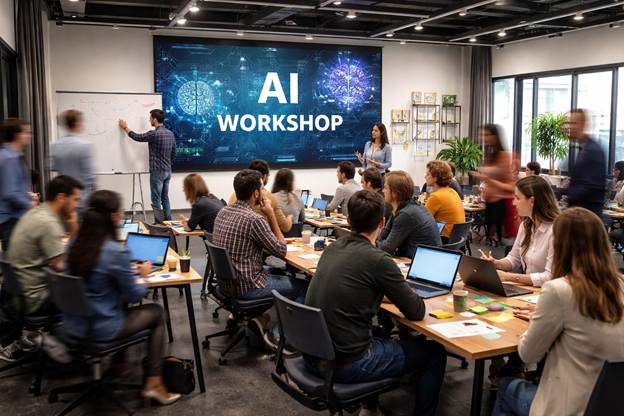
One of the most common concerns surrounding Artificial Intelligence involves employment.
People often worry that machines will eventually replace workers entirely.
While automation will certainly transform some roles, history suggests that technological revolutions tend to reshape jobs rather than eliminate human contribution altogether.
When computers became widespread, many administrative tasks became automated.
However, entirely new professions emerged.
Digital marketers, app developers, data analysts, and social media managers did not exist decades ago.
Today, these roles are common.
The same pattern may occur with Artificial Intelligence.
Imagine a marketing professional.
AI may help generate ideas, analyze campaigns, identify trends, and automate repetitive tasks.
But understanding customer emotions, building relationships, and creating compelling brand stories still require human creativity.
Similarly, AI may help accountants generate reports quickly.
However, strategic financial planning and business advisory services continue to depend heavily on human expertise.
Businesses should focus on helping employees adapt.
Training programs.
Upskilling initiatives.
Technology workshops.
Experimentation opportunities.
These investments allow employees to see Artificial Intelligence as a partner rather than a threat.
Organizations that combine human creativity with intelligent systems are likely to achieve the strongest outcomes.
Understanding Customers Will Become More Important Than Ever

Artificial Intelligence can process information faster than humans.
It can identify patterns.
Recognize trends.
Analyze behaviors.
And generate insights.
However, these capabilities are only useful when businesses truly understand their customers.
Imagine owning a clothing brand.
Without data, decisions rely largely on assumptions.
Managers guess which products customers may prefer.
They estimate seasonal demand.
They predict purchasing behavior based on intuition.
Now imagine having access to years of customer information.
Purchase histories.
Browsing behavior.
Preferences.
Feedback.
Seasonal patterns.
Artificial Intelligence can analyze this information and uncover insights that would otherwise remain hidden.
Businesses may discover that certain products sell particularly well during specific periods.
They may identify customer segments that respond positively to promotions.
They may recognize opportunities to personalize experiences.
The businesses that prepare for the AI era successfully are often those that begin collecting meaningful customer information today.
Because better data leads to better decisions.
And better decisions often lead to stronger businesses.
Businesses Should Experiment Before Competitors Do

One mistake many companies make is waiting until technology becomes unavoidable.
By the time adoption becomes necessary, competitors may already have significant advantages.
Preparing for the AI era does not mean completely transforming operations overnight.
Small experiments can create substantial learning opportunities.
A business may test AI-powered customer service tools.
Marketing teams may explore content assistance platforms.
Sales departments might experiment with predictive analytics.
Retail businesses may investigate recommendation engines.
Educational institutions may evaluate personalized learning systems.
These initiatives do not require massive investments.
Instead, they help businesses understand what works, what doesn't, and where future opportunities may exist.
Companies that begin experimenting today are likely to become more confident in adopting emerging technologies later.
Adaptability often becomes one of the most valuable competitive advantages businesses can develop.
The Businesses That Thrive Will Be the Ones That Adapt

History consistently shows that businesses capable of adapting to change tend to survive and grow.
Companies that embraced e-commerce early benefited significantly from changing customer behavior.
Businesses that adopted digital marketing gained advantages over competitors that relied entirely on traditional advertising.
Organizations that invested in digital transformation often became more resilient during periods of uncertainty.
Artificial Intelligence may become another defining shift.
The businesses that succeed in the coming years may not necessarily be those with the biggest budgets.
Instead, they may be the companies willing to learn, experiment, and evolve.
Adaptability is becoming increasingly important.
Customer expectations change.
Markets shift.
Technology advances.
Businesses that remain flexible often position themselves more effectively for future opportunities.
Preparing for the AI era is ultimately about building organizations that can respond to change rather than resist it.
How Lacspace Helps Businesses Prepare for the Future
At Lacspace, we believe the future belongs to businesses that embrace innovation while maintaining the human qualities that make organizations unique.
Artificial Intelligence should not be viewed as a replacement for people.
Instead, it should be seen as a tool that helps businesses become more efficient, more informed, and more capable of delivering better customer experiences.
Our goal is to help organizations build strong digital foundations through websites, business software, ERP systems, automation solutions, and custom technologies designed to support long-term growth.
Because preparing for the AI era is not simply about implementing technology.
It is about creating businesses that are ready to evolve, adapt, and thrive in an increasingly intelligent world.
Frequently Asked Questions
Is Artificial Intelligence only for large companies?
No. AI is becoming increasingly accessible, and businesses of all sizes can benefit from intelligent tools that improve efficiency, automate repetitive tasks, and enhance customer experiences.
Does preparing for AI require significant investment?
Not necessarily. Many businesses can begin by improving existing systems, organizing data, and experimenting with affordable AI-powered solutions before making larger investments.
Will AI replace employees completely?
Current AI technologies are better suited for automating repetitive tasks rather than replacing entire roles. Human creativity, emotional intelligence, leadership, and strategic thinking remain highly valuable.
What is the first step businesses should take?
The first step is often digital transformation. Businesses should organize processes, centralize information, and create systems that allow future technologies to function effectively.
How can Lacspace help businesses prepare for the AI era?
Lacspace provides software solutions, automation systems, websites, ERP platforms, and digital transformation services that help businesses build stronger foundations for future growth.
Conclusion
Artificial Intelligence is no longer a distant concept reserved for the future.
It is already influencing the way businesses operate, communicate, and compete.
Some changes may happen gradually.
Others may happen faster than expected.
But one thing remains clear.
Businesses that remain curious, embrace innovation, and continuously improve their operations are likely to be better positioned for whatever comes next.
Preparing for the AI era is not about fearing technology.
It is about understanding it.
Learning from it.
Experimenting with it.
And using it to create businesses that are more adaptable, more efficient, and more prepared for the future.
Because the companies that succeed tomorrow may not necessarily be the biggest.
They may simply be the ones that start preparing today.
Frequently asked questions
Is AI only for large corporations?
No. The article argues that the businesses that benefit most from AI may not be the biggest companies, but those that understand change, embrace innovation and start preparing early.
Will AI replace employees?
Preparing for the AI era is not about replacing people with machines. It is about building businesses that are more efficient, more adaptable and better equipped to respond to changing customer expectations.
How are businesses already using AI?
Marketing teams use AI to analyze campaigns, customer support departments rely on chatbots, retailers forecast demand with predictive models, and financial institutions detect fraud with machine learning systems.
How could a restaurant or logistics company use AI?
A restaurant can use AI to identify which menu items sell best at weekends, which products are losing popularity and which inventory needs replenishment. A logistics company can optimize delivery routes to cut fuel costs and improve delivery times.