You’ve got the idea, you know the market, and you’re ready to build. Then comes the question that stops most non-technical founders in Nepal cold: who actually builds the product? You’ll hear three answers — hire a freelancer, hire an agency, or find a technical co-founder. They sound similar. They are not. Choosing wrong can cost you months, money, and sometimes the company itself.
Here’s an honest breakdown of all three, and how to pick the right one for where you are.
The freelancer: fast for a task, not a company
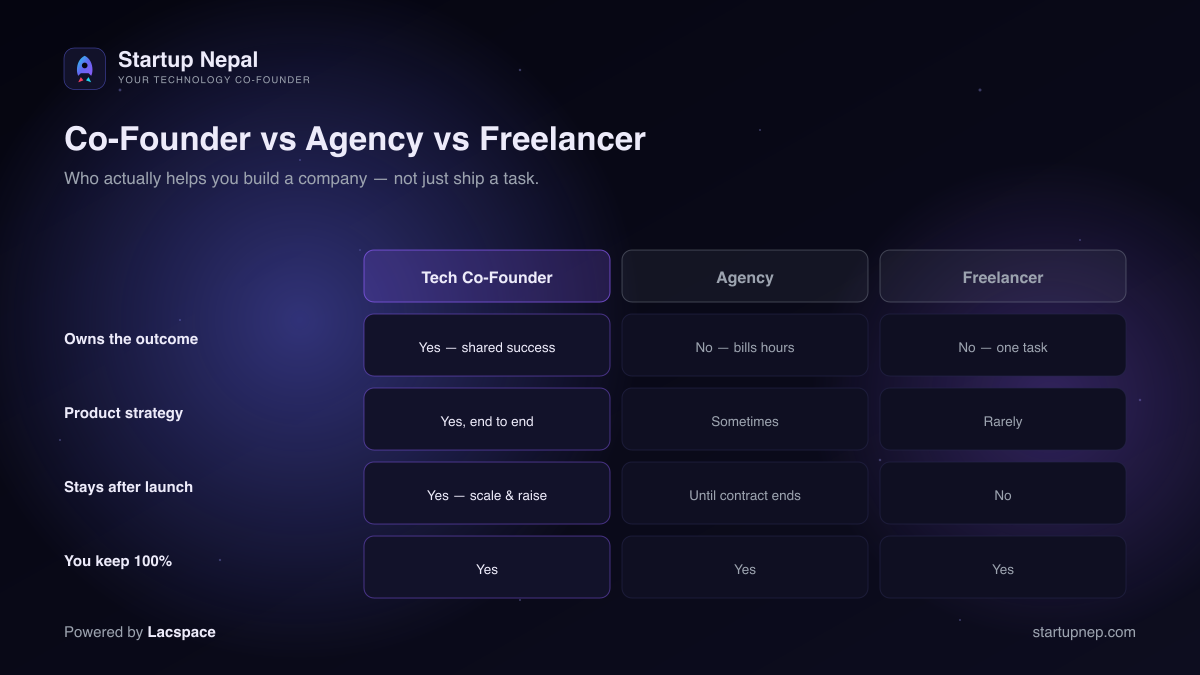
A freelancer is perfect when you have a small, well-defined job — a landing page, a logo, a single screen. They’re affordable and quick. But a startup isn’t a task; it’s a moving target. A freelancer executes exactly what you specify and then moves on to the next client. There’s no product strategy, no ownership of the outcome, and no one thinking about what happens after launch. If you don’t already know precisely what to build, a freelancer can’t tell you — that’s not their job.
The agency: a project, delivered and closed
An agency is a step up: a team, a process, and the capacity to deliver a real project. For a fixed scope with clear specifications, that can work well. The catch is the business model. Agencies are generally paid for hours or scope, and their engagement ends when the contract does. That creates a subtle misalignment — they’re rewarded for delivering the brief, not for your startup succeeding six months later. When you need to pivot, iterate fast, or keep building through launch and fundraising, the meter is running and the relationship is transactional.
The technology co-founder: owns the outcome with you
A technology co-founder is a different relationship entirely. They bring what you don’t have — product strategy, design, AI, infrastructure and engineering — and they own the outcome alongside you. They help decide what to build and why, ship the MVP, stay through launch, add the infrastructure to scale, and help you get investor-ready. Their success is tied to yours, not to an invoice.
The problem in Nepal is that finding one committed, capable individual technical co-founder is genuinely hard — and betting a big slice of your equity on a single unproven person is risky. That’s exactly the gap Startup Nepal was built to fill.
How Startup Nepal fits — a co-founder with a whole team behind it
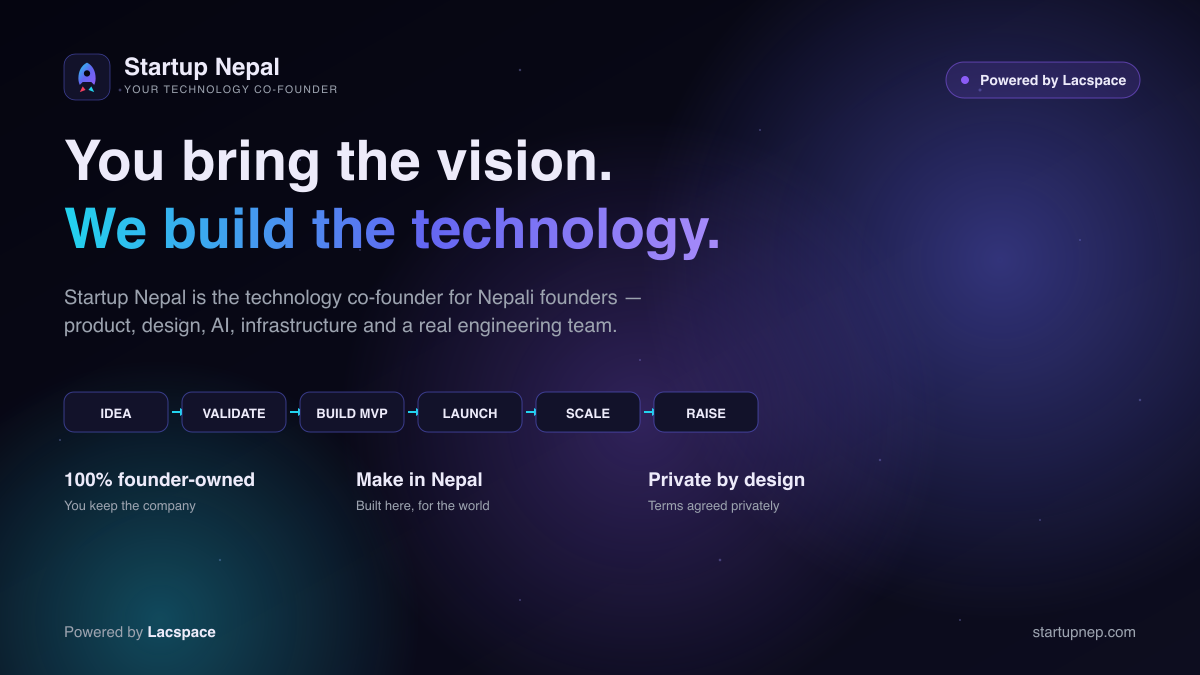
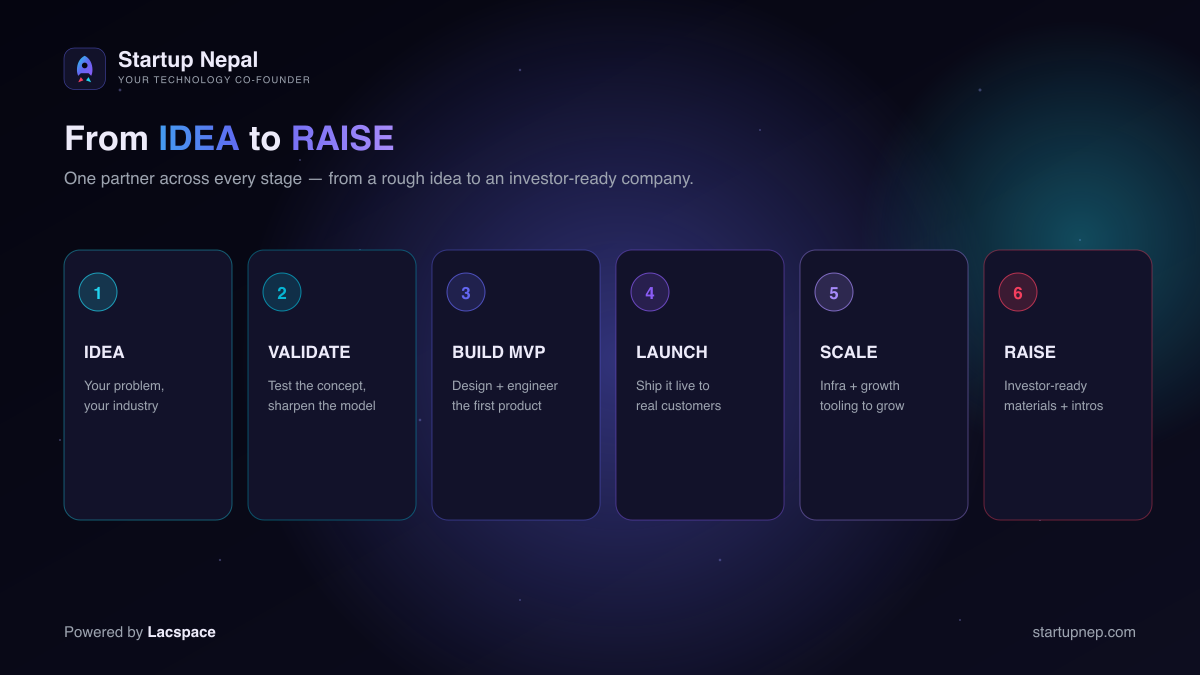
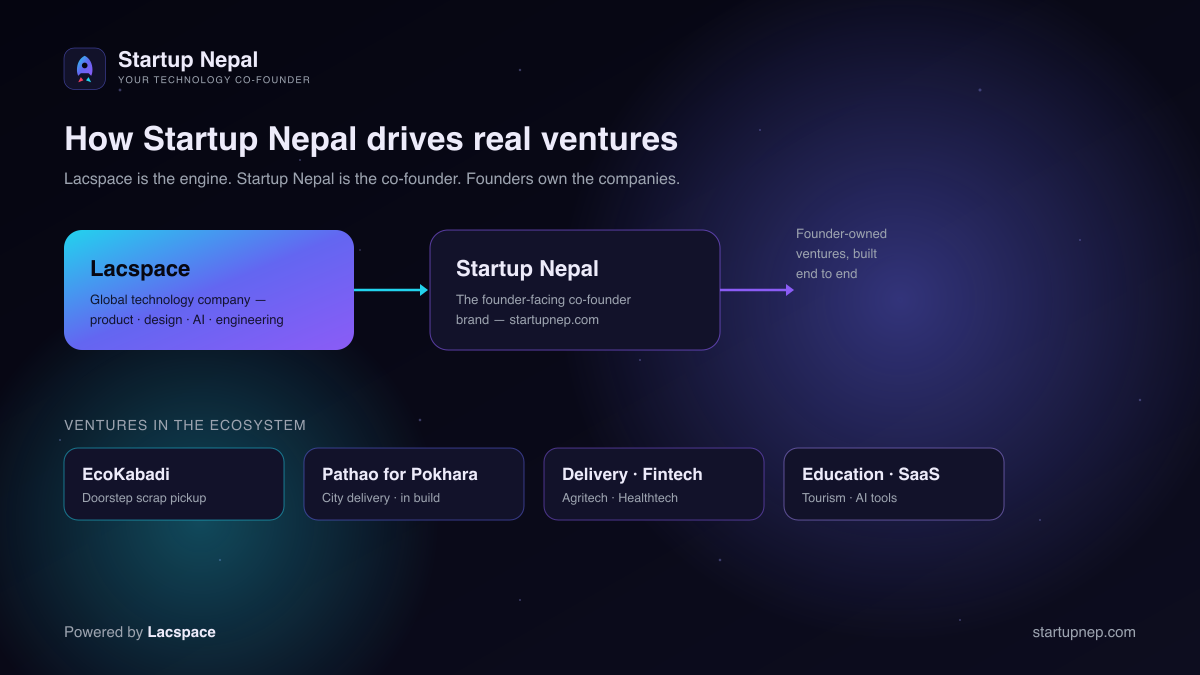
Startup Nepal is Nepal’s technology co-founder, powered by Lacspace. Instead of one hire, you get a technology co-founder backed by a full engineering team — the same team that builds real, running products. You bring the vision; they bring the technology, from IDEA to RAISE.
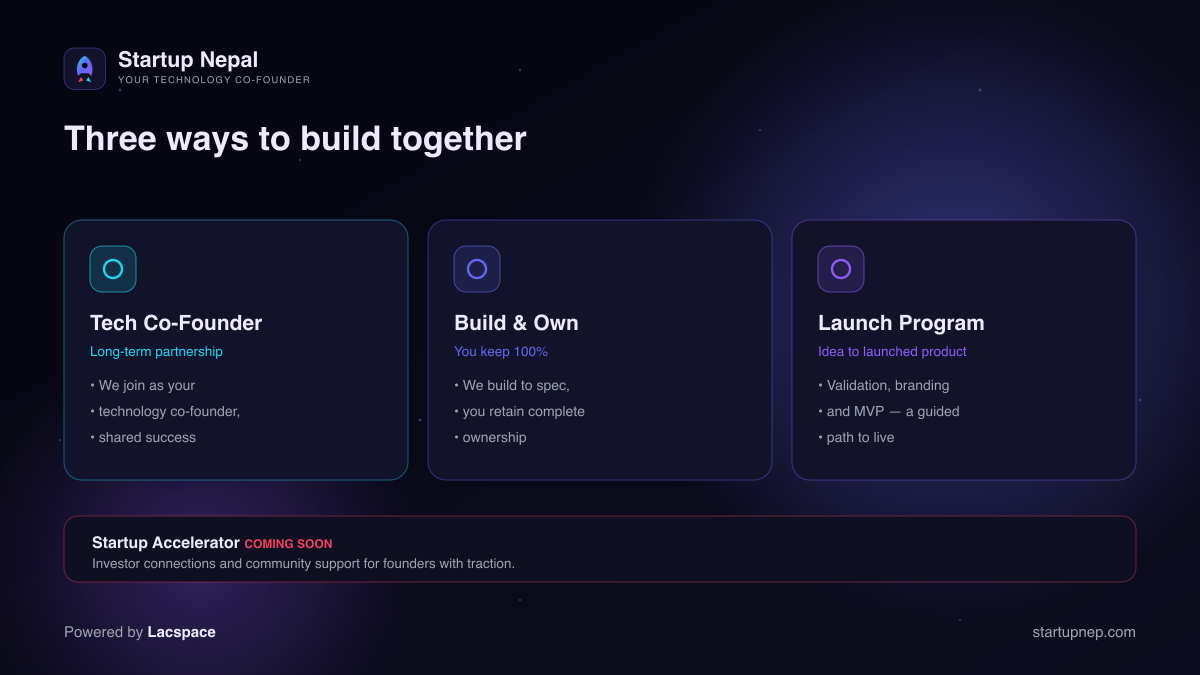
And it’s flexible, because founders come in at different stages. Startup Nepal offers three ways to build together:
- Tech Co-Founder — a long-term partnership with shared success.
- Build & Own — they build to your spec and you keep 100% ownership.
- Startup Launch Program — a guided path from raw idea to launched product.
There are no fixed price tags; the right terms are agreed privately, always structured so the founder keeps the company.
This isn’t theory — it ships companies
The co-founder model isn’t a pitch; it’s how real Nepali companies get built. EcoKabadi — a doorstep scrap-collection business with a website, iOS and Android apps, a backend and an admin dashboard — was built end to end for its founder, who owns the company today. You can read the story in EcoKabadi is now on iPhone. Other ventures are in build across delivery, fintech, agritech and more.
So which should you choose?
Match the model to your stage. Need a small, defined task done? A freelancer is fine. Have a fixed project with clear specs? An agency can deliver it. But if you’re building a real, long-term company and you’re non-technical, you don’t need a vendor — you need a partner who owns the technology the way you own the vision. That’s a technology co-founder, and in Nepal, that’s what Startup Nepal is built to be.
Keep reading: How to build a startup in Nepal in 2026 · How to get your startup investor-ready in Nepal · What is Startup Nepal?
Frequently asked questions
What is the difference between a tech co-founder, an agency and a freelancer?
A freelancer executes a defined task and moves on. An agency delivers a project against a contract and typically bills for hours or scope. A technology co-founder owns the outcome with you — shaping the product strategy, building the MVP, staying through launch, scale and fundraising, and sharing in the success. The first two build what you specify; a co-founder helps you build a company.
Should a non-technical founder in Nepal get a tech co-founder?
If your startup is fundamentally a software or app business and you are non-technical, yes — you need someone who owns the technology the way you own the vision. Finding an individual technical co-founder in Nepal is hard and risky. A technology co-founder partner like Startup Nepal gives you the same commitment and product ownership, backed by a full engineering team, without gambling your equity on one unproven person.
Is an agency or a freelancer cheaper than a co-founder?
On a single invoice, a freelancer can look cheapest. But cost is not the same as value. Freelancers and agencies are paid to ship a deliverable; when the contract ends, so does their interest in whether your startup succeeds. A co-founder model aligns incentives with your outcome, so the product keeps evolving, launching and scaling. For a company you intend to grow and raise on, alignment usually matters more than the lowest quote.
Do I keep ownership of my startup with a tech co-founder?
With Startup Nepal, yes — outcomes are 100% founder-owned. Whether we join as a long-term technology co-founder or build to your specification under a Build & Own model, the company, the brand and the vision stay yours. Terms are agreed privately, case by case, and always structured around founder ownership.
How do I choose the right way to build my startup?
Match the model to your stage. A freelancer suits a small, well-defined task. An agency suits a fixed project with clear specs. If you are building a real, long-term company and you are non-technical, a technology co-founder is the strongest fit — it brings product strategy, a real engineering team, and a partner who stays from IDEA to RAISE. Startup Nepal offers Tech Co-Founder, Build & Own and Launch Program tracks to match where you are.