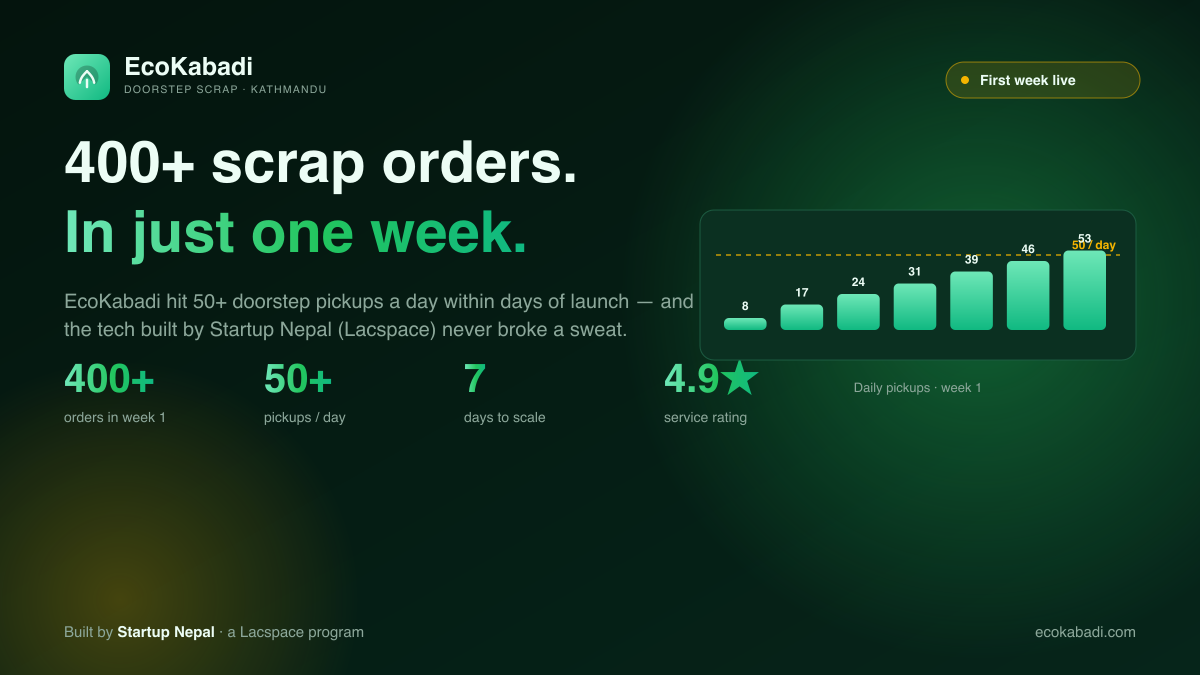
Every founder pictures the launch that takes off. Very few actually get it. EcoKabadi just did — and the numbers are the kind you read twice. In its first week live, EcoKabadi booked 400+ scrap-collection orders, hit 50+ doorstep pickups a day within days, and watched its market value climb as more households — and more collectors — piled in. From a standing start to a small logistics operation, in seven days.
But here’s the surprising part — the part most launch stories quietly skip. When demand exploded, nothing broke. No crashed app, no lost orders, no frantic all-nighters patching a backend. And that wasn’t luck. It was infrastructure — built, before a single order came in, by Startup Nepal, the technology co-founder program powered by Lacspace.
A launch week most startups only dream of
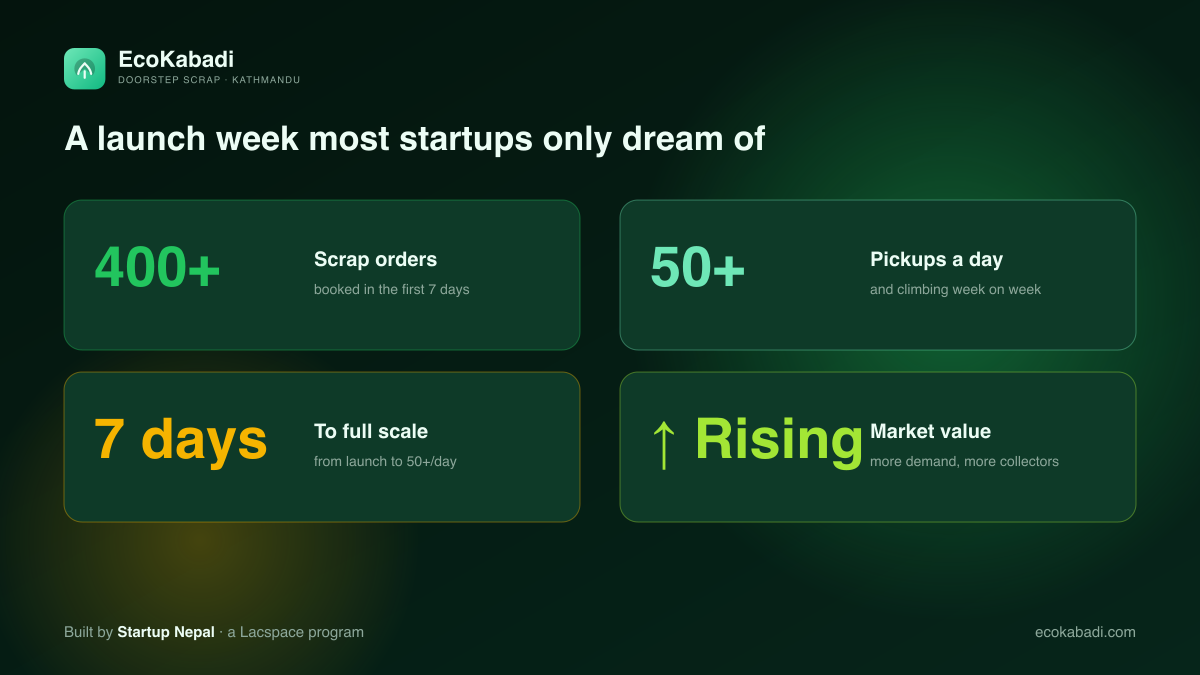
Let the numbers sit for a second, because they’re remarkable for any startup — let alone one formalising the humble kabadi (scrap) trade:
- 400+ orders booked in the first 7 days.
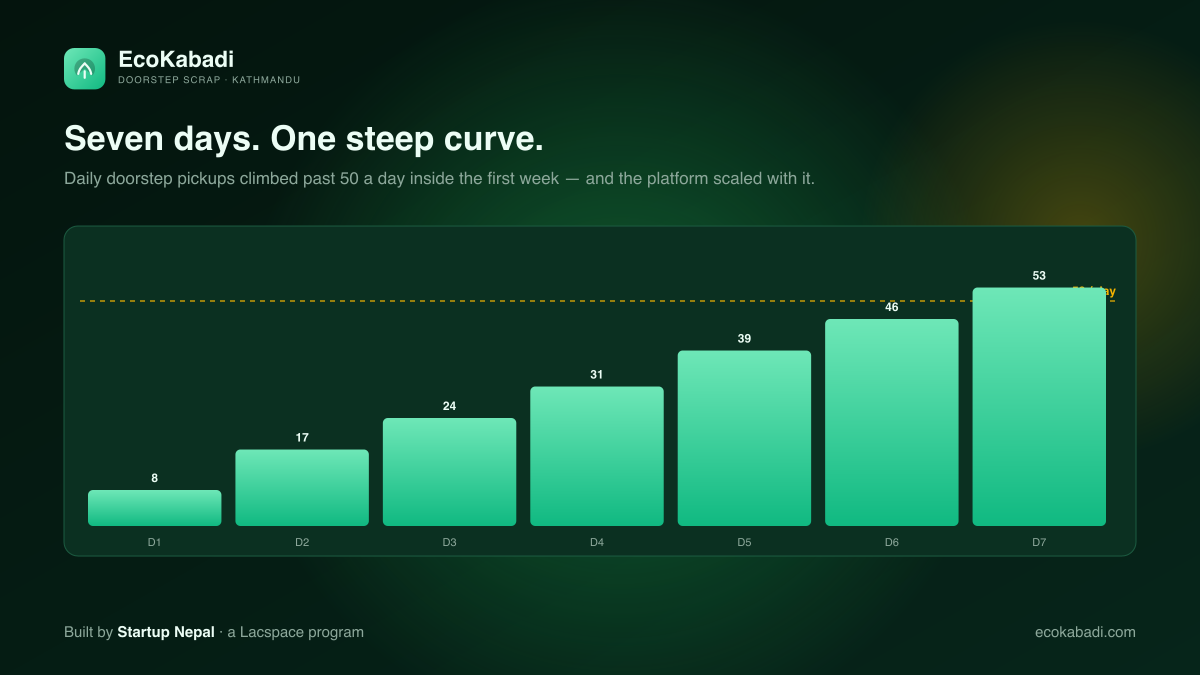
- 50+ doorstep pickups a day, reached within days of launch.
- 7 days from launch to full-scale daily operations.
- Rising market value — more demand pulling in more collectors, week on week.
This is a business that, not long ago, ran on a passing cart and a tired weighing scale. In a week, it started running like a modern company.
Seven days. One steep curve.
Growth like this is exciting on a chart and terrifying in real life — if your systems can’t keep up. Every new order is a booking to route, a collector to dispatch, a weight to record, a payment to settle and a customer expecting it all to just work. Multiply that by fifty a day, climbing, and most early-stage operations buckle.
EcoKabadi’s didn’t. The daily pickup count climbed past 50 inside the first week, and the platform scaled right along with it — because it was built to.
The surprising part: the tech was ready before the orders were
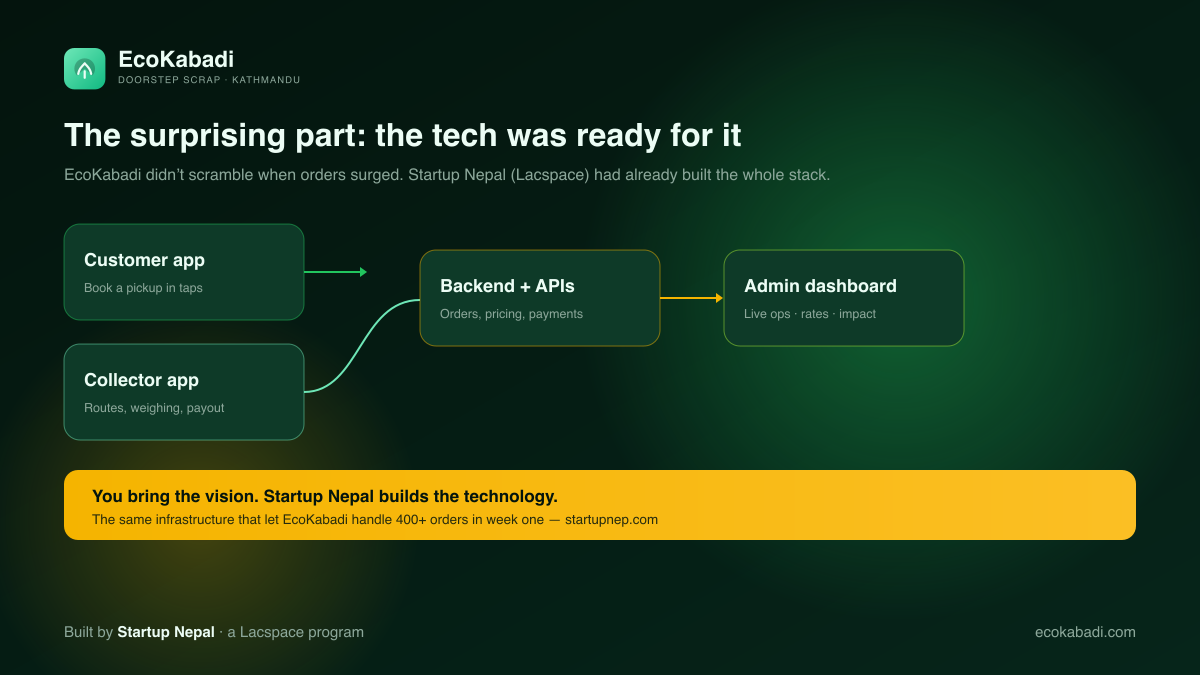
Here’s the twist that turns a nice traction story into a genuinely useful one for founders. EcoKabadi didn’t scale because it got lucky. It scaled because, long before launch day, Startup Nepal had already built the entire technology stack that a doorstep-logistics business needs:
- A customer app to book a free pickup in a few taps.
- A collector app for routes, digital weighing and instant payout.
- A backend and APIs handling orders, live pricing and payments.
- An admin dashboard for live operations — collectors, rates, and impact — all in one place.
So when the orders surged, there was nothing to scramble for. The founder could pour energy into growth and customers, not firefighting, because the hard technical questions were already answered.
“You bring the vision. We build the technology.”
This is exactly what Startup Nepal is built to do. It’s a technology co-founder for Nepali founders: you bring the idea, the industry knowledge and the customers; Startup Nepal — powered by Lacspace — brings the product strategy, design, AI, infrastructure and engineering team to turn it into a launched, founder-owned company. EcoKabadi’s founder kept 100% of the business; Startup Nepal built and stands behind the technology.
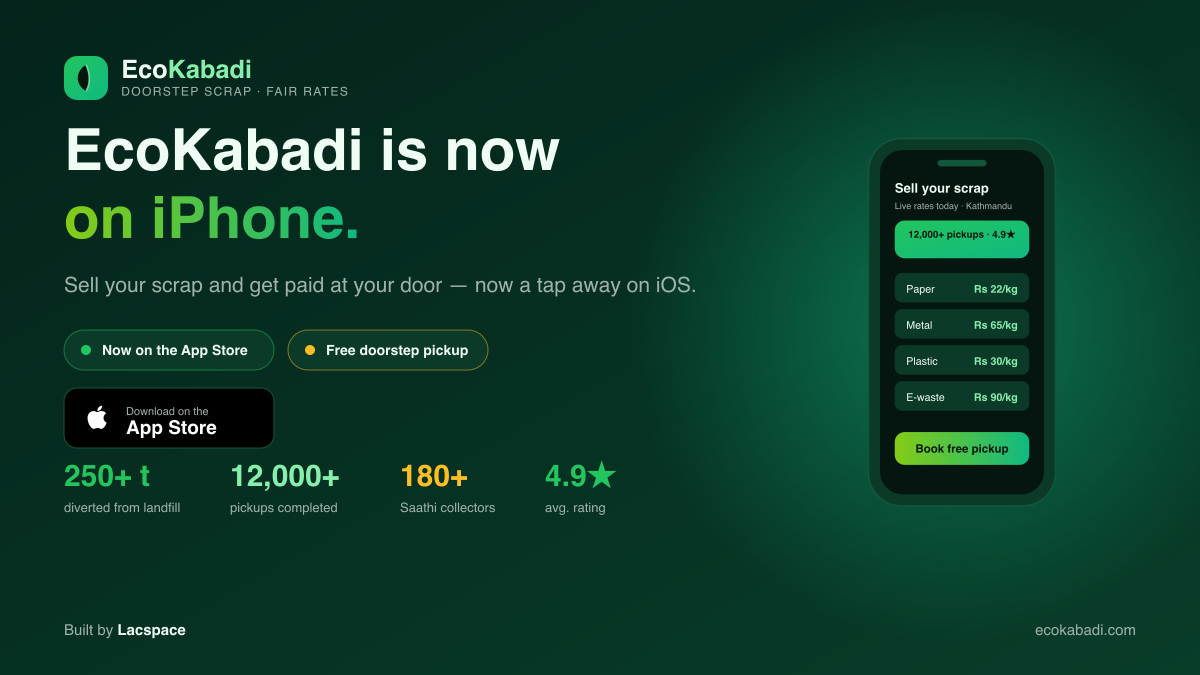
EcoKabadi is what that partnership looks like when it works: a sharp local insight, met with real infrastructure, producing a launch week that would make any startup proud. You can read the product story in EcoKabadi is now on iPhone, and how the co-founder model compares to hiring an agency in Tech Co-Founder vs Agency vs Freelancer.
Your idea could be the next EcoKabadi
The lesson isn’t “scrap collection is hot.” It’s that a great idea plus real technology infrastructure is a combination that can move astonishingly fast. Most founders have the first half. Startup Nepal is how you get the second — without giving up your company, and without a launch that falls over the moment it succeeds.
If you’ve got the vision, Startup Nepal will build the technology. Start at startupnep.com.
Figures reflect EcoKabadi’s reported early traction in its first week of operations. EcoKabadi is a founder-owned venture; Startup Nepal, powered by Lacspace, is its technology partner.
Frequently asked questions
How many orders did EcoKabadi get in its first week?
EcoKabadi booked more than 400 scrap-collection orders in its first week live, reaching 50+ doorstep pickups per day within days of launch — and demand kept rising week on week. It’s a launch curve most startups only dream of.
What is EcoKabadi?
EcoKabadi is a doorstep scrap-collection service in the Kathmandu Valley. Households and offices book a free pickup in the app, a verified collector weighs their recyclables on a digital scale at the door, and they get paid instantly. It brings fair, transparent pricing to a trade that used to run on haggling — and it’s a founder-owned venture built by Startup Nepal, a Lacspace program.
How did EcoKabadi scale so fast without breaking?
The surprising part isn’t the demand — it’s that the technology was ready for it. Before launch, Startup Nepal (Lacspace) had already built EcoKabadi’s full stack: a customer app for booking, a collector app for routes and weighing, a backend for orders, pricing and payments, and an admin dashboard for live operations. So when orders surged past 50 a day, nothing scrambled — the platform simply scaled.
Who built EcoKabadi’s technology?
EcoKabadi’s entire technology stack was built by Startup Nepal — the technology co-founder program powered by Lacspace (startupnep.com). The founder brought the vision and the market knowledge; Startup Nepal brought the product, engineering and infrastructure. The company stays 100% founder-owned.
Can Startup Nepal build the same kind of platform for my startup?
Yes. That’s exactly what Startup Nepal does — it’s a technology co-founder for Nepali founders. You bring the idea, the industry knowledge and the customers; Startup Nepal brings product strategy, design, AI, infrastructure and an engineering team to turn it into a launched, founder-owned company. Learn more at startupnep.com.
What does “you bring the vision, we build the technology” mean?
It means the founder owns the company and the market insight, while Startup Nepal builds and runs the technology side end to end — the apps, backend, dashboard and infrastructure. EcoKabadi is proof of what that partnership can do: a single local idea, turned into a platform that handled 400+ orders in week one.