Walk into almost any hospital, lab or pharmacy in Asia and you will find good people doing careful work on software that cannot talk to the building next door. The diagnosis is in one system, the lab result in another, the pharmacy history in a third, and the patient is the courier carrying photocopies between them. As CareSewa puts it: “Nothing here is broken. Everything here is disconnected.”
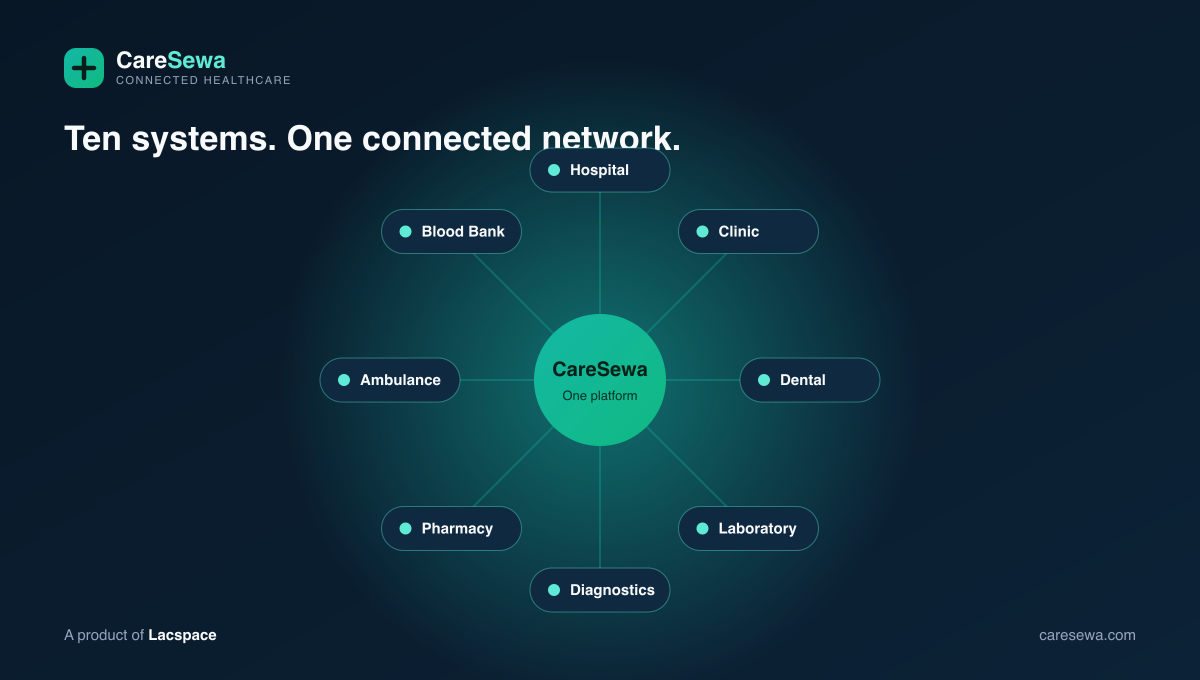
CareSewa’s answer is not one more hospital system. It is the layer between them all — a suite of ten healthcare ERPs that share a single engine, a single identity and a single source of truth. This is a tour of that suite: every system, what it does, and the architecture that lets ten systems behave like one.
The thesis: care in Asia is many small participants
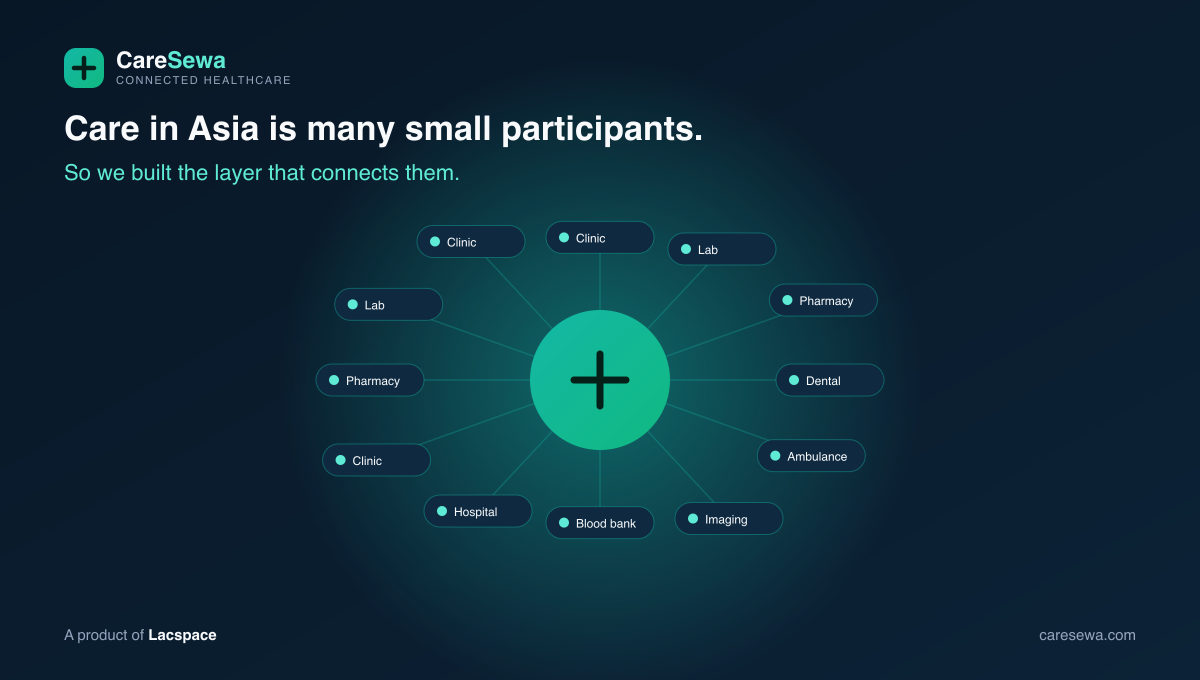
Most healthcare software was built for consolidated markets — a handful of large buyers running one giant integrated system. That architecture quietly fails across Asia, where care is delivered by “dense networks of small independent participants”: single-doctor clinics, standalone labs, independent pharmacies, small ambulance operators. There was never a product for the connective tissue between them, because the connective tissue was never anybody’s product.
So CareSewa built exactly that. “Care in Asia is many small participants. So we built the layer that connects them.” Born out of the pandemic — when disconnected systems meant no one could see bed availability, lab capacity, pharmacy stock or ambulance status in one place — it treats connection, not consolidation, as the problem worth solving.
One account. Every system you run.
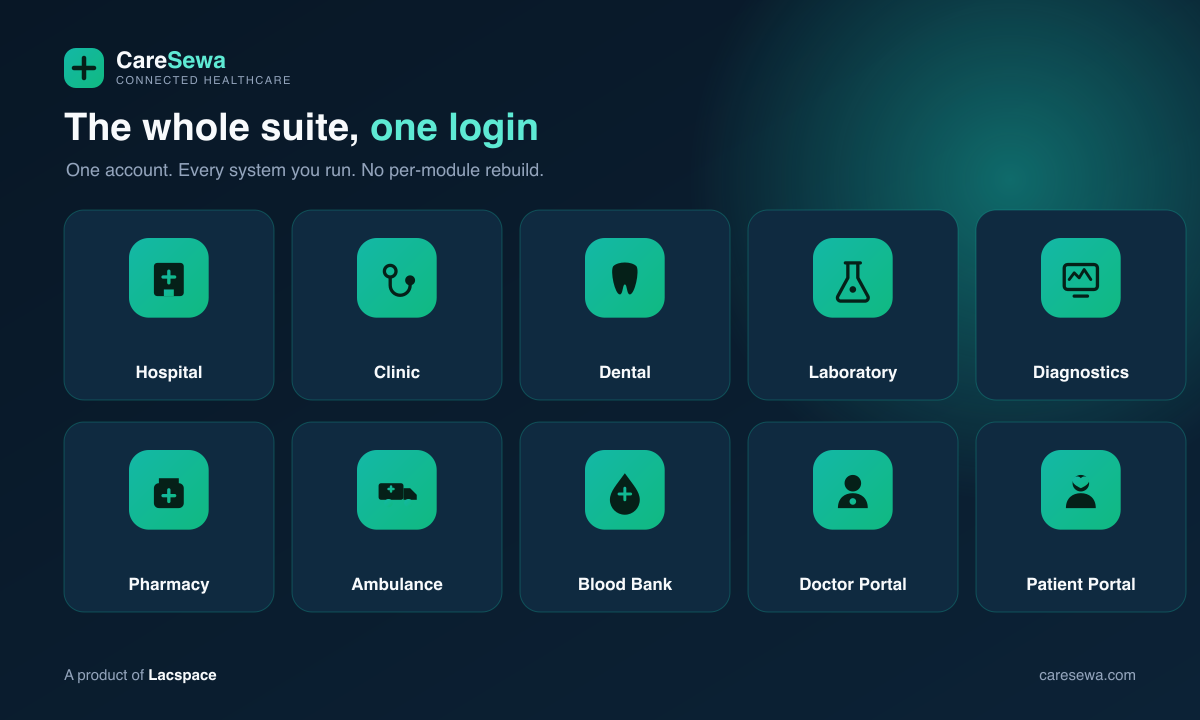
The entire suite sits behind a single login and a single identity. “One account, ten systems.” A group that runs a hospital, a lab and a pharmacy does not juggle three vendors and three integrations — it runs three CareSewa ERPs that already share data, staff and patients. Seven of the ten ship with seeded defaults to get you moving; three launch deliberately blank so you build only what you need.
The ten systems, one by one
Each ERP is a focused product in its own right — and every form and field in it is yours to change.
1. Hospital ERP — run the whole hospital
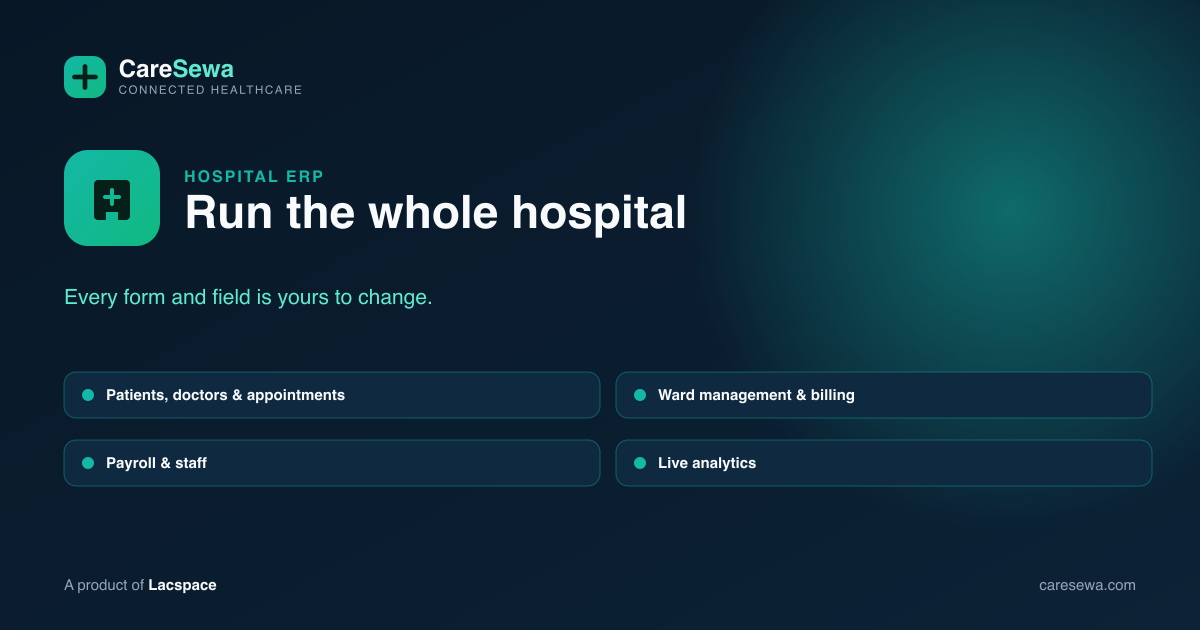
Full hospital administration in one place: patient management, doctor scheduling and appointments, billing, ward management, payroll and live analytics. It is comprehensive by default, but never rigid — “every form and field is yours to change.”
2. Clinic ERP — a practice, your way
For a single or multi-doctor practice, CareSewa starts blank and lets you build the three or four core models you actually need. No inherited hospital bloat, no template fighting your workflow — just the lightweight system an independent practice wants.
3. Dental ERP — built around your speciality
Dentistry is not general medicine with a different logo, so the Dental ERP is “built around your speciality instead of a generic clinical template.” Treatments and procedures, dental charts, appointments and patient recalls — modelled for the chair.
4. Laboratory ERP — from order to report
A full path from request to result: a test catalog, order management, sample tracking and reports — with customisable panels, reference ranges and turnaround rules so the lab runs on your definitions, not a vendor’s.
5. Diagnostics & Imaging ERP — modelled on your machines
Radiology and imaging, “modelled around the machines you own and the workflow your radiologists use.” Scan and modality tracking, radiologist reporting and turnaround monitoring — the imaging department, digitised the way it actually operates.
6. Pharmacy ERP — shaped to how you dispense
Medicine inventory and dispensing “shaped to how your pharmacy runs”: stock management, prescription dispensing, supplier records and expiry tracking. And because it shares the suite, a prescription written in a clinic can be dispensed without re-keying.
7. Ambulance ERP — dispatch that writes itself
Fleet management, intelligent dispatch and trip logging, designed around a single moment that matters: “the nearest available ambulance goes to the call, and the record writes itself.”
8. Blood Bank ERP — the right unit, in time
Blood inventory and transfusion services: stock by blood group and component, donor records, and both hospital and patient requests — so the right unit can be found when minutes count.
Two portals, for the two people who matter
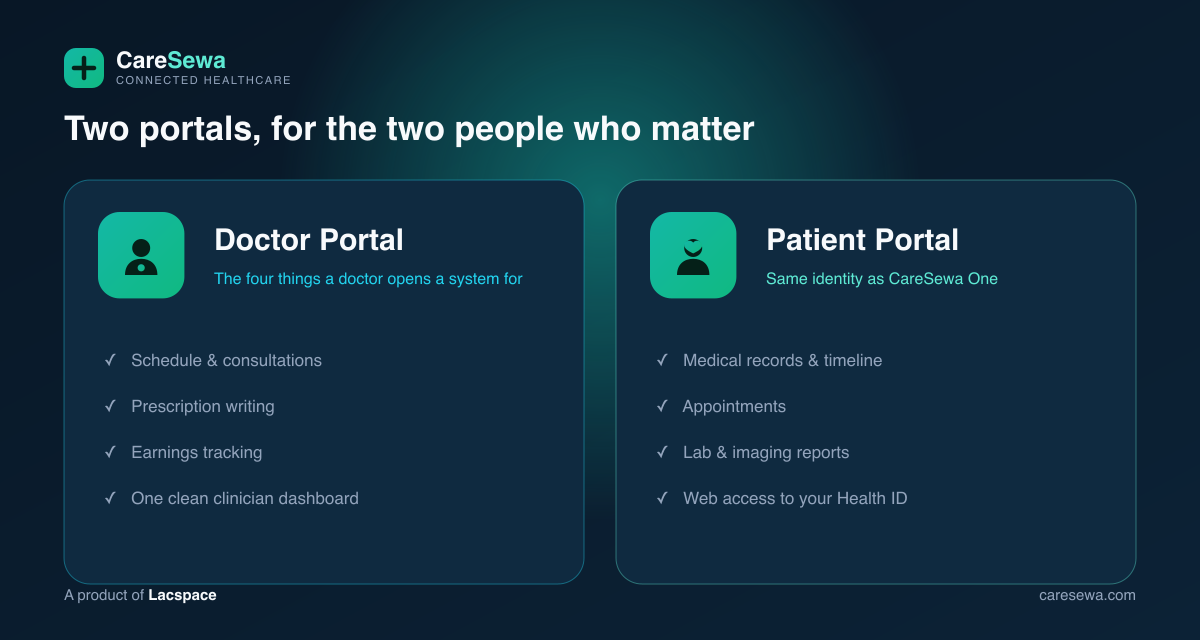
Beyond the eight operational ERPs, two portals serve the humans at either end of care. The Doctor Portal is deliberately narrow — “the four things a doctor actually opens a system for”: schedule and consultations, prescription writing and earnings tracking, on one clean clinician dashboard. The Patient Portal gives web access to medical records, appointments and lab/imaging reports — using the very same identity as the CareSewa One app.
The engine underneath: CareSewa Studio
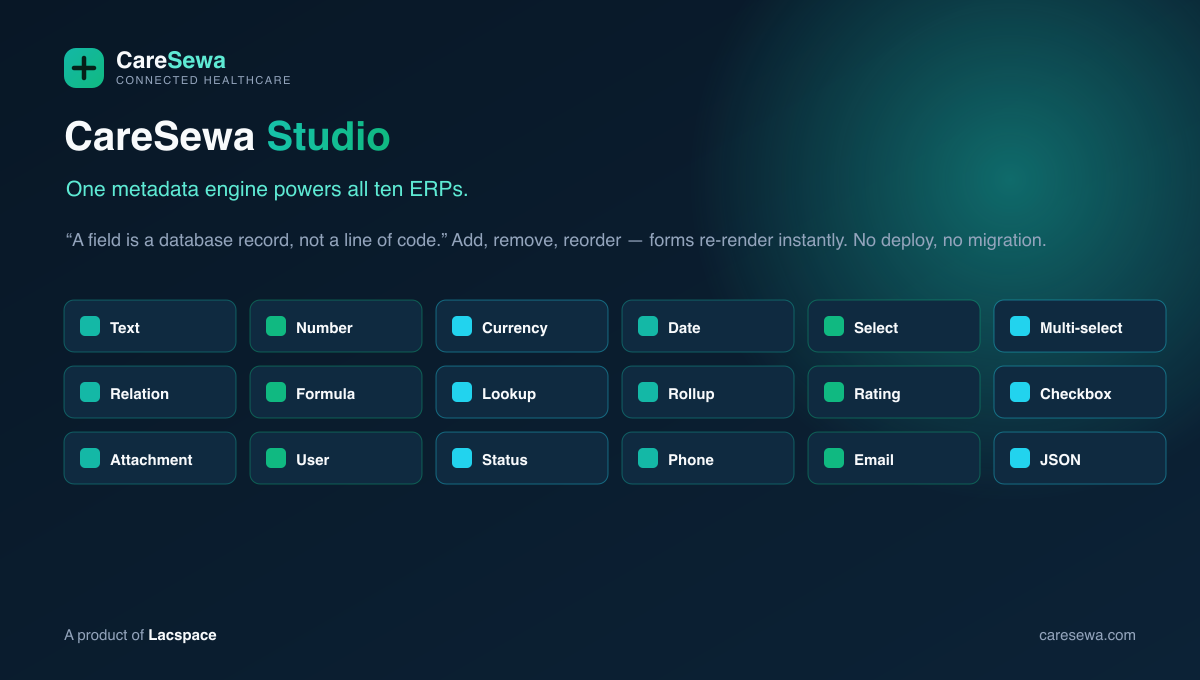
Here is the part that makes ten systems maintainable instead of ten separate products to keep alive: they are all the same engine. One metadata-driven core powers every ERP, and healthcare models are never hard-coded into the codebase. In CareSewa Studio, “a field is a database record, not a line of code.”
With 18 field types and browser-based control over relations, validation and permissions, you add, remove and reorder fields and the forms re-render in real time. “In the real Studio this saves to your ModelDefinition and every user sees it on their next render. No deploy, no migration.” The distance between “we should change that” and “it’s changed” collapses from a quarter to an afternoon.
Trust, built into the architecture
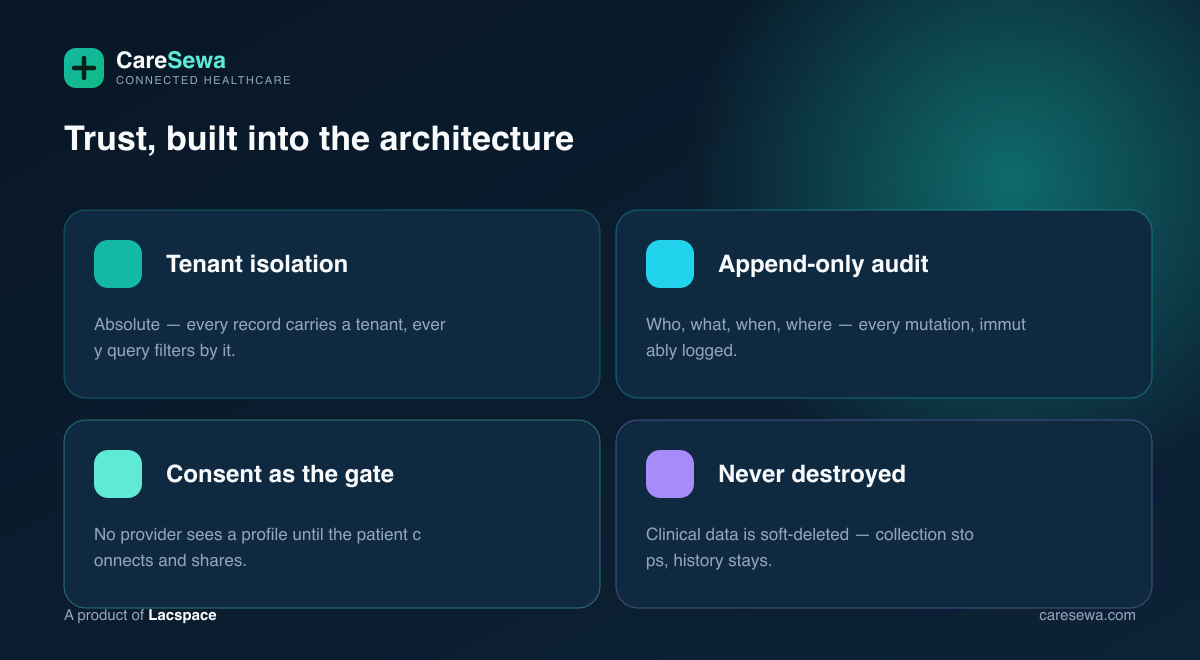
For a health platform, trust cannot be a promise in the footer — it has to be structural. CareSewa builds it into the way data is stored and queried:
- Tenant isolation is absolute — “every record carries a tenant; every query filters by it.” It is not a feature or a tier.
- The audit trail is append-only — every mutation is logged immutably with actor, action, IP and timestamp.
- Consent is the access gate — no provider sees a profile until the patient connects and shares, and revoking hides everything instantly.
- Clinical data is never destroyed — removing a field stops collection but preserves history; deletes are soft by default.
The patient side: CareSewa One
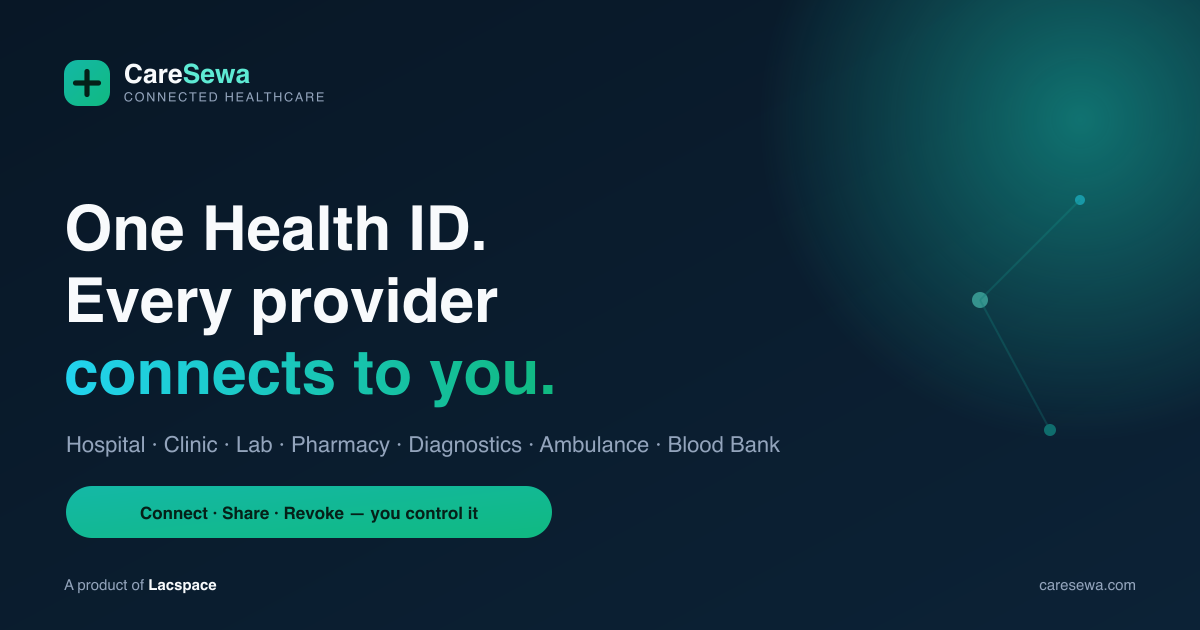
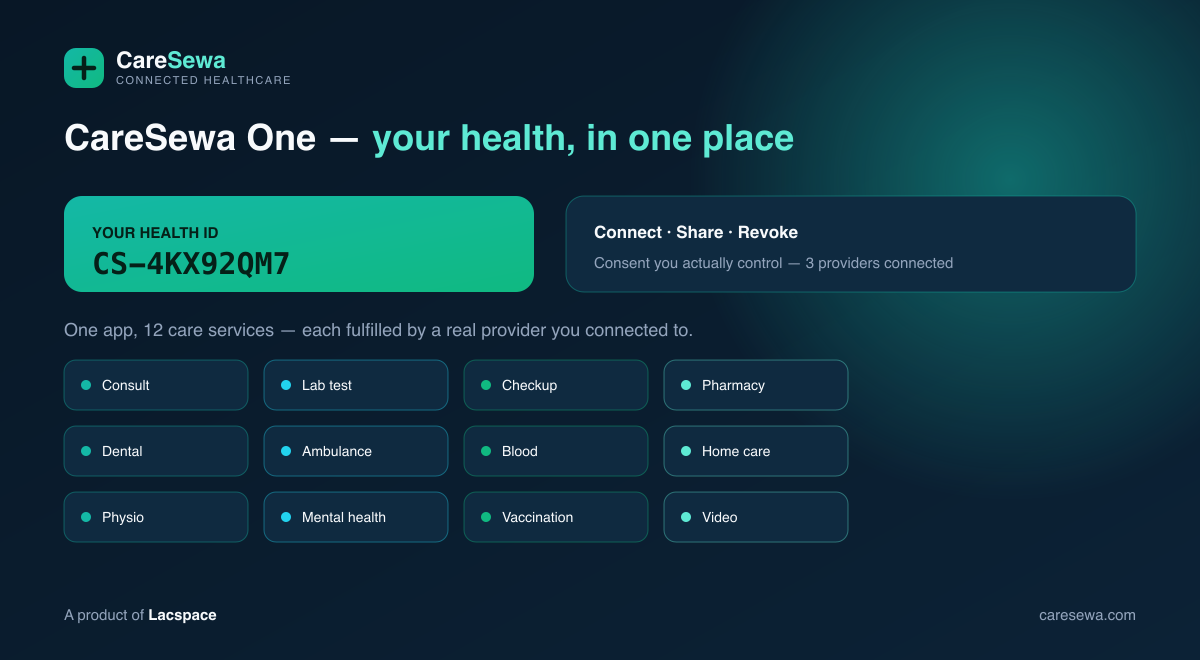
All of that provider infrastructure exists to serve one person. Through CareSewa One, the patient holds a single Health ID (something like CS-4KX92QM7) that belongs to them, not to any hospital. From one app they book across 12 care services — consultation and instant video, lab tests, health checkups, pharmacy, dental, ambulance, blood availability, home care, physiotherapy, mental health and vaccination — and each one is “fulfilled by a real provider the patient has connected to, not an anonymous marketplace listing.” Records aggregate into one timeline, and consent stays in the patient’s hands: connect, share, revoke.
Live in days, not quarters
The pay-off of one engine is speed. Onboarding is five steps: create an organisation with a public patient-discovery code; connect the ERPs you need from the marketplace; configure your models in Studio; create staff accounts with scoped permissions; and let patients connect through CareSewa One to book services and carry their records. Whatever the shape of your organisation — a two-doctor clinic or a four-hospital group — you are “live in days, not quarters.”
Why it holds together
CareSewa is a product of Lacspace, and it reflects the same discipline behind everything Lacspace ships: one flexible engine, configured per use case, instead of a rigid rebuild for every workflow. That is how ten healthcare systems can share an identity, a consent model and an audit trail without ten disconnected teams holding them together — and why “multi-country is not a phase two; it is the reason the engine works the way it does.”
Explore the full platform at caresewa.com, get CareSewa One free on iOS and Android, or see the rest of the ecosystem on the Lacspace products page.
Frequently asked questions
How many ERPs does CareSewa have?
Ten connected systems: Hospital, Clinic, Dental, Laboratory, Diagnostics & Imaging, Pharmacy, Ambulance and Blood Bank ERPs, plus a Doctor Portal and a Patient Portal. Seven arrive with sensible seeded defaults; three launch deliberately blank so you build only what you need. All ten share one login, one identity and one engine.
Do I have to buy each ERP separately or rebuild for each module?
No. CareSewa’s promise is “one account, every system you run, no per-module rebuild.” Because a single metadata-driven engine powers all ten ERPs, you connect the systems you need from the marketplace and configure them — you are never re-integrating separate products.
Can I customise the forms and workflows myself?
Yes. CareSewa Studio is a no-code engine with 18 field types. “A field is a database record, not a line of code.” You add, remove and reorder fields, set relations, validation and permissions in the browser, and forms re-render instantly — no deploy, no migration, no consultant.
How is patient data kept private and secure?
Trust is structural, not a setting. Every record carries a tenant and every query filters by it (absolute isolation); every change is written to an append-only audit trail (actor, action, IP, time); consent is the access gate — no provider sees a profile until the patient connects and shares; and clinical data is soft-deleted, never destroyed.
Who owns the patient’s records?
The patient. CareSewa is built on the principle that “the only coherent owner of a record is the patient.” Your Health ID belongs to you, records follow you across providers through CareSewa One, and you connect, share and revoke access yourself.
Who builds and runs CareSewa?
CareSewa is a product of Lacspace, a software and AI company that has shipped 26+ products across many industries. CareSewa is its healthcare platform — Asia-first and multi-country by design.
Frequently asked questions
What is the CareSewa ERP suite?
It is a suite of ten healthcare ERPs that share a single engine, a single identity and a single source of truth. Rather than one more hospital system, CareSewa positions it as the layer that connects them all.
Why was CareSewa built around small providers?
Care in Asia is delivered by dense networks of small independent participants, such as single-doctor clinics, standalone labs, independent pharmacies and small ambulance operators, and there was never a product for the connective tissue between them.
Can one account run several CareSewa systems?
Yes. The entire suite sits behind a single login and identity, so a group running a hospital, a lab and a pharmacy runs three CareSewa ERPs that already share data, staff and patients instead of juggling three vendors.
Do the CareSewa ERPs come preconfigured?
Seven of the ten systems ship with seeded defaults to get you moving, while three launch deliberately blank so you build only what you need. The Clinic ERP, for example, starts blank.