
MVP development: a small first version, shipped to real users.
A minimum viable product is the smallest version of your idea that real people can use, built to answer one question: will they use it, and will they pay? Most first products fail not because the code is bad but because they took too long, tried to do everything and launched to silence.
How we approach it
Lacspace has taken its own products from idea to the App Store and Google Play, and builds first versions for founders too. We help you cut the scope to what proves the idea, build it on a foundation that can grow, and launch it with the analytics you need to decide what comes next.
Scope cut to the core
A short workshop to find the one journey that proves your idea, and a written list of what waits for version two.
Design that earns trust
Simple, polished screens, because early users judge a product by how it looks before they try what it does.
Web or mobile, or both
A web app, an iPhone and Android app, or both from one codebase, chosen by where your users are.
The essentials done right
Sign-up, payments, email and notifications built properly, so you are not rebuilding the basics after launch.
Analytics from day one
Events and dashboards that show where people sign up, drop off and come back.
A path to version two
Clean code and documentation, so the product can grow with us or with your own team.
How the project runs
- 01
First call
Your idea, your users, what you have already learned and what you need to prove next.
- 02
Scope workshop and quote
We cut the idea down to its core journey and send a written scope, timeline and price.
- 03
Prototype
A clickable prototype you can show to users and investors before the build.
- 04
Build in short cycles
Weekly or fortnightly releases you can try, so feedback shapes the product as it is built.
- 05
Launch and learn
Store and web launch, analytics review and a plan for the next version, with support if you want it.
The technology, in plain words
We build MVPs on the same stack as our own products: TypeScript, React and Next.js for the web, React Native for iPhone and Android, and managed cloud services that cost little at small scale and grow when you do.
Speed comes from reuse rather than shortcuts. Sign-in, payments, forms, SEO and security come from open-source building blocks we already maintain, which leaves more of your budget for the part of the product that is actually new.
Who it is for
- Founders with an idea and no technical co-founder
- Startups that need a working product for users or investors
- Companies testing a new product line before a large investment
- Teams that tried to build everything at once and stalled
- Non-technical founders who want a partner that explains decisions plainly
Related client work
Case studies from projects we built, written from what was actually delivered.
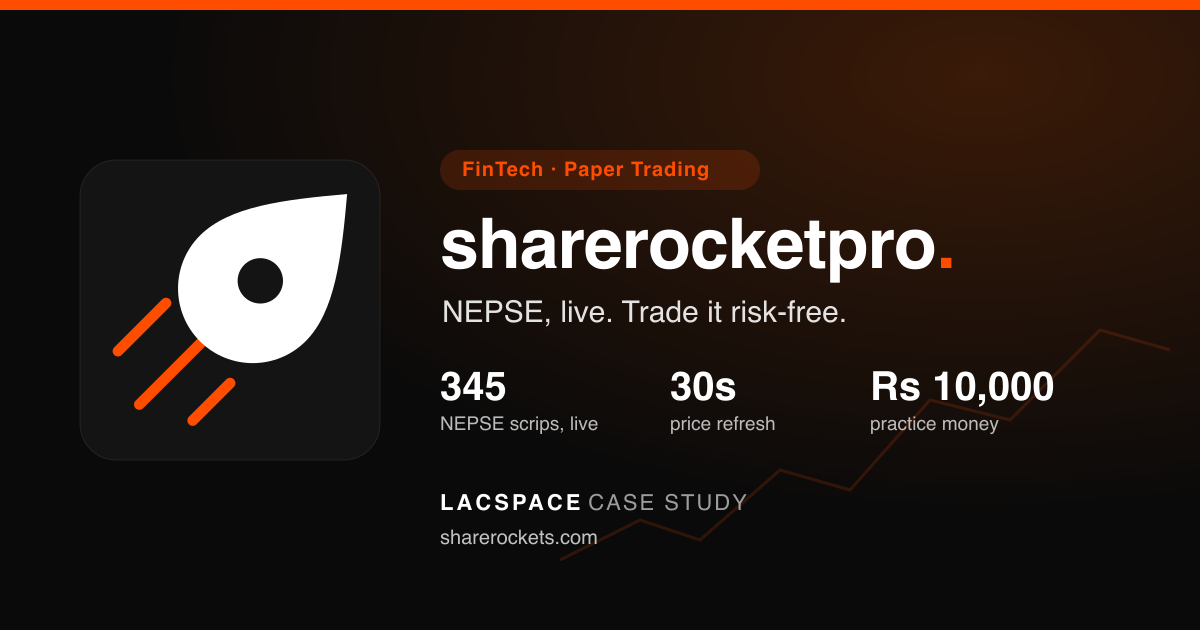 FintechShareRocketProLacspace built and maintains ShareRocketPro — live NEPSE market data for all 345 listed scrips, plus an iOS and Android paper-trading app with Rs. 10,000 practice money and a 24/7 practice market. The client found us through StockYatra, our own paper-trading app.Read the case study
 Commerce & retailColour NepalA full-scale e-commerce marketplace platform built to empower jewellery and beauty vendors across Nepal, combining cultural elegance with modern shopping, secure payments, and nationwide delivery.Read the case study
Also in products we build and run
Questions buyers ask
What should an MVP include?
Only the core journey that proves your idea, plus the basics needed to use it safely: sign-up, the main feature, and payments if you are testing willingness to pay. Everything else goes on a version-two list.
How much does MVP development cost?
It depends on the platforms, the number of screens and whether payments or integrations are needed. After a scope workshop we send a written price, and the scope is cut to fit a budget when that matters.
How long does it take to build an MVP?
A focused MVP is typically a matter of weeks rather than months, and the written scope sets out the milestones. Short release cycles mean you can show working software early.
Do I own the code?
Yes. The code, designs and data are yours. We hand over the repository and documentation so you can continue with us or with your own team.
Can the MVP grow into the full product?
Yes. We build on a production-grade stack with clean code, so the MVP becomes the foundation of version two rather than something to throw away.
Related reading
- How Much Does It Cost to Build an MVP in Nepal in 2026? (Real Price Breakdown)Startup Guides
- Tech Co-Founder vs Agency vs Freelancer: How to Build Your Startup in Nepal (2026)Startup Guides
- Build-for-Fee vs Tech Co-Founder: Which Way Should You Build Your Startup? (2026)Startup Guides
- How to Build a Startup in Nepal in 2026 — From Idea to Launch, Even Without a Tech TeamStartup Guides
Related services
- UI/UX designUI/UX design for web and mobile products: research, wireframes, clickable prototypes, usability checks and design systems your developers can build from.
- Mobile app developmentiPhone and Android apps built from one codebase: design, development, App Store and Google Play publishing, push notifications and updates after launch.
- Custom software developmentCustom web platforms, internal tools, APIs and integrations, scoped in writing and built in short releases by a team that runs its own software products.
- Every service we offer
Tell us what you need built.
Start with a call. You get a written scope and price before anything is agreed.