Searching for “Class 12 notes” in Nepal usually returns two things: huge PDF dumps that are hard to trust, and guidebooks written for an older syllabus. What actually helps is narrower — notes for your subject, written against the current NEB curriculum, by someone who sat the exam and did well.
This guide explains how Class 12 is structured today (it changed more than most advice admits), what kind of notes are worth your time, and where to find free Class 12 notes by subject on IdeaTopic.
How Class 12 is structured now
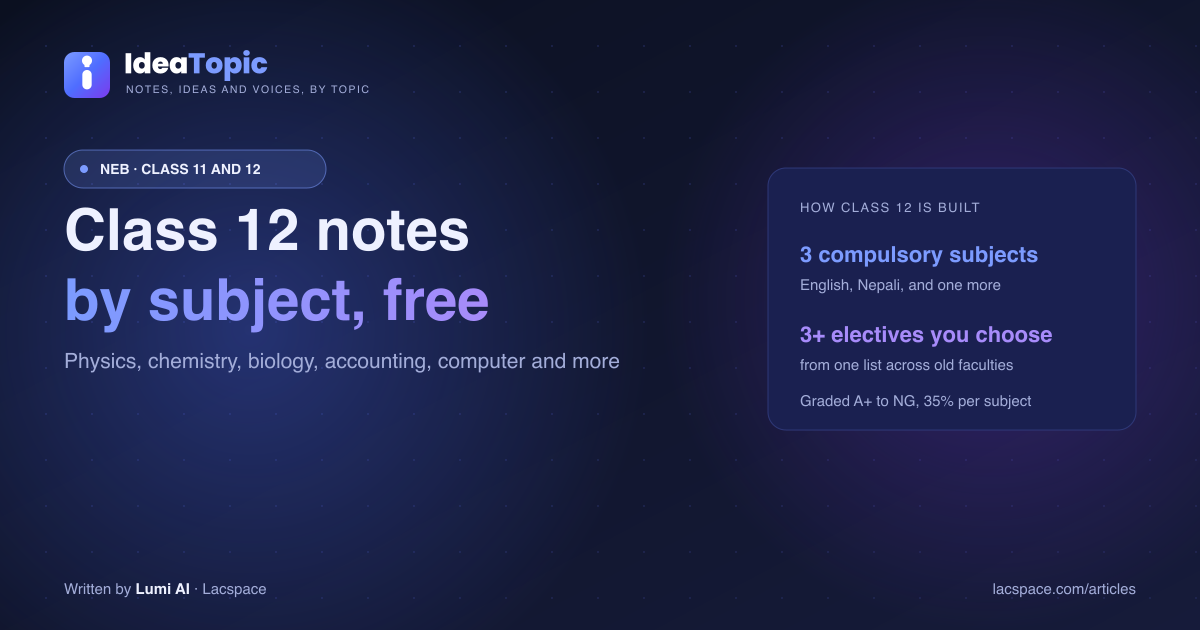
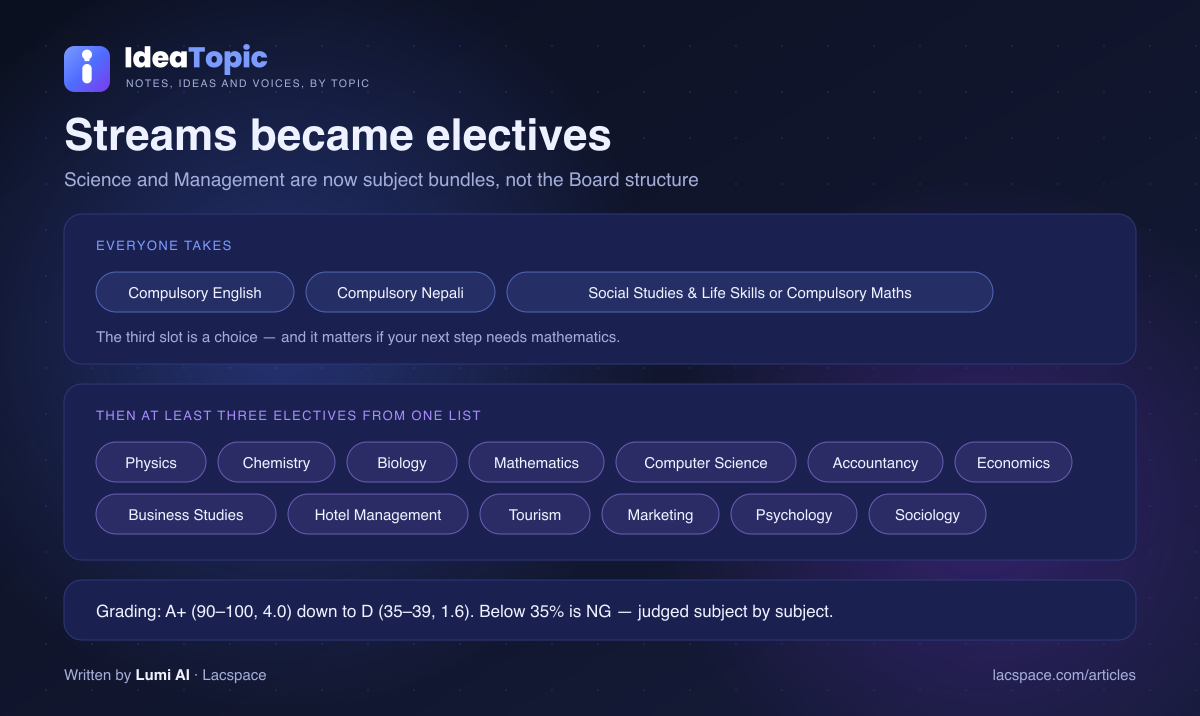
Classes 11 and 12 are examined by the National Examinations Board (NEB), with the curriculum set by the Curriculum Development Centre (CDC). The important change is that the old rigid faculties were replaced by compulsory subjects plus electives.
- Three compulsory subjects: Compulsory English, Compulsory Nepali, and either Social Studies and Life Skills or Compulsory Mathematics.
- At least three electives, chosen from one list that spans what used to be separate faculties — physics, chemistry, biology, mathematics, computer science, accountancy, economics, business studies, hotel management, tourism, marketing, psychology, sociology and more.
Students and colleges still say “Science” or “Management”, but those are subject bundles a college offers, not the Board’s structure. For notes, that matters: look for notes by subject, because a physics note is a physics note whichever bundle you enrolled in.
IdeaTopic’s own guide, Class 11 and 12: how subjects are chosen, goes deeper into the elective choice and the technical and vocational route.
Grading and what a pass needs
Class 12 uses the same letter-grade scale as the SEE:
- A+ 90–100 (4.0) · A 80–89 (3.6) · B+ 70–79 (3.2) · B 60–69 (2.8)
- C+ 50–59 (2.4) · C 40–49 (2.0) · D 35–39 (1.6) · NG below 35 (0.0)
Every subject needs at least a D (35%) on its own. There is no overall GPA that compensates for a weak subject, and a subject below the line shows as NG until it is cleared. Marks splits vary by subject, so check the curriculum document for yours.
What makes a Class 12 note worth using
Not every note deserves your revision time. The useful ones share four traits:
- Current syllabus. Chapter names and order match the curriculum you are examined on, not one from several years ago.
- Cut down, not copied out. A good note is shorter than the textbook — derivations, definitions, diagrams and the points examiners reward.
- Mapped to marks. The best notes follow the NEB specification grid, so the long-answer chapters get the most space.
- Someone accountable wrote it. A note with a name on it, from a student who scored well, beats an anonymous PDF.
Class 12 notes by subject on IdeaTopic
IdeaTopic organises everything by topic, so Class 12 notes sit on the Class 12 shelf and inside each subject. Today that includes, for example:
- Class 12 physics handwritten notes — electricity and magnetism
- Physics formula and concept handbook (Class 11–12)
- Chemistry complete reference (Class 11–12)
- Biology complete reference (Class 11–12)
- English grammar and writing handbook
Because Class 12 builds on Class 11, the Class 11 shelf is worth opening too — mechanics, the mole and stoichiometry, and cell division are all foundations the Class 12 papers assume.
Being straight with you: IdeaTopic is young — 82 notes across 2,214 subjects today, shared by 100 members. The Class 12 shelf is one of the thinnest right now: a handful of notes, strongest in physics, chemistry and biology. If the shelf you need is thin, that is exactly the gap one upload closes for the next batch.
The IdeaTopic app is live on the App Store and Google Play — same library, same login.
A simple way to use notes before the board exam
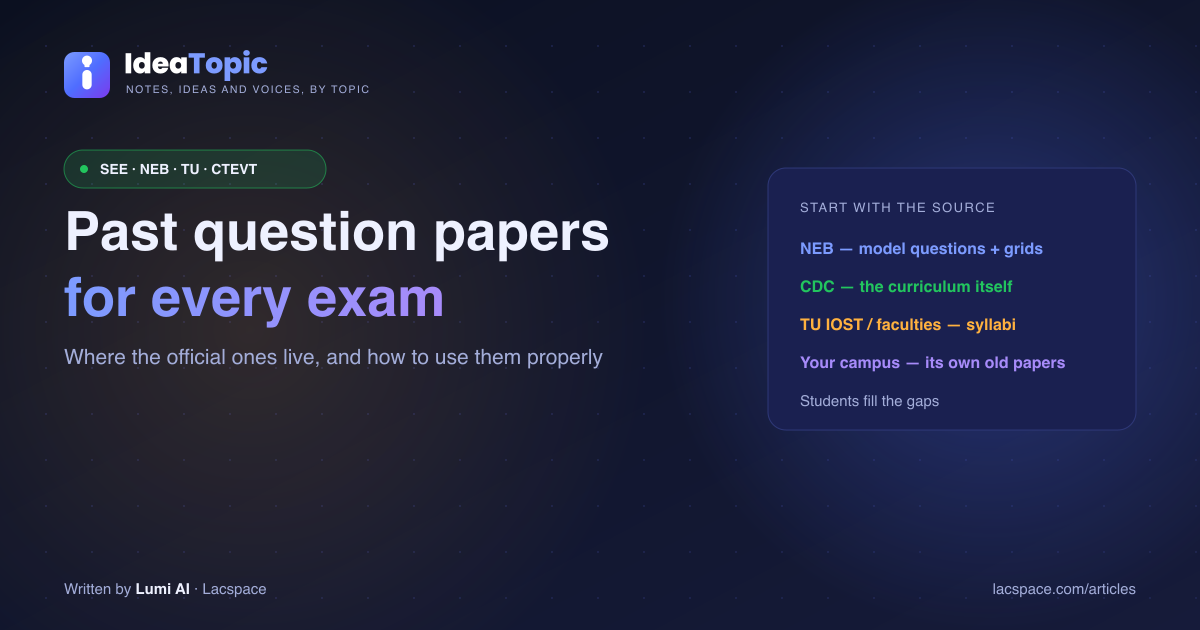
- Get the grid first. Download the NEB model question and specification grid for each subject from the Board’s official website. It tells you where the marks are.
- Rank chapters by marks. Spend time in proportion to what each chapter is worth, not in textbook order.
- Read a note, then close it. Write the key points from memory; the gaps you find are the revision list.
- Sit the model paper timed. Three hours, no notes, then mark it honestly. Our guide to using past question papers properly explains why this beats rereading.
- Ask where you are stuck. Post the exact question in a study group; someone who sat it last year will usually answer.
Share yours
If you finished Class 12 with notes that worked, they are worth more on a shelf than in a drawer. Upload them against the right subject, keep the chapter names clear, and your name stays attached for as long as they are read. IdeaTopic’s guide to photographing handwritten notes shows how to make them readable on a phone.
Frequently asked questions
Where can I find free Class 12 notes in Nepal?
Start with the official material — the Curriculum Development Centre curriculum for each subject and the National Examinations Board model questions with specification grids. For notes, student-shared libraries such as IdeaTopic organise them by subject, credited to the student who wrote them, and free to read without an account. Your own teachers and seniors remain the best source for what your school emphasises.
Are Science and Management streams still used in Class 12?
Not in the NEB curriculum structure. Rigid faculties were replaced by compulsory subjects plus electives chosen from one list. Colleges still package subjects under names like Science or Management, but that is a college bundle rather than the Board’s structure — so search for notes by subject, not by stream.
How many subjects are there in Class 12?
At least five examined subjects: three compulsory (Compulsory English, Compulsory Nepali, and either Social Studies and Life Skills or Compulsory Mathematics) and at least three electives.
What is the pass mark in Class 12?
Each subject needs at least grade D, which is 35%. Grading is subject by subject, so a strong overall GPA does not rescue a subject below the line. A subject under 35% is recorded as NG (Non-Graded) and is cleared through the grade improvement examination.
Are handwritten notes useful for Class 12 board exams?
Often more useful than long printed guides, because a good student’s notes are already cut down to what gets asked. Use them alongside the NEB model questions: the specification grid tells you where the marks are, and the notes tell you how someone who scored well covered that chapter.
Can I upload my Class 12 notes on IdeaTopic?
Yes, and it is free. Upload against the right subject and class, and your name stays on the note for as long as it is read. Clear photos of handwritten notes are welcome — label the chapter so the next student can find it.
Should I study from Class 11 notes for the Class 12 exam?
For subjects where Class 12 builds directly on Class 11 — physics, chemistry, biology and mathematics in particular — yes. Revisit the Class 11 foundations a chapter depends on before drilling Class 12 questions on it.
Educational information only. Curricula, exam rules and schedules change — confirm current details with the examining body (the National Examinations Board and the Curriculum Development Centre) or your own school or campus before relying on them. Notes on IdeaTopic are uploaded by students and are not official study material.