BSc CSIT is one of the most searched degrees among Nepali science students, and one of the most note-hungry. Eight semesters of programming, mathematics and theory move fast, and the students who do well usually have one thing in common: good notes from someone a year ahead.
This guide lays out the CSIT structure, what the first two years ask for subject by subject, how to judge notes for a programming-heavy course, and where to find free CSIT-relevant notes on IdeaTopic.
How BSc CSIT is structured
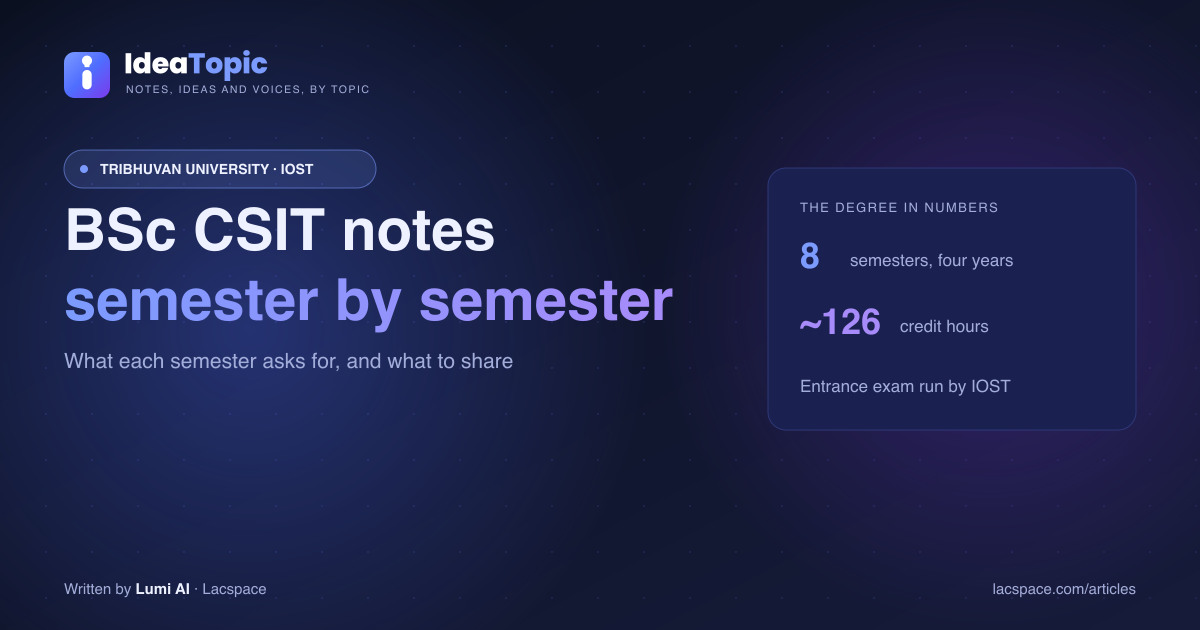
BSc Computer Science and Information Technology at Tribhuvan University runs under the Institute of Science and Technology (IOST). It is a four-year degree of eight semesters totalling around 126 credit hours, with admission through an entrance examination conducted by IOST.
The first half builds foundations in mathematics, physics, programming and core computer science. Electives, project work and specialisation arrive in the later semesters. Course structures and marks splits get revised, so treat the course structure published by TU IOST — and your own campus — as the authority.
Semesters 1 to 4, subject by subject
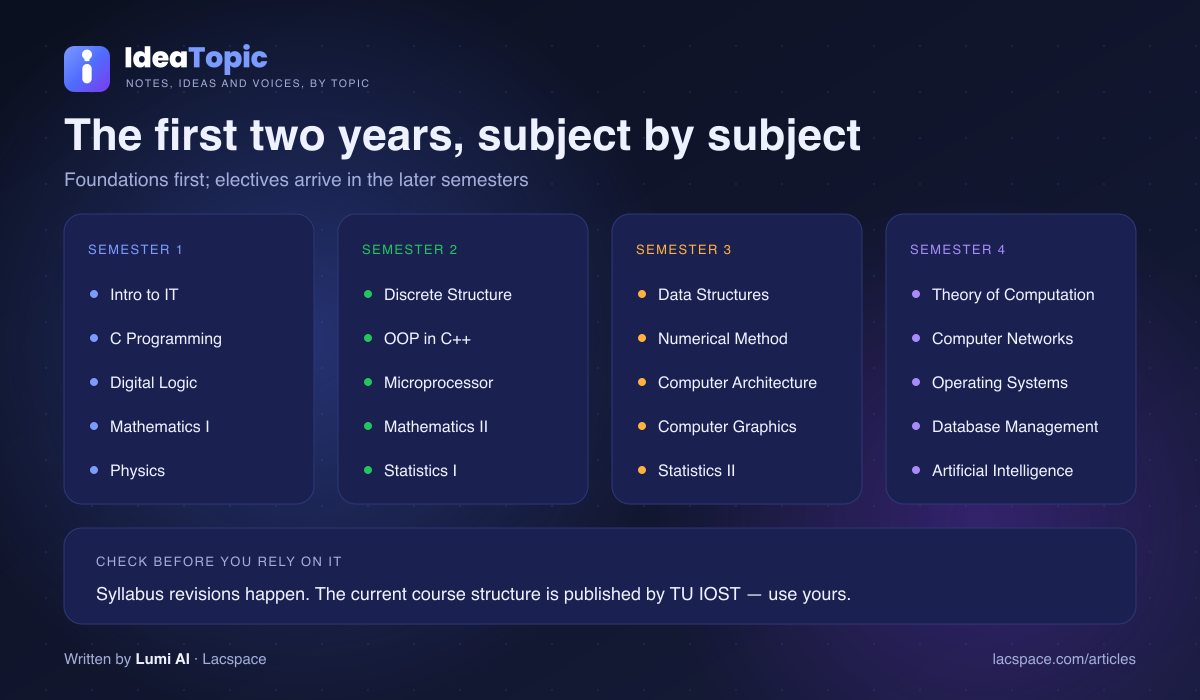
- Semester 1: Introduction to Information Technology, C Programming, Digital Logic, Mathematics I, Physics.
- Semester 2: Discrete Structure, Object Oriented Programming (C++), Microprocessor, Mathematics II, Statistics I.
- Semester 3: Data Structures and Algorithms, Numerical Method, Computer Architecture, Computer Graphics, Statistics II.
- Semester 4: Theory of Computation, Computer Networks, Operating Systems, Database Management System, Artificial Intelligence.
Two subjects carry more weight across the whole degree than their credit hours suggest: C Programming and Data Structures and Algorithms. Nearly every later programming course assumes them, and interviewers ask about them long after graduation. If you keep only two sets of notes forever, keep those.
The later semesters
From the middle of the degree the course broadens into areas such as algorithm design, software engineering, web technology and project work, with electives that vary by college. Because elective offerings and structures differ between campuses and syllabus versions, we have not listed them here — check the current IOST course structure and what your own college offers.
What good CSIT notes look like
Programming-heavy courses punish the wrong kind of note. The useful ones:
- Show working code, not just definitions. A sorting algorithm you can trace beats a paragraph describing it.
- Include the dry-run. Step-by-step traces of recursion, stacks and pointers are exactly what theory questions ask for.
- Separate theory from lab. Exam answers and lab reports are marked differently; notes that blur them waste revision time.
- Carry the semester in the title. A note labelled only “Data structures” may be from a different course entirely.
CSIT notes on IdeaTopic
IdeaTopic does not have a dedicated BSc CSIT shelf yet. What it does have is a growing IT and Computer Science section whose notes map directly onto CSIT subjects:
- Semester 1 — C Programming: Programming in C — complete guide
- Semester 3 — Data Structures and Algorithms: Data structures and algorithms — complete guide
- Semester 4 — Database Management System: Database notes
- Web technology: Web technology II and Web development and internet fundamentals
- Programming practice: Python programming and Java programming
Being straight with you: IdeaTopic is young — 82 notes across 2,214 subjects today, shared by 100 members. There is no CSIT-specific semester shelf yet — the notes above are subject notes that happen to fit CSIT courses. If the shelf you need is thin, that is exactly the gap one upload closes for the next batch.
BCA students share several of these subjects; our BCA notes guide covers that degree, and the engineering notes guide covers IOE computer engineering.
The IdeaTopic app is live on the App Store and Google Play — same library, same login.
Share yours
CSIT is exactly the kind of course where one good upload changes the next batch’s semester. If you have clean notes, lab solutions you wrote yourself, or a worked set of past questions, upload them against the subject and put the semester in the title. Your name stays on it — and so does the credit when a junior passes Data Structures because of it.
Frequently asked questions
How many semesters are there in BSc CSIT?
BSc CSIT at Tribhuvan University is a four-year programme of eight semesters, run under the Institute of Science and Technology (IOST), totalling about 126 credit hours.
What subjects are in BSc CSIT first semester?
The first semester covers Introduction to Information Technology, C Programming, Digital Logic, Mathematics I (calculus) and Physics. Confirm against the current course structure published by TU IOST, because syllabus revisions happen.
Where can I find free BSc CSIT notes?
Your own campus and seniors are the most reliable source for what your college emphasises. Online, several CSIT-focused sites publish semester-wise notes, and student libraries such as IdeaTopic hold subject notes — C programming, data structures, databases, web technology — that map directly onto CSIT courses.
Is BSc CSIT harder than BCA?
They are different rather than simply harder. BSc CSIT sits under IOST and is more mathematics- and theory-heavy, with an entrance exam; BCA sits under the Faculty of Humanities and Social Sciences and is more application-oriented. Our BCA notes guide covers that course.
Do I need notes if I have the recommended textbook?
Textbooks teach the subject; notes teach the exam. A good senior’s notes are already filtered to what your campus examines, so use the textbook to understand a topic and notes to decide where the final revision time goes.
Can I upload my CSIT notes on IdeaTopic?
Yes. Upload them against the subject — for example C Programming or Data Structures — and put the semester in the title. Your name stays on the note for as long as it is read.
Educational information only. Curricula, exam rules and schedules change — confirm current details with the examining body (Tribhuvan University Institute of Science and Technology) or your own school or campus before relying on them. Notes on IdeaTopic are uploaded by students and are not official study material.