BCA in Nepal has more notes online than almost any other course, and students still struggle. The reason is not scarcity — it is that most published BCA notes describe the syllabus, and your exam describes what your college taught.
New name, same library: IdeaTopic was previously called WeGrowNepal (why we renamed). Your account, your uploads and every note are exactly where you left them. The IdeaTopic app is now on the App Store and Google Play under its own name.
This guide covers the structure of the degree, what each year demands, and how to combine published notes with the campus-specific material that actually moves your grade.
How the degree is built
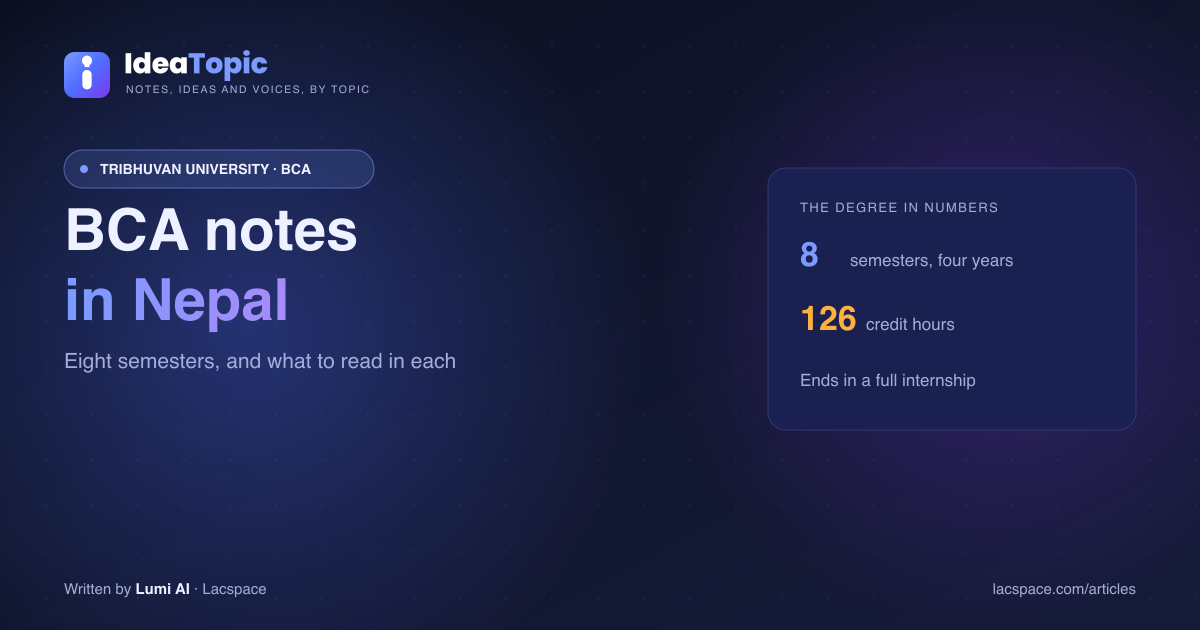
The Tribhuvan University Bachelor of Computer Application is a four-year degree of eight semesters, taught in English under the Faculty of Humanities and Social Sciences, totalling around 126 credit hours.
The shape of it:
- Most subjects carry three credits; two first-year subjects carry more.
- Project work runs from the second semester onward, with the final-year project carrying the heaviest load.
- The eighth semester is a full internship.
That last point changes how you should treat the whole degree. BCA is not a theory course with a placement bolted on the end — it is built to finish with you having worked.
What each year asks of you
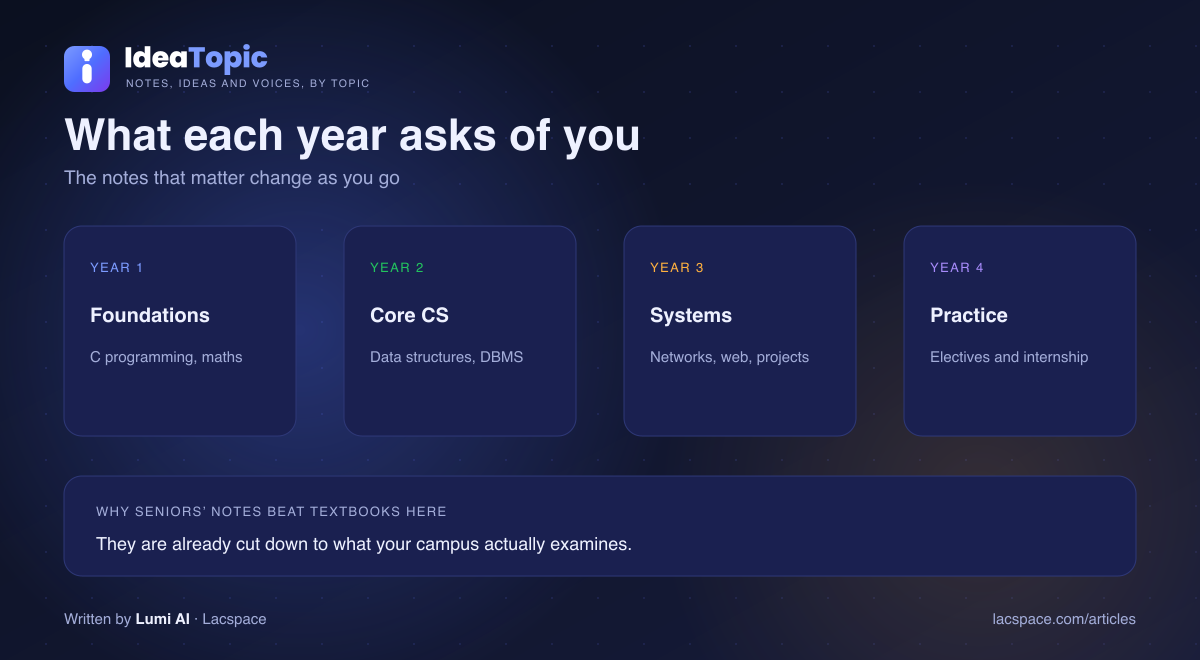
- Year one — foundations. Programming in C, computer fundamentals, mathematics, English. Volume is manageable; the failure mode is treating programming as a subject to memorise rather than to practise.
- Year two — core computer science. Data structures, databases and the subjects everything later depends on. This is the year where falling behind compounds.
- Year three — systems and projects. Networking, web development, and project work that starts to resemble real deliverables.
- Year four — electives and the internship. Specialisation, then the workplace.
Why published notes miss
Nepal's BCA notes sites are genuinely useful and cover the syllabus thoroughly. Their limitation is structural rather than a criticism: they publish one general version of a subject, and colleges do not teach one general version.
Two campuses running the same syllabus will weight units differently, set different practicals, and ask different questions. A senior at your college knows which chapters were skimmed and which came up twice. No national notes site can know that.
So use both, and use them for different jobs:
- Published notes and textbooks — to learn a topic properly the first time.
- Seniors' notes and your college's past papers — to decide where the last two weeks go.
Where to find BCA notes
- Dedicated BCA sites for semester-wise notes, lab reports and past questions on the TU syllabus. Largest collections available.
- Your own department for past papers that never reached the internet.
- Seniors, for the filtered version of everything above.
- Student-upload platforms. IdeaTopic holds student-uploaded BCA notes sorted by subject and semester — computer fundamentals, C programming, society and technology and others — with each contributor named. Free to read, no account needed.
Being straight with you: IdeaTopic is new, and the library is still small. Some subjects have a handful of notes and some have none at all. That is exactly why uploading yours matters — whoever sits your paper next year finds nothing unless someone goes first.
The eighth semester
The internship is the part of your degree an employer will actually ask about, and the part least helped by notes.
- Start looking a semester early. The good placements go to whoever asked first.
- Log what you built, not what you attended. A weekly line takes a minute and becomes your report.
- Finish with something demonstrable. A repository someone can open beats any certificate.
Sharing yours
Every BCA batch rebuilds the same C programming and data structures notes from scratch, because the previous batch's copies left on a graduate's laptop. It costs each year weeks that nobody needed to spend.
Uploading takes two minutes. Tag the subject and the semester properly — a mislabelled note is invisible to the person who needs it — and your name stays on it for as long as anyone reads it.
Read next: the best notes platforms in Nepal, compared, engineering notes in Nepal, Lok Sewa notes and the IdeaTopic app.
Educational information only. Syllabuses, exam rules and licensing requirements change — always confirm current details with the examining body (Tribhuvan University or your own college) or your own campus before relying on them. Notes on IdeaTopic are uploaded by students and are not official study material.
Frequently asked questions
How long is the BCA course in Nepal?
Four years, structured as eight semesters, two per academic year. The Tribhuvan University BCA sits under the Faculty of Humanities and Social Sciences, is taught in English, and totals roughly 126 credit hours. Most subjects carry three credits, project work appears from the second semester onward, and the eighth semester is a full internship.
Where can I find BCA notes in Nepal?
Several dedicated BCA sites publish semester-wise notes, lab reports and past questions for the TU syllabus, and they hold the largest ready-made collections. Your own college is the other essential source, because past papers and the emphasis of your lecturers are rarely published anywhere. Student-upload platforms such as IdeaTopic collect notes from students by subject and semester, with the contributor named so you can see which campus they came from.
What subjects are in BCA first semester?
The first year is foundational: programming in C, computer fundamentals and applications, mathematics, English and a society-and-technology style subject, with the exact combination depending on your syllabus version. Two first-year subjects carry a heavier credit load than the standard three. Always check your college's current course structure, because syllabus revisions do happen.
Is BCA harder than BSc CSIT in Nepal?
They are different rather than simply harder or easier. BSc CSIT is more theoretical and mathematics-heavy, sitting under the Institute of Science and Technology. BCA is more application-oriented and ends in an internship, under the Faculty of Humanities and Social Sciences. Students who prefer building things over proving them usually find BCA the better fit, and vice versa.
Do I need notes if I have the textbook?
Textbooks teach the subject; notes teach the paper. A recommended textbook covers far more than your college examines, while a senior's notes are already filtered down to what was actually asked at your campus. Use the textbook to understand a topic the first time and notes to decide where the final fortnight of revision goes.
What should I do about the eighth-semester internship?
Treat it as the part of the degree employers will ask about, because it is. Start looking a semester early, keep a written log of what you actually built rather than what you attended, and finish with a project you can demonstrate. Notes help far less here than a repository someone can open.
Can I upload my BCA notes and get credit?
Yes. On IdeaTopic you upload against the subject and semester and your name stays attached for as long as the note is read, with contributions counting towards a public leaderboard. Photographed handwritten notes are welcome. Label the semester correctly — a mislabelled note is invisible to the person who needs it.