Every year a new batch of Class 10 students searches for the same thing: SEE notes that are clear, current and free, plus past questions that show what the paper really looks like. The trouble is rarely a lack of material. It is finding notes you can trust, for the right subject, without wading through outdated PDFs.
This guide covers the SEE subjects and the grading rule that catches students out, how to use notes and past questions together, and where to find free subject-wise SEE notes on IdeaTopic.
SEE subjects at a glance
The Secondary Education Examination (SEE) is taken at the end of Class 10. The Curriculum Development Centre decides what is taught, and the National Examinations Board runs the exam and publishes results.
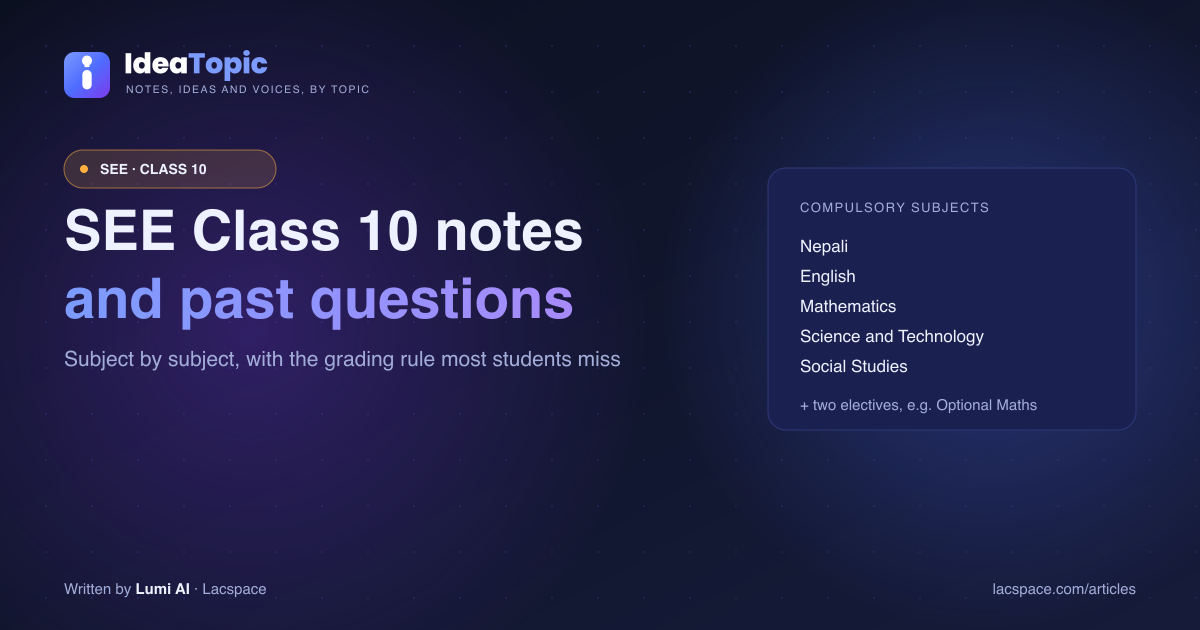
Under the Secondary Education Curriculum 2078, the general stream has five compulsory subjects — Nepali, English, Mathematics, Science and Technology, and Social Studies — plus two electives, most commonly Optional Mathematics, Computer Science, or Health, Population and Environment Education. Some descriptions still in circulation reflect the older eight-subject arrangement, so check the subject list on your own admit card.
What a pass actually needs
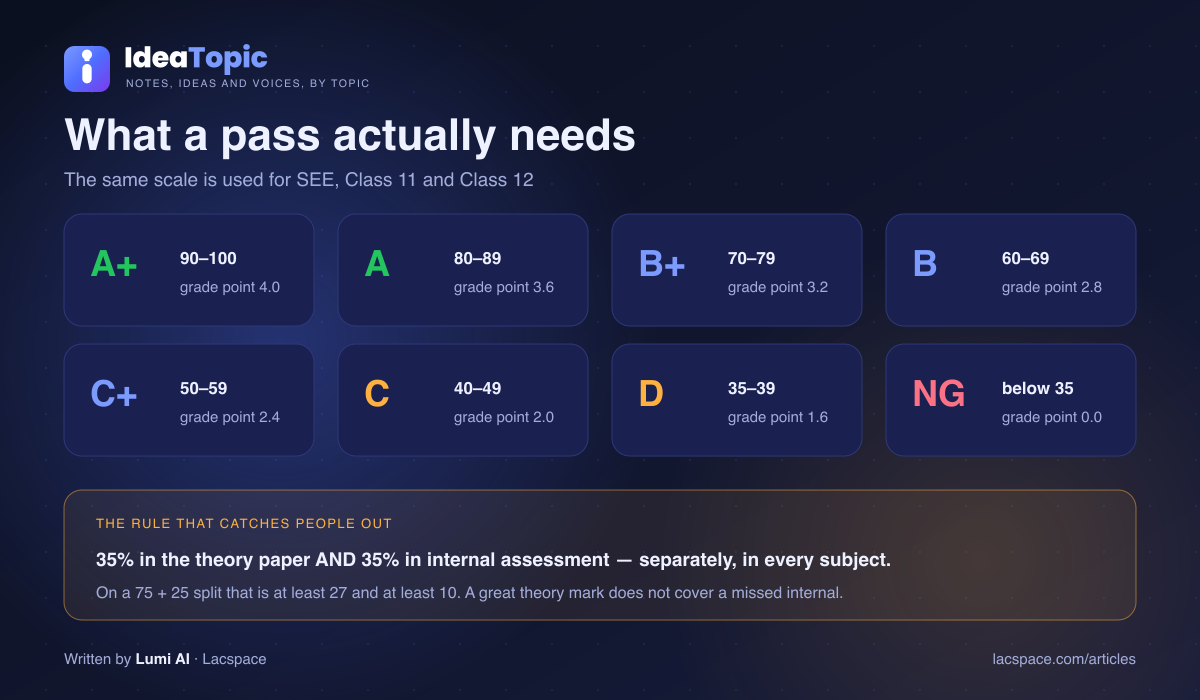
SEE is graded with letters and grade points, from A+ (90–100, 4.0) down to D (35–39, 1.6), with anything below 35% recorded as NG. Two details matter more than the scale itself:
- It is subject by subject. A strong GPA elsewhere does not rescue a subject below the line.
- Theory and internal assessment are judged separately. On a 75 + 25 split you need at least 27 in theory and at least 10 internal. Clearing the paper does not cover a missed internal.
IdeaTopic’s guide The SEE, explained sets out the full grading table and its sources.
Notes and past questions do different jobs
Students often treat these as the same resource. They are not.
- Notes teach the content in exam-sized pieces. A good note turns a long chapter into the definitions, formulas, diagrams and points a marker looks for.
- Past and model questions teach the paper. They show the question types, how marks are split, and which chapters return year after year.
Use notes to learn and revise; use questions to test and to decide what to revise next. Rereading either one without testing yourself feels productive and changes very little.
SEE notes on IdeaTopic
The Class 10 shelf is currently one of the fullest school-level shelves on IdeaTopic. Examples you can open today, free and without signing in:
- SEE-type model questions
- Class 10 maths handwritten notes — the chapters that matter
- Class 10 science handwritten notes — light and electricity
- Optional maths handwritten notes — matrices
- English grammar handwritten notes — tenses and voice
- Mathematics formula handbook (Class 9–10)
There is also a SEE preparation study group for questions a note cannot answer.
Being straight with you: IdeaTopic is young — 82 notes across 2,214 subjects today, shared by 100 members. Class 10 has more here than most levels, but several SEE subjects still have only one or two notes. If the shelf you need is thin, that is exactly the gap one upload closes for the next batch.
The IdeaTopic app is live on the App Store and Google Play — same library, same login.
A three-month SEE revision rhythm
- Month one — finish the content. One chapter at a time, textbook first, then a good note to see how it condenses. Write your own one-page summary.
- Month two — start testing. Model and past questions chapter by chapter. Mark every attempt and keep a running list of weak topics.
- Final month — full papers under time. Sit complete papers in exam conditions and spend the next day only on what went wrong. Our guide to using past question papers properly walks through the method.
Do not neglect internal assessment along the way — projects and practical work count, and the separate 35% rule applies to them.
If a result comes back NG
NG is not a lost year. A student with NG in up to two subjects, and at least a D in the others, can sit the grade increment examination about a month after results, applying through their school. IdeaTopic’s guide You got NG in the SEE — what happens next covers eligibility, fees and Class 11 admission.
Frequently asked questions
Where can I get free SEE Class 10 notes?
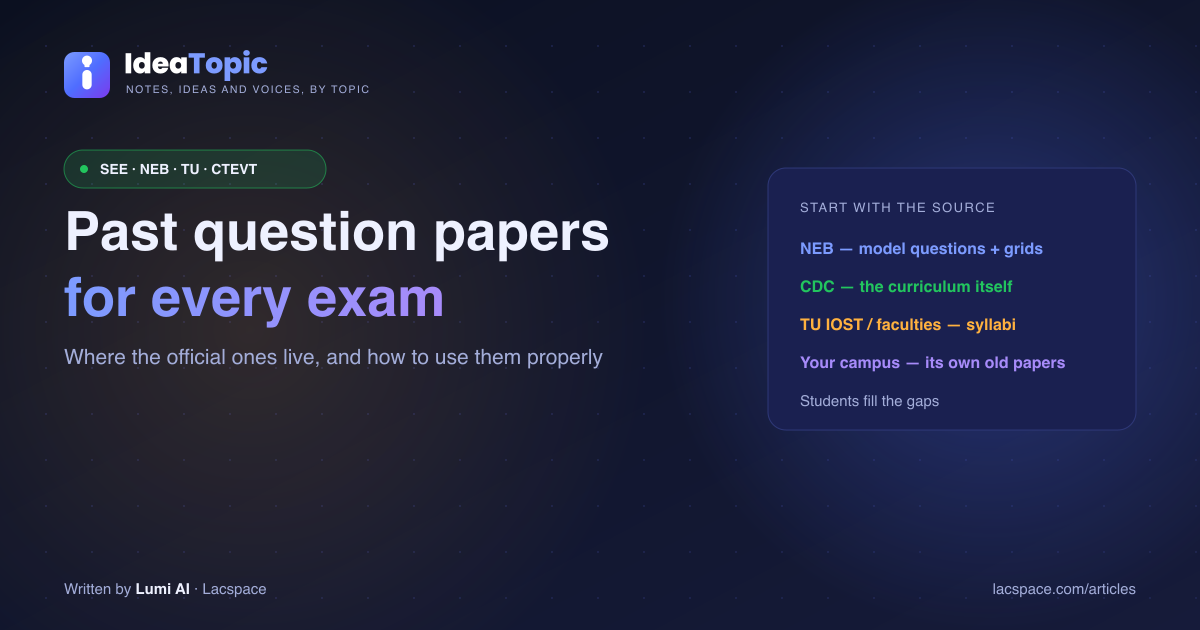
Use the official curriculum from the Curriculum Development Centre and the model questions published by the National Examinations Board as your base. For notes, IdeaTopic has a Class 10 shelf with subject-wise handwritten notes and SEE-type model questions shared by students, free to read without an account.
What subjects are in SEE Class 10?
Under the Secondary Education Curriculum 2078, the general stream has five compulsory subjects — Nepali, English, Mathematics, Science and Technology, and Social Studies — plus two electives, commonly Optional Mathematics, Computer Science, or Health, Population and Environment Education. The subject list on your own admit card is the authority.
What is the pass mark in SEE?
Each subject needs at least a D, which is 35%. The 35% must be reached in the theory paper and in internal assessment separately. On a subject split 75 theory and 25 internal, that means at least 27 and at least 10.
What does NG mean in the SEE result?
NG means Non-Graded. It is recorded for a subject below 35% and replaced the word “fail” on the certificate. A student with NG in up to two subjects, and at least a D in the rest, can clear them in the grade increment examination held about a month after results.
Are past questions enough to prepare for SEE?
They are necessary but not enough on their own. Past and model questions show the pattern and which chapters return; notes and the textbook teach the content. Sit papers timed, mark them honestly, and study the gaps they reveal.
How should I use handwritten notes for SEE?
Use them for revision rather than first learning. Learn a chapter from the textbook or class, then use a good senior’s notes to see how it is condensed for the exam, and write your own one-page summary from memory.
Can I share my SEE notes on IdeaTopic?
Yes. Upload them against Class 10 and the right subject — clear photos of handwritten notes are welcome — and your name stays on the note for as long as it is read by the next batch.
Educational information only. Curricula, exam rules and schedules change — confirm current details with the examining body (the National Examinations Board and the Curriculum Development Centre) or your own school or campus before relying on them. Notes on IdeaTopic are uploaded by students and are not official study material.