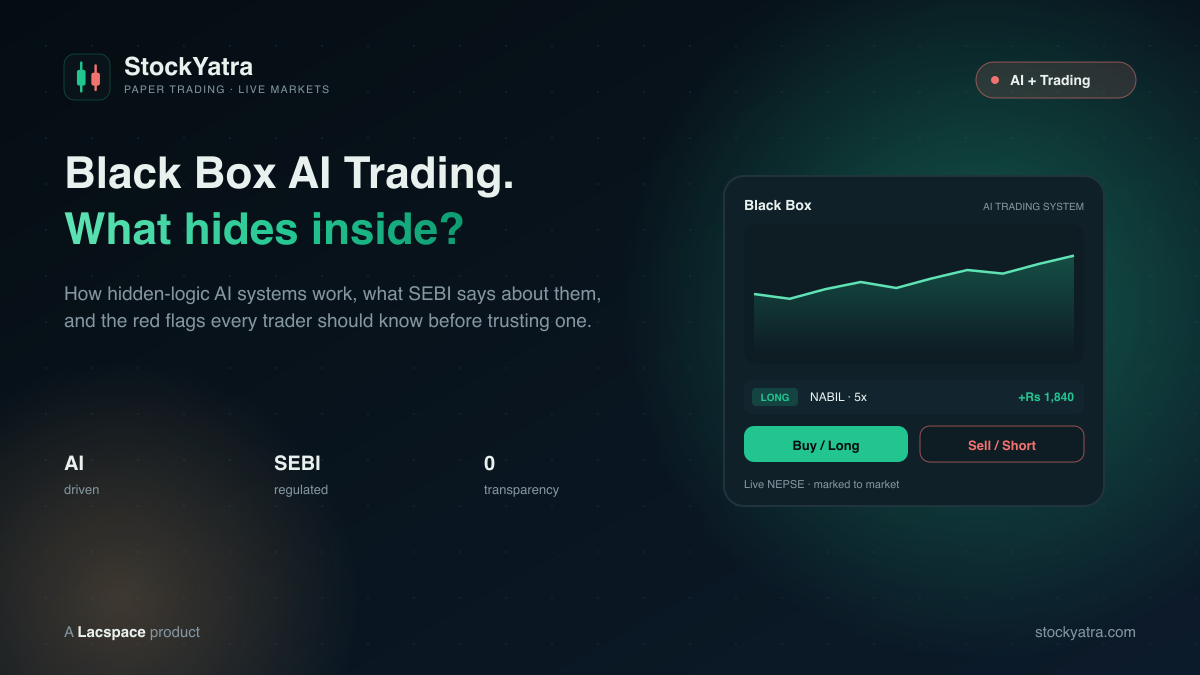
You have probably seen the ads. A chart that moves on its own. A voice-over promising 30% monthly returns. An AI that "reads" the market and places trades for you while you sleep. This is black box AI trading — or at least the version of it sold to retail traders. The reality is more complicated, more regulated and far riskier than the ads suggest.
This guide explains what black box AI trading actually is, how it works under the hood, what SEBI requires of anyone operating such a system, and the red flags that reliably separate a scam from a legitimate tool. It also covers how to build the skills to evaluate any AI trading claim — by practising the underlying ideas yourself, risk-free, on StockYatra.
What "black box" actually means
In technology, a black box is any system where you can see the inputs and the outputs but not what happens in between. A black box AI trading system takes in market data — prices, volume, news headlines, order book depth, social sentiment — and outputs trading signals: buy this stock, sell that one, hold. The process that turns inputs into outputs is invisible, even to the people running the system.
This is not inherently sinister. Many of the most powerful machine learning models are difficult to interpret. A deep neural network with hundreds of layers and millions of parameters does not have a simple explanation for why it made a particular prediction. The "black box" label describes a technical reality, not necessarily an intention to deceive.
The problem comes when that opacity is used to make claims that cannot be verified — guaranteed returns, win rates of 90%, "proven" strategies — and when it prevents you from evaluating whether a system is worth trusting.
How black box AI trading systems work
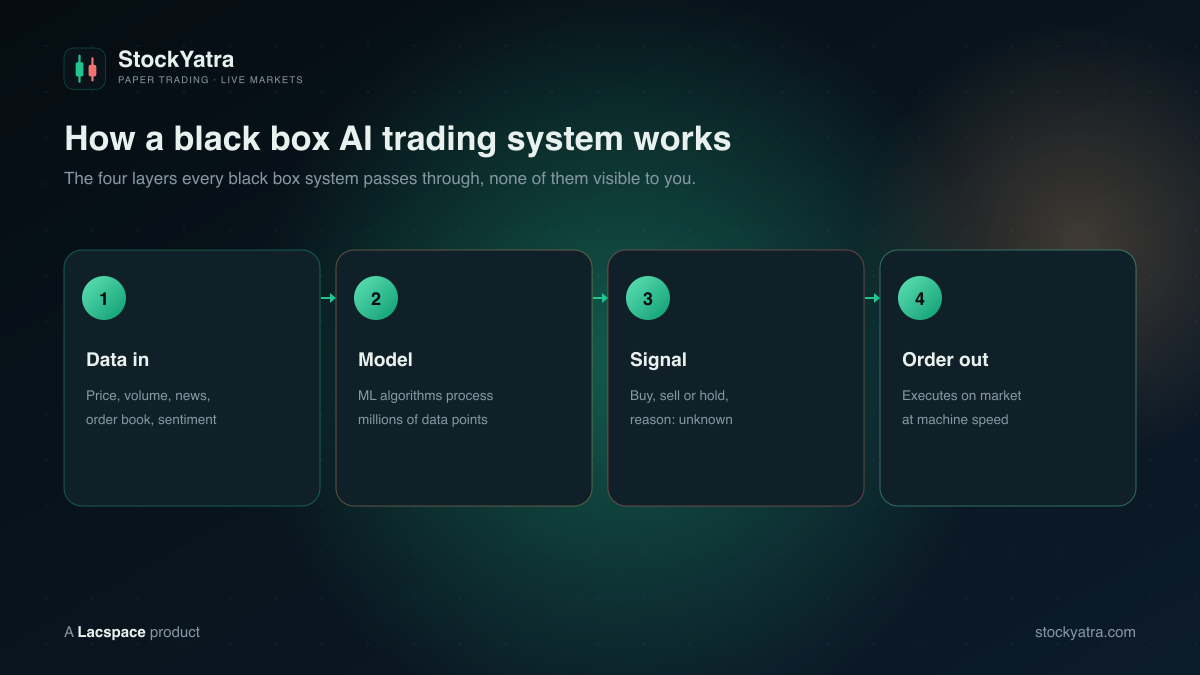
At a high level, every algorithmic trading system — AI or otherwise — follows the same loop:
- Data in. The system ingests market data. For sophisticated AI systems this includes price and volume data, order book depth (what buy and sell orders are sitting at various price levels), news headlines and sentiment from social media, economic releases and sometimes alternative data like satellite imagery or credit card transaction patterns.
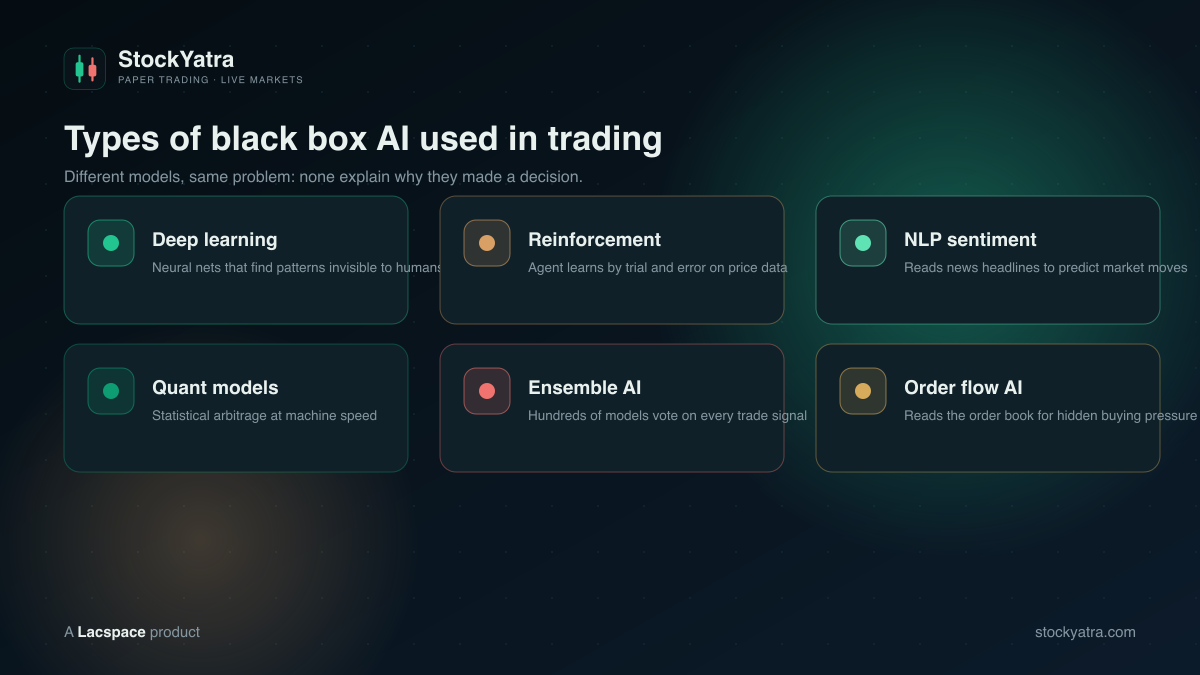
- Model processes. A machine learning model — or an ensemble of many models — processes the data and looks for patterns it associates with profitable trading opportunities. Common model types include deep neural networks, reinforcement learning agents (which learn by playing against simulated markets), gradient boosting ensembles, and NLP (natural language processing) models that read text.
- Signal out. The model outputs a trading signal: buy, sell, hold, or a probability. Often the signal is accompanied by a confidence score, but not an explanation of which input features drove the decision.
- Order out. The system translates the signal into a market order, routed through a broker's API, potentially at speeds measured in microseconds.
The real risks of black box AI trading
The risks of black box AI fall into two broad categories: technical risks that apply even to legitimate systems, and fraud risks that apply when a bad actor uses "AI" as a selling point for something that was never intended to work.
Technical risks from legitimate systems:
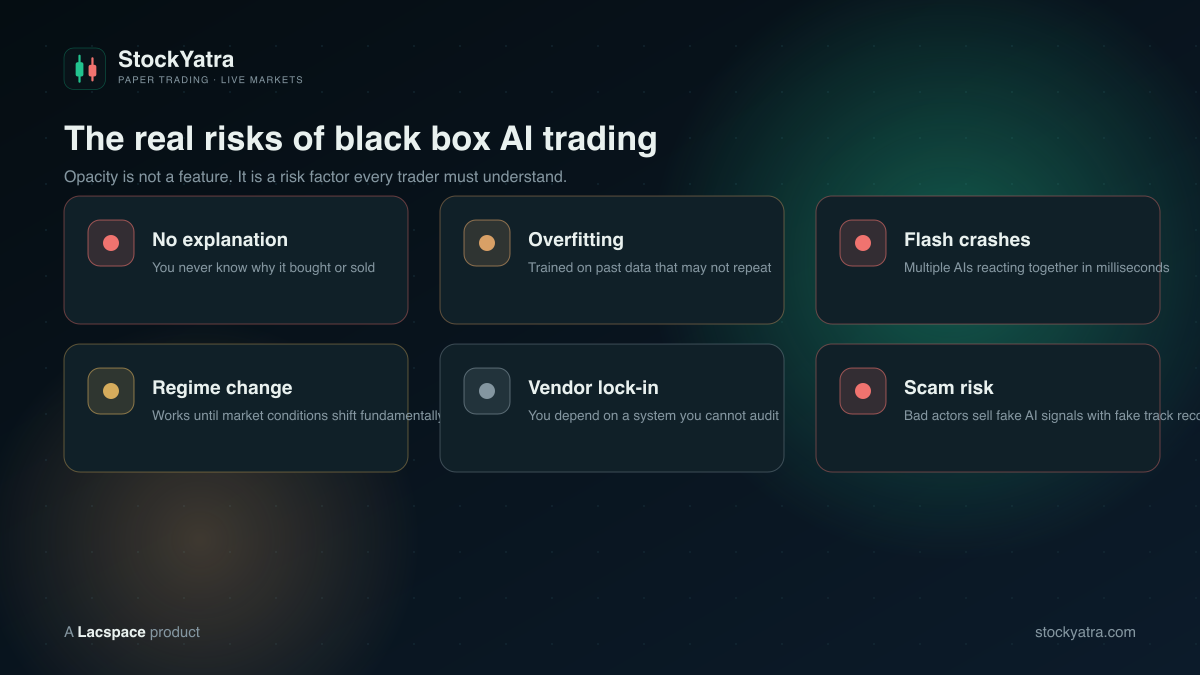
- Overfitting. A model that is trained on historical data can learn patterns that appear in that data but do not persist in future markets. An AI that back-tests at 80% win rate on five years of price history may perform much worse going forward, because it has memorised the past rather than learned durable market behaviour.
- Regime change. Markets change character over time. A strategy calibrated on a low-volatility bull market will often fail during a crisis. AI systems are particularly vulnerable to this because the patterns they learn are defined by the training data.
- Flash crashes. When many algorithmic systems respond to the same signal at the same time, they can collectively move markets in ways that briefly make no sense — and then snap back. The 2010 Flash Crash, where the Dow Jones fell nearly 1,000 points and recovered in minutes, is the most cited example. This is a risk of algorithmic markets in aggregate, not just individual systems.
- No explanation. When something goes wrong, you cannot understand why, and therefore cannot fix it or learn from it.
What SEBI says: the regulatory framework
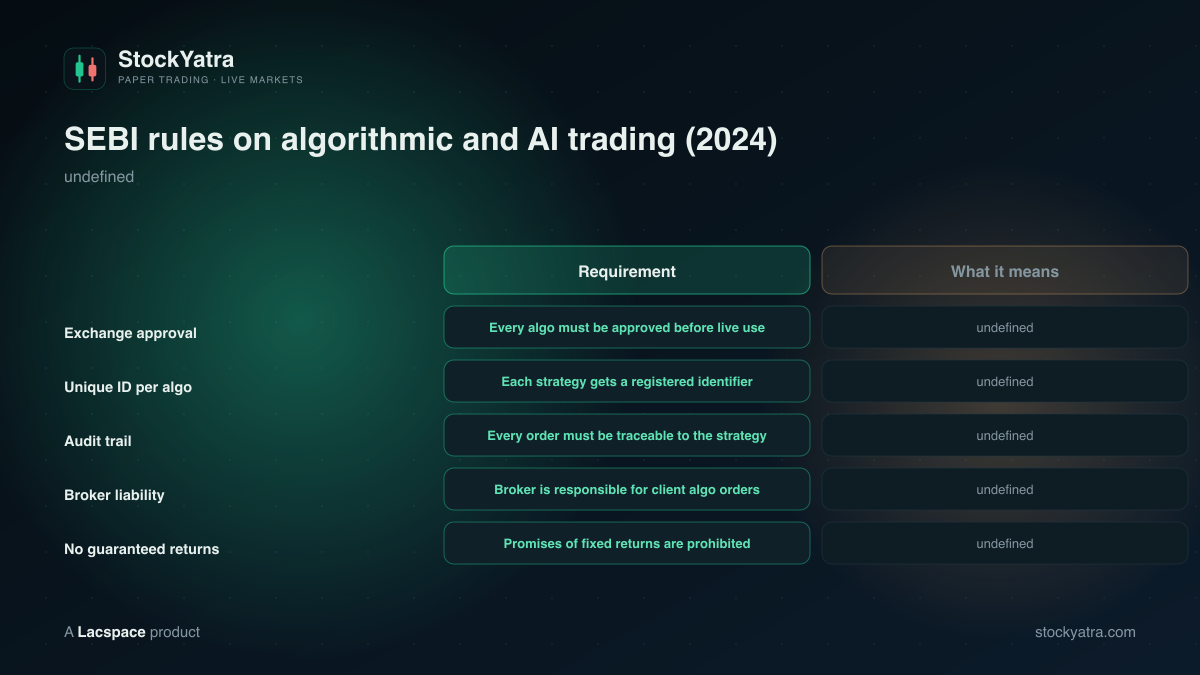
India's Securities and Exchange Board of India (SEBI) has one of the more developed regulatory frameworks for algorithmic trading in Asia. The key requirements are:
| SEBI requirement | What it means in practice |
|---|---|
| Exchange approval required | Every algorithm must be submitted to a recognised stock exchange (NSE, BSE) and approved before it can place live orders. |
| Unique strategy identifier | Each approved strategy gets a unique ID that must be tagged to every order it places. |
| Audit trail | Every order must be traceable back to the algorithm and the logic that triggered it. |
| Broker liability | The broker through whom the algorithm trades is responsible for the orders it places — even if the algorithm is a client's. |
| No guaranteed returns | Any communication that promises fixed returns from an algorithmic or AI trading system is prohibited under SEBI rules. |
The regulatory situation for Nepal (SEBON) is different: algorithmic trading on NEPSE is not formally permitted under current rules. Any service claiming to run AI-driven trades on NEPSE on your behalf should be treated as unregulated and potentially illegal.
Red flags: when "AI trading" is a scam
The marketing language of black box AI has been heavily exploited by fraudsters. These red flags appear consistently in AI trading scams:
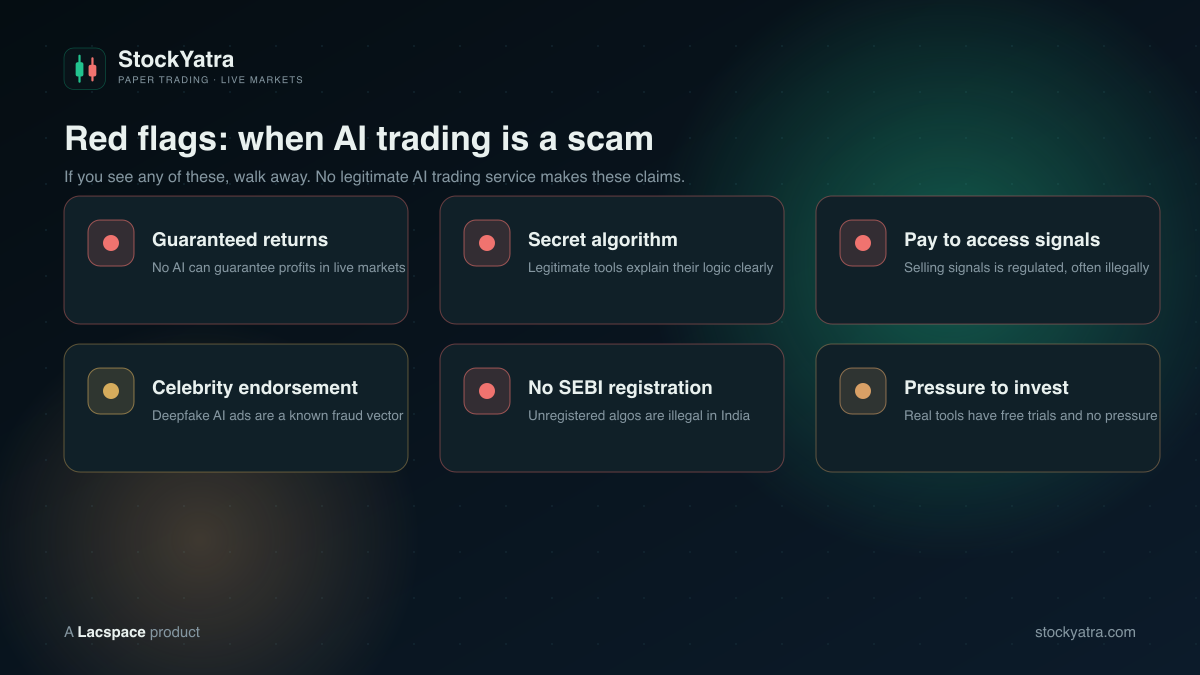
- Guaranteed returns. No trading system — AI or otherwise — can guarantee profits. Markets are inherently uncertain. Any guarantee of a specific return (10% a month, 40% a year) is either a lie, a fraud, or both. SEBI explicitly prohibits this claim.
- A "secret" algorithm. Legitimate trading tools explain their methodology. They may not disclose every parameter — that would give away the edge — but they explain what they are doing and why. A system that refuses to describe its approach at all has something to hide.
- Pay-to-access signals. Selling trading signals or "tips" is regulated activity in India. Anyone selling AI signals without SEBI registration as a research analyst or investment adviser is operating illegally. In Nepal, no equivalent legal framework currently covers this.
- Celebrity deepfakes. AI-generated video ads using the faces of Warren Buffett, Elon Musk or prominent local investors to promote trading software are a known fraud vector. If a celebrity appears to be endorsing a specific trading system, verify the endorsement independently before taking any action.
- Pressure to invest or withdraw. Legitimate tools have free trials, low-commitment entry points and no pressure tactics. Urgency ("offer ends tonight") and pressure to add more funds are fraud signals.
Lumi AI is the opposite of a black box
This is worth saying clearly, because StockYatra has AI built in: Lumi AI is not a black box system. Lumi does not place trades. It does not have a proprietary model that outputs opaque signals. It reads charts, answers questions and explains reasoning — out loud, in plain English — so that you can understand the thinking and make your own decision.
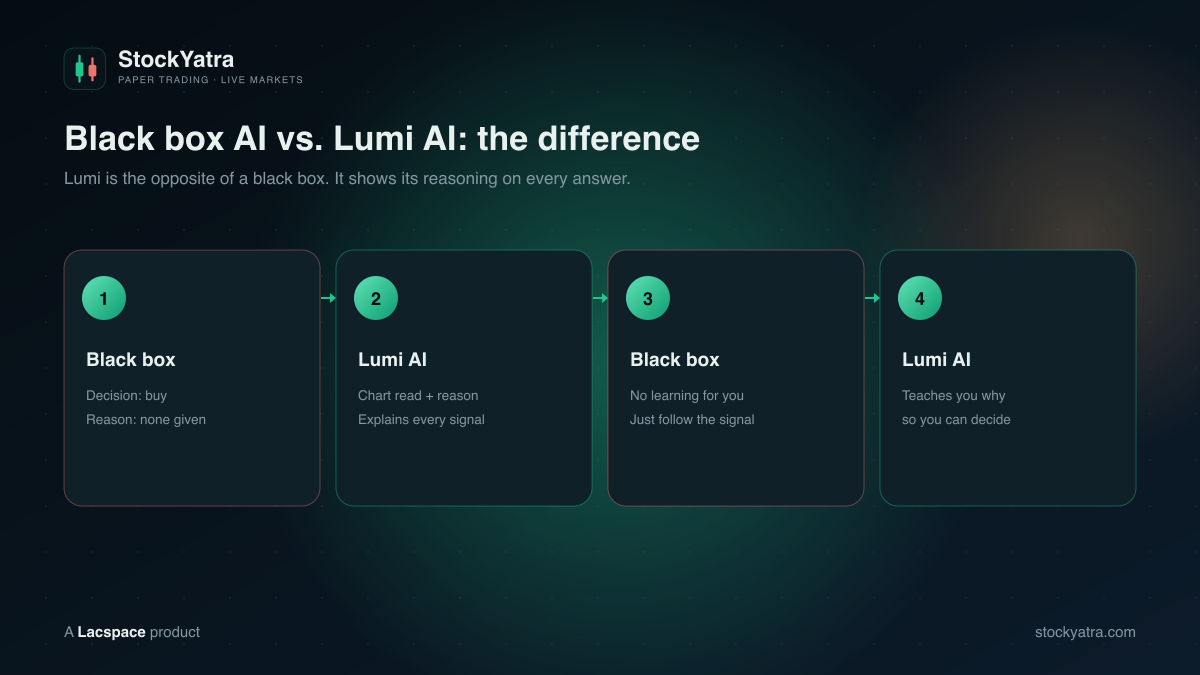
When you ask Lumi "what is this chart saying?", it does not just say "buy" or "sell". It describes what pattern it sees, what the indicator values suggest, where it would look for confirmation, and what a stop-loss might look like. The goal is for you to understand the thinking so that, eventually, you can do it yourself without asking.
That is the opposite of a black box — and it is intentional. The premise of StockYatra is that you should practise trading with full visibility into what is happening and why, so that when you move to real money, you are making informed decisions, not following signals you do not understand.
How to build real skills before trusting any AI system
The best protection against black box AI risk — and AI trading scams — is not to avoid AI entirely. It is to build enough knowledge that you can evaluate a system's claims critically.
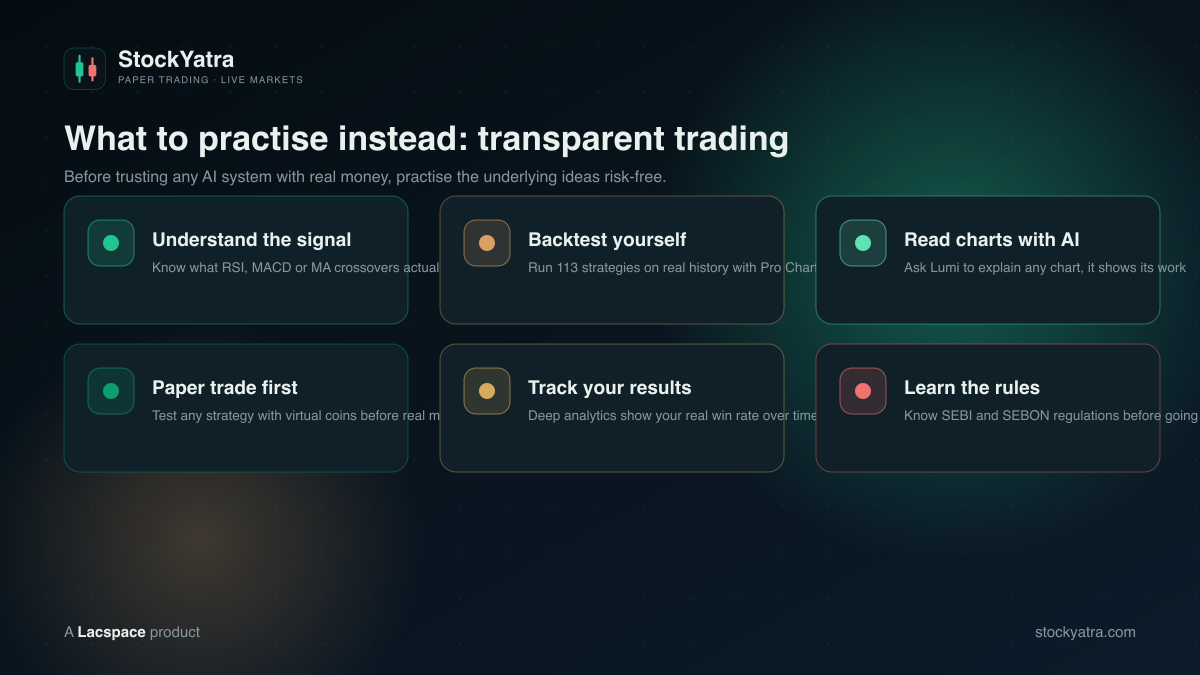
Here is a practical path to do that on StockYatra, risk-free:
- Learn the underlying signals. Before trusting any AI system to act on RSI or MACD signals, understand what RSI and MACD actually measure. StockYatra's chart lab lets you add any indicator, see the values live on real prices and ask Lumi to explain what it is showing.
- Backtest systematically. With StockYatra Pro, you can run any of 113 built-in strategies against real historical NEPSE, NSE or US price data and see the win rate, maximum drawdown and P/L curve. This is how you evaluate whether a strategy claim is plausible — not by trusting a vendor's marketing.
- Read charts with transparent AI. Use Lumi AI to read charts alongside you. Pay attention not just to the conclusion ("this looks like a breakout") but to the reasoning ("RSI is at 58, the 20-day MA has crossed the 50-day MA upward, and volume is expanding"). Learn to reproduce that reasoning yourself.
- Paper trade any strategy first. Before running any strategy with real money — AI-assisted or otherwise — run it in the simulator on live prices. See how it performs in current market conditions. A strategy that back-tests well but is forward-losing is not worth trading live.
- Measure your actual results. The deep analytics dashboard in StockYatra Pro shows your real win rate, average gain/loss ratio, streaks and Sharpe estimate. This is the standard you should hold any AI system to as well — independently verified, forward performance, not back-tested claims.
Before you trust any AI trading system: a checklist
Apply this before you give any service your money or your market access:
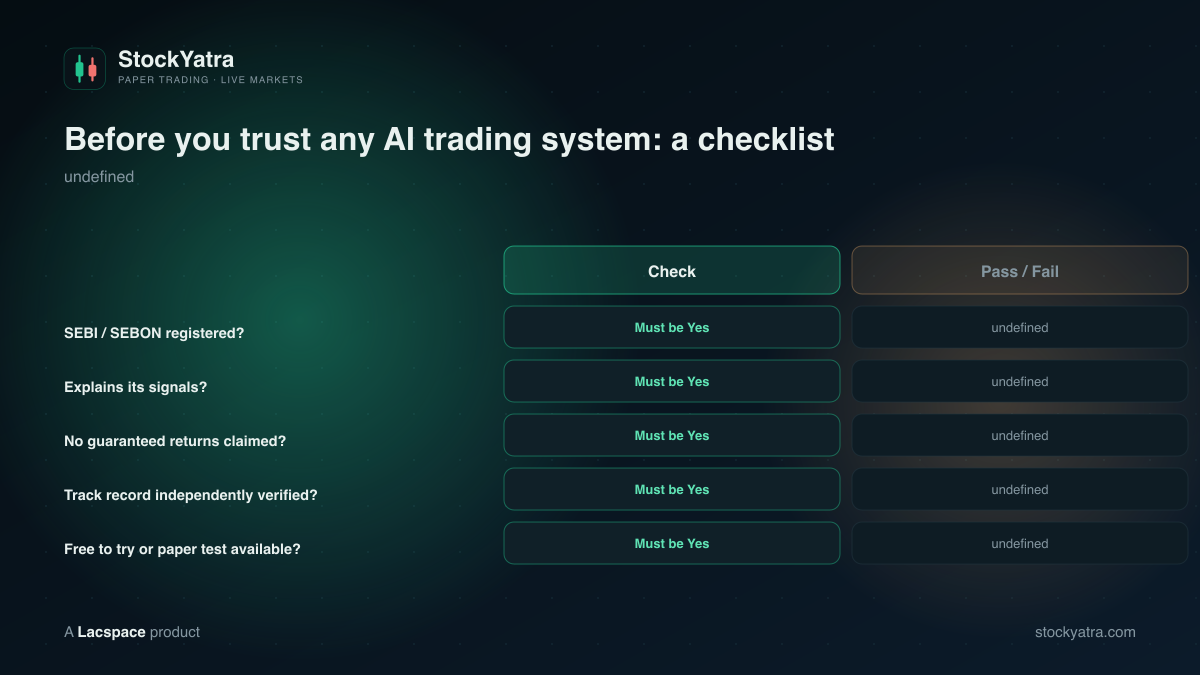
- Is the service SEBI-registered (India) or SEBON-registered (Nepal)? If not, it is operating outside the regulatory framework.
- Does it explain its signals? Can you see the reasoning behind each buy or sell? If not, you cannot evaluate it.
- Does it claim guaranteed returns? If yes, it is either misleading you or operating illegally.
- Is the track record independently verified — not just a spreadsheet the vendor produced? Third-party audited performance is meaningful; vendor-produced screenshots are not.
- Can you try it before paying? Legitimate tools offer a free tier, a trial period or a paper-trading simulation. If there is no way to evaluate it without committing real money, that is a red flag.
The short version: transparency is not a luxury. It is the minimum standard for any trading tool worth trusting. Understand what it is doing and why, or do not use it.
Keep reading: How StockYatra works · StockYatra Pro explained · The StockYatra blog
StockYatra is an educational paper-trading simulator. Coins are virtual, have no monetary value and cannot be withdrawn or exchanged for money. StockYatra does not facilitate the buying or selling of real securities and does not constitute investment, financial or trading advice. Market data is for learning purposes only.
Frequently asked questions
What is black box AI trading?
Black box AI trading refers to algorithmic trading systems powered by machine learning models where the internal decision-making process is hidden or cannot be explained. The system takes in market data and outputs buy or sell signals, but the reasoning behind each signal is opaque — even to the people running it. The term "black box" contrasts with "white box" or explainable AI, where every decision can be traced back to specific rules or factors.
Is black box AI trading legal in India?
Algorithmic trading is legal in India but strictly regulated by SEBI. Any algorithm used in live trading must be approved by a SEBI-registered stock exchange before it can place orders. Each strategy must carry a unique identifier and produce a complete audit trail. Brokers are liable for their clients' algorithmic orders. Selling trading signals or "tips" based on an algorithm without SEBI registration is illegal. Promises of guaranteed returns from any AI system are prohibited under SEBI rules.
Is black box AI trading legal in Nepal?
Nepal's NEPSE market is regulated by SEBON (Securities Board of Nepal). Algorithmic trading on NEPSE is not yet formally permitted under existing regulations, though the regulatory environment is evolving. Any claim that an AI system is trading legally on your behalf on NEPSE should be treated with extreme scepticism. If in doubt, contact SEBON directly.
What are the risks of black box AI trading?
The core risk is opacity: you cannot see why the system made a decision, so you cannot evaluate whether it is sound. Additional risks include overfitting (the model learned patterns from past data that do not repeat), regime change (the strategy worked in certain market conditions that no longer exist), flash crashes (multiple black box systems reacting simultaneously to the same signal), and outright fraud (bad actors who sell fake AI signals with fabricated track records).
What does SEBI say about AI trading systems?
SEBI requires all algorithmic trading strategies to be approved by a recognised stock exchange before live use. Every order must carry a unique identifier linking it to the approved strategy. Brokers are responsible for the algorithmic orders placed by their clients. Firms offering AI-based trading services must be registered with SEBI as research analysts or investment advisers. Guaranteed return claims are explicitly prohibited.
How can I spot a black box AI trading scam?
Red flags include: promises of guaranteed returns or a specific profit percentage; pressure to invest money quickly; celebrity endorsements (especially deepfake video ads using the face of a known investor); no SEBI or SEBON registration number; fees to access "signals" without a free trial; and refusal to explain how the system works. Legitimate tools have audit trails, regulatory registration, transparent methodologies and no promises of fixed returns.
What is the difference between black box AI and Lumi AI?
Lumi AI, built into StockYatra, is the opposite of a black box. When you ask Lumi to read a chart or explain a signal, it gives you its reasoning — not just a verdict. It tells you what pattern it sees, what the indicator values are and why it is suggesting what it suggests. The goal is for you to understand the thinking and make your own decision, not to blindly follow a signal. Black box systems do the opposite: they output a decision with no explanation.
Can I practise algorithmic trading ideas on StockYatra?
Yes. StockYatra Pro includes 113 built-in Pro Chart strategies that you can backtest against real historical NEPSE, NSE and US price data. You can also write your own rules using Pine Script-style logic and run them on the same historical data. This lets you test whether an idea would have worked before committing to it in live markets — which is exactly the discipline that separates successful from unsuccessful traders.