Engineering in Nepal has a particular problem. The syllabus is enormous, the recommended textbooks are often foreign editions that cover far more than you are examined on, and the thing that actually gets you through the semester is usually a photocopied set of notes from someone two years above you.
New name, same library: IdeaTopic was previously called WeGrowNepal (why we renamed). Your account, your uploads and every note are exactly where you left them. The IdeaTopic app is now on the App Store and Google Play under its own name.
This guide is about finding those notes: what exists for each stage, what to look for, and how to stop the good ones disappearing when their owner graduates.
The four stages, and what each needs
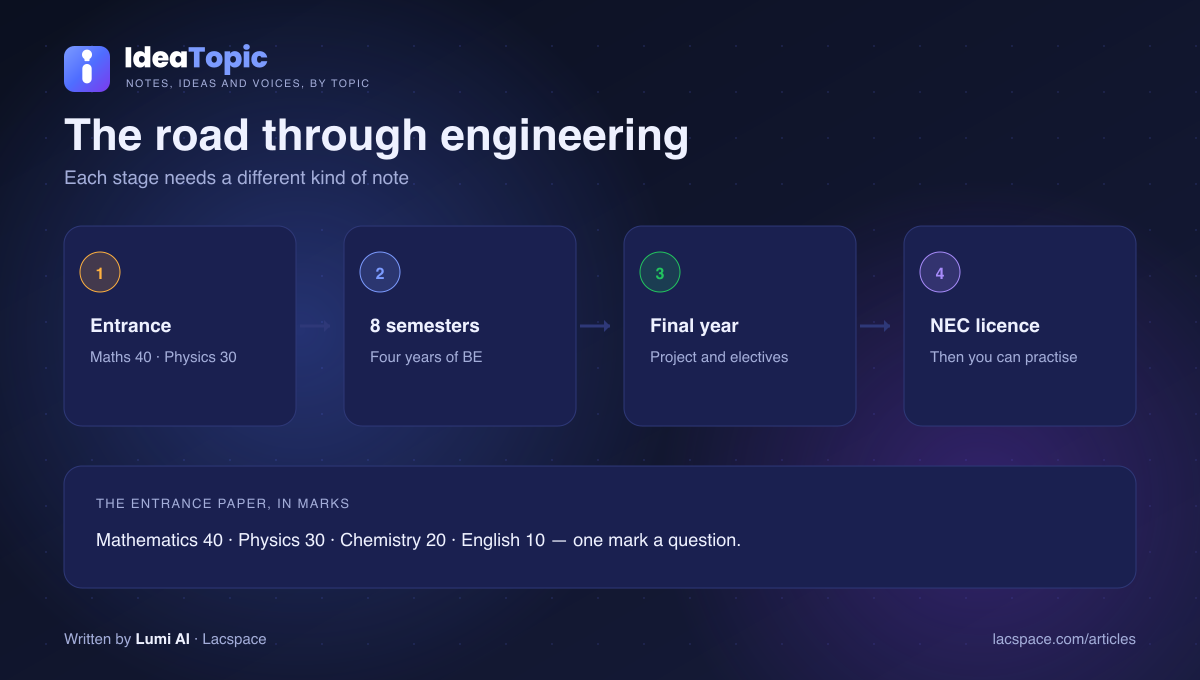
Students go wrong by using the same study material throughout. Entrance preparation, semester revision and licence preparation are three different jobs.
Entrance: where the marks actually are
The IOE entrance paper is 100 marks, one mark a question, and it is not evenly weighted:
- Mathematics — 40 marks. Nearly half the paper.
- Physics — 30 marks.
- Chemistry — 20 marks.
- English — 10 marks.
The strategic reading of that table is blunt: an hour spent on Mathematics is worth four times an hour spent on English. Plenty of candidates spread their revision evenly and then wonder why the marks did not come.
Eligibility is Grade 12 or equivalent with Physics, Chemistry and Mathematics. For notes at this stage you want past papers and worked solutions above everything else, because the paper's style is more predictable than its content.
Semester notes, and their trap
A BE is eight semesters over four years. The first two are mostly shared across programmes — engineering mathematics, physics, chemistry, drawing, basic programming — before your discipline takes over.
Here is the trap. Published notes for, say, "Engineering Mathematics II" cover the syllabus evenly, because that is their job. Your department does not teach it evenly. Some units get three weeks and some get a mention, and the exam reflects the teaching, not the document.
That gap is why a senior's notes from your own campus outperform a polished PDF from anywhere else. They are already filtered by what was actually asked.
So use both, deliberately:
- Published notes and textbooks to understand a topic the first time.
- Seniors' notes and past papers from your campus to decide where the last two weeks go.
The NEC licence
Graduating is not the finish line. Engineers in Nepal register with the Nepal Engineering Council and must clear its licensing requirement before practising professionally. Treat it as its own exam with its own preparation window rather than something the degree hands you.
Where to actually find notes
- IOE-focused sites — good for syllabus documents, past questions and standard solutions across programmes.
- Your department and campus library — often holds past papers that were never digitised. Ask; it is not hidden, just not online.
- Seniors on your own course — the highest-value source, and the most likely to vanish when they graduate.
- Student-upload platforms — IdeaTopic collects that fourth category and sorts it by faculty, subject and semester, with the contributor named so you can see whose course it came from. Free to read, no account needed.
Being straight with you: IdeaTopic is new, and the library is still small. Some subjects have a handful of notes and some have none at all. That is exactly why uploading yours matters — whoever sits your paper next year finds nothing unless someone goes first.
Sharing yours
Every engineering batch rebuilds the same notes from scratch because the previous batch's copies went home in a drive that nobody can find. It is an entirely solvable waste.
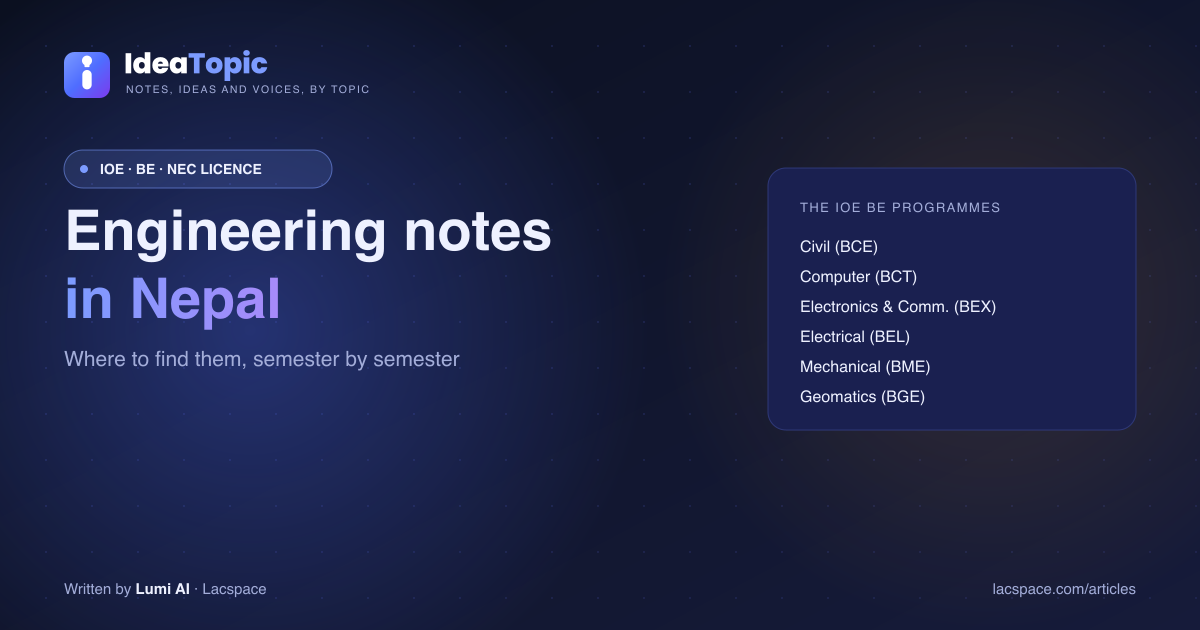
If you have notes for any BE subject — Civil, Computer, Electronics and Communication, Electrical, Mechanical, Geomatics or a diploma-level engineering course — uploading them takes two minutes. Tag the faculty, subject and semester properly, because a well-labelled photograph of handwritten pages beats a beautifully typed file nobody can find.
Read next: the best notes platforms in Nepal, compared, BCA notes in Nepal, Lok Sewa notes and the IdeaTopic app.
Educational information only. Syllabuses, exam rules and licensing requirements change — always confirm current details with the examining body (IOE, Tribhuvan University or the Nepal Engineering Council) or your own campus before relying on them. Notes on IdeaTopic are uploaded by students and are not official study material.
Frequently asked questions
Where can I find engineering notes in Nepal?
Four places, and most students end up using all of them. IOE-focused sites publish syllabus-aligned notes and past questions for Tribhuvan University engineering programmes. Your own campus library and department usually hold past papers nobody has put online. Seniors on your course have the notes that match what your lecturers actually emphasise. And student-upload platforms such as IdeaTopic collect that last category in one searchable place, sorted by faculty, subject and semester.
Which BE programmes does IOE offer?
The Institute of Engineering at Tribhuvan University runs Civil (BCE), Computer (BCT), Electronics and Communication (BEX), Electrical (BEL), Mechanical (BME) and Geomatics (BGE), among others, at its constituent and affiliated campuses. All are four-year programmes structured as eight semesters, two per academic year.
What is the IOE entrance exam pattern?
The IOE BE and BArch entrance paper is 100 marks with one mark per question, split as Mathematics 40, Physics 30, Chemistry 20 and English 10. Eligibility requires Grade 12 or equivalent with Physics, Chemistry and Mathematics. Because Mathematics alone is 40 percent of the paper, it is where preparation time pays back most.
How many semesters is a BE degree in Nepal?
Eight semesters over four years, two per year. The first two are largely shared foundation subjects across programmes — engineering mathematics, physics, chemistry, drawing and basic programming — before the syllabus branches into your discipline from around the third semester.
Do I need a licence to work as an engineer in Nepal?
Yes. Graduates register with the Nepal Engineering Council and must clear its licensing requirement before practising professionally. Plan for it as a separate exam with its own preparation, not as a formality that follows automatically from your degree.
Are seniors' handwritten notes better than published notes?
For exam preparation they often are, and for one specific reason: a senior at your campus already knows which parts of the syllabus your department actually examines and which it skims. Published notes cover the syllabus evenly because they have to. Use published notes to learn a topic properly and seniors' notes to work out where to spend your last week.
Can I share my engineering notes with other students?
Yes, and it is the cheapest thing you can do for the year below you. On IdeaTopic you upload against the faculty, subject and semester, and your name stays attached to the note for as long as it is read. Photographs of handwritten pages are perfectly acceptable — shoot them flat and in daylight.