
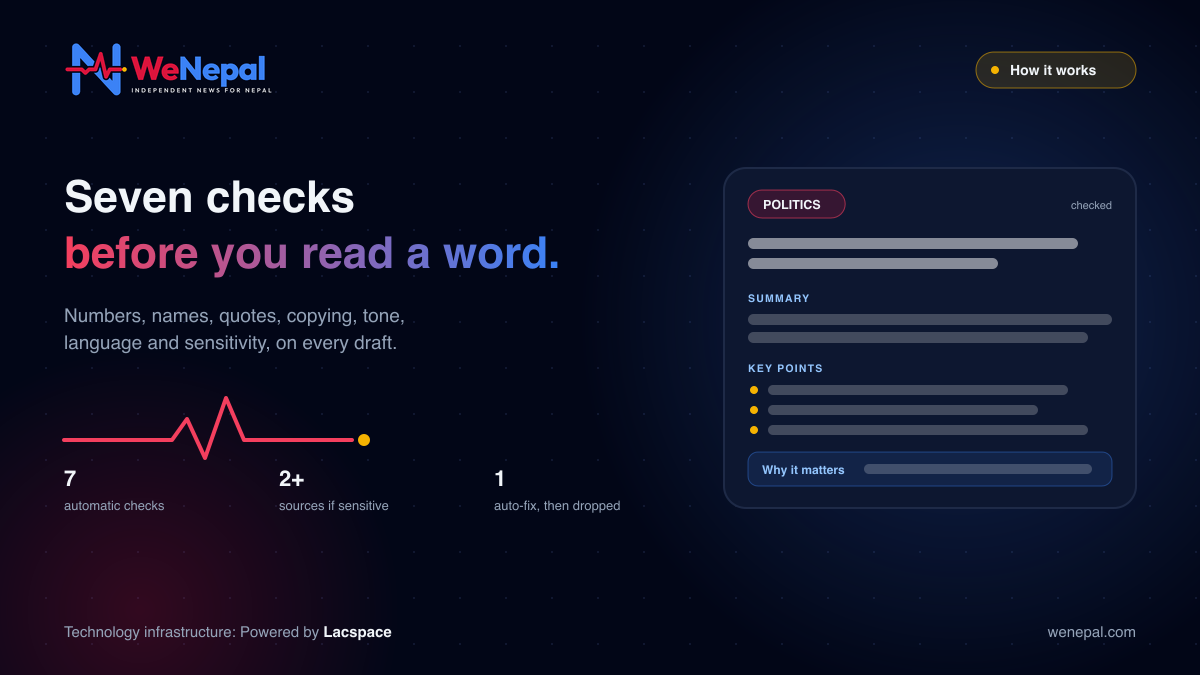
The honest question about AI in a newsroom is not “do you use it?” but “what stops it going wrong?” WeNepal, the independent bilingual news platform for Nepal, answers that question in public. Its newsroom rules, its AI policy and even the behaviour of its crawler are published pages. This article walks through them.
Where a story starts
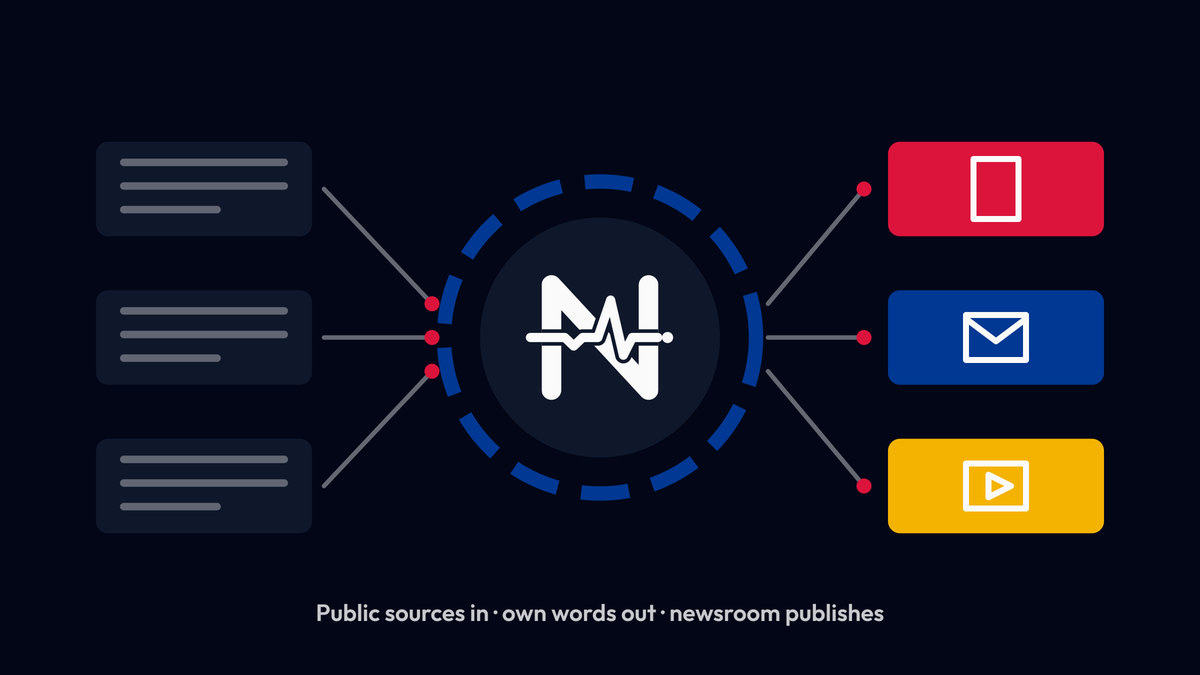
Every WeNepal story is built from what it calls public sources and the WeNepal research team:
- Official primary sources: government and ministry notices, the Nepal Gazette, court orders, Nepal Rastra Bank figures and other official releases.
- Public reporting in Nepal and abroad, used to find and cross-check events, never to copy.
- Its own checks against those sources.
Each source has a trust score that goes down when it is repeatedly wrong and up when it holds. A social media post counts only when the account is verified as the person or institution it claims to be.
A story begins in one of two ways: a staff member builds it, or the tools prepare a draft when two or more independent reports, or one official primary source, cover the same event. Either way the format is the same: a short summary, three key points and a line on why it matters.
The seven checks
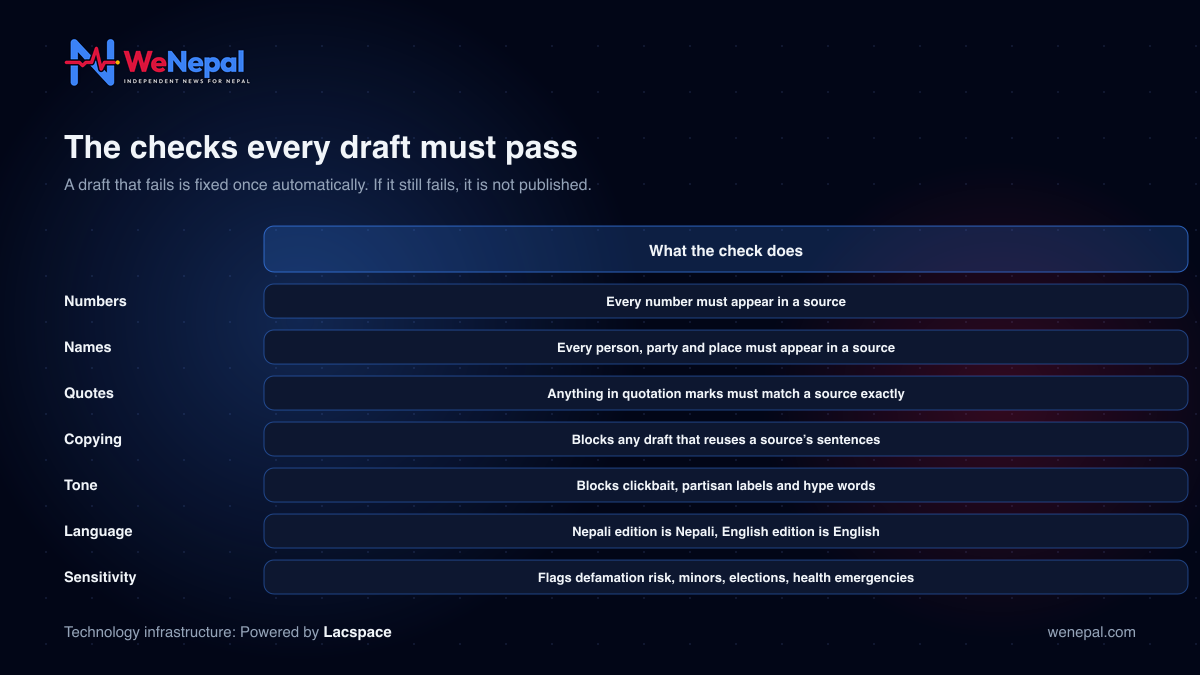
| Check | What it does |
|---|---|
| Numbers | Every number must appear in a source |
| Names | Every person, party and place must appear in a source or in a list of known names |
| Quotes | Anything in quotation marks must match a source exactly |
| Copying | Blocks any draft that reuses a source’s sentences |
| Tone | Blocks clickbait, partisan labels and hype words |
| Language | Confirms the Nepali edition is Nepali and the English edition is English |
| Sensitivity | Flags defamation risk, unverified claims, graphic content, hate, election sensitivity, minors and health emergencies |
Stricter rules for sensitive subjects
Elections, court cases, deaths and violence, communal issues, named individuals facing allegations, health emergencies and anything involving minors carry more risk of harm. WeNepal publishes those stories only when they also pass:
- At least two independent sources, or an official primary source such as a gazette notice, a court order or an official press release.
- Neutral attribution (“police said…”).
- No accusation stated as fact.
- No graphic detail, and nothing that could prejudice a case still before the courts.
- Minors are never named.
What the tools are never allowed to do
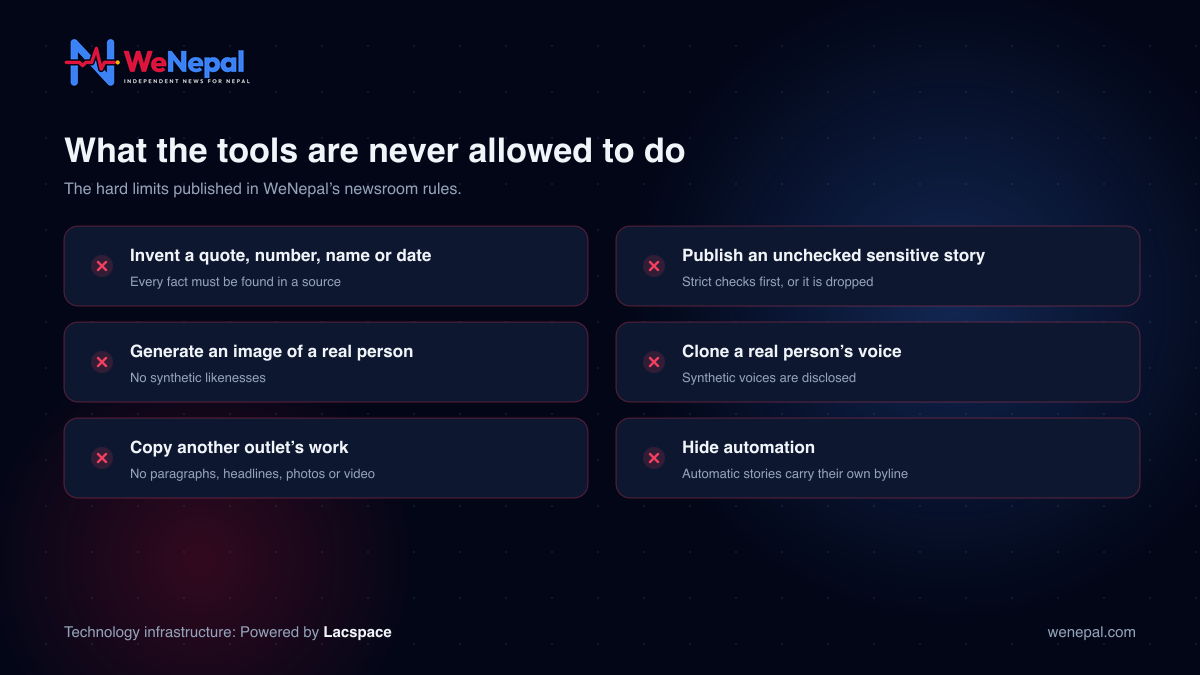
Some videos use a synthetic voice. WeNepal says that where it publishes them on YouTube, Facebook, Instagram or TikTok, it turns on the platform’s own setting for altered or synthetic content.
People stay in charge
Staff build, edit and approve stories. Routine stories that pass every check can publish automatically, editors check a sample of those every day, and any editor can edit, correct or unpublish any story at any time. Any editor or engineer can pause the whole newsroom at once.
Two bylines, so you can always tell
| Byline | What it means |
|---|---|
| Dev Sagar | Built, edited or approved by newsroom staff. Dev Sagar is the newsroom editor and answers for staff stories |
| LacNova AI | Prepared and published automatically by LacNova AI, WeNepal’s own newsroom AI, after passing every check |
Under each story you also see the line “From public sources and the WeNepal research team”. Sources are kept on record for review and corrections.
A crawler with manners
The software that reads sources has its own public page. WeNepalBot identifies itself by name, respects robots.txt and re-reads it every 24 hours, prefers RSS or Atom feeds, keeps one connection per site with at least five seconds between requests, and pauses a source automatically after ten failures in a row. It does not train AI models on what it reads, and any site can opt out with a robots.txt rule or one email. The full rules are at wenepal.com/bot.
Corrections in public
When a story is wrong, WeNepal corrects it on the story with a dated note that says what changed. Major corrections are also posted where the story appeared and listed on a public corrections page. A story that should not have been published is retracted, not quietly deleted. Sources that are wrong repeatedly are dropped.
Where Lacspace stands
Lacspace is WeNepal’s technology provider. It supplies the technology infrastructure and hosting that the site and the app run on, and it has no say over what WeNepal covers or publishes. The rules above are WeNepal’s, written and enforced by its newsroom. We think they are a good template for anyone using AI near the news: say what the software does, limit it in writing, label its work, and fix mistakes where readers can see.
Read the originals: How the WeNepal newsroom works and How we use AI.
Keep reading: WeNepal: independent news for Nepal · Tracking government promises in Nepal · Nepal news in two minutes: the Pulse · The WeNepal app: Nepal in one app
WeNepal is an independent news platform. Lacspace is its technology provider: it supplies the technology infrastructure and hosting, and has no say over what WeNepal covers or publishes. This article describes WeNepal as published on wenepal.com on 5 October 2026; features and details can change. WeNepal does not represent the Government of Nepal or any public body.
Frequently asked questions
Does WeNepal use AI to write news?
Yes, and it says so. Automated tools help staff find, sort and draft stories, and some routine stories are prepared and published automatically after passing every check. Those stories carry the byline “LacNova AI”, the name of WeNepal’s own newsroom AI.
What checks does a WeNepal story pass?
Seven automatic checks: numbers, names, quotes, copying, tone, language and sensitivity. A draft that fails is fixed once automatically; if it still fails, it is not published.
What are the rules for sensitive stories?
Stories on elections, courts, deaths and violence, communal issues, named individuals, health emergencies and minors need at least two independent sources or an official primary source, neutral attribution, no accusation stated as fact, no graphic or sub judice detail, and minors are never named.
What does the byline mean?
“Dev Sagar”, the newsroom editor, means the story was built, edited or approved by staff. “LacNova AI” means it was prepared and published automatically after passing every check.
Does Lacspace decide what WeNepal publishes?
No. Lacspace provides technology infrastructure and hosting. It does not choose, edit or approve stories.