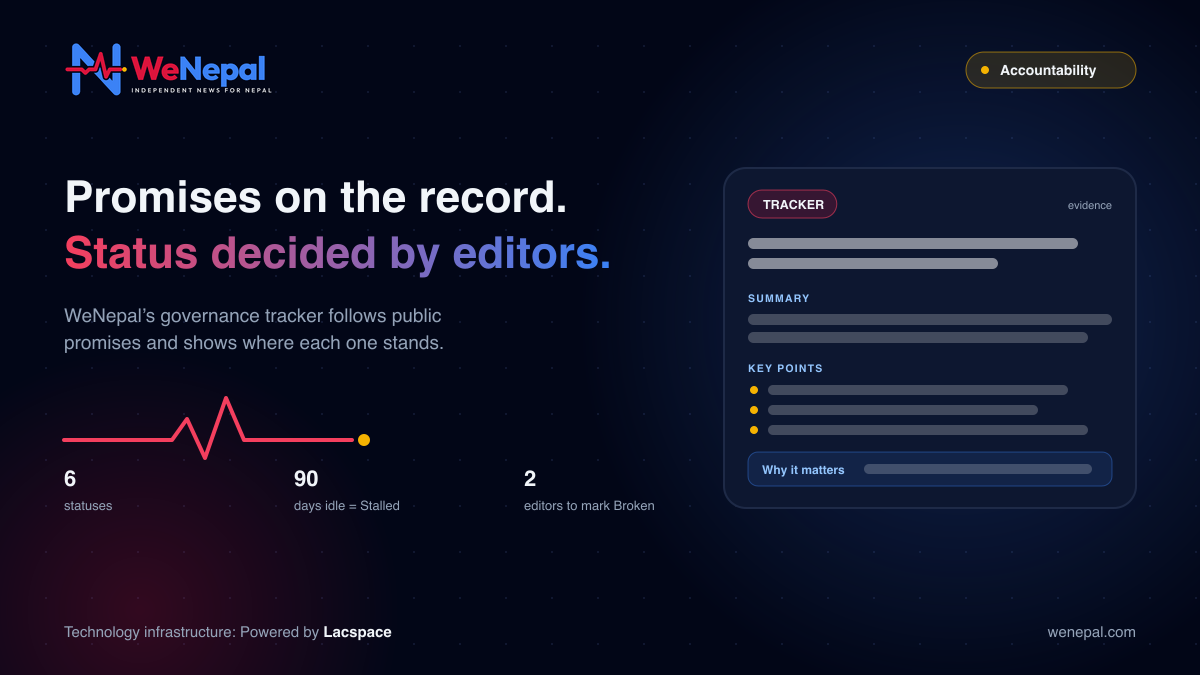
A promise made in a speech is easy to make and easy to forget. Budgets are announced, deadlines pass, and unless someone writes it down, nobody can say with certainty what was promised and what happened. WeNepal’s governance tracker is that written record: a public list of specific promises made by Nepal’s governments, each with a status, a history and its sources.
What gets tracked
The tracker records promises made in public by the federal government, ministries, provinces and local bodies. A promise is tracked when it is:
- Specific and checkable: a concrete commitment made on the record, in a speech, a policy programme, the budget, a cabinet decision, a manifesto adopted by the government, or an official statement.
- Clear about who and what: it names who is responsible and what will change. Where a deadline was given, it is recorded; where none was given, the tracker says so.
Vague aims such as “improve governance” are not tracked. Promises made in a government’s first 100 days carry a 100-days flag, so that early period can be followed on its own.
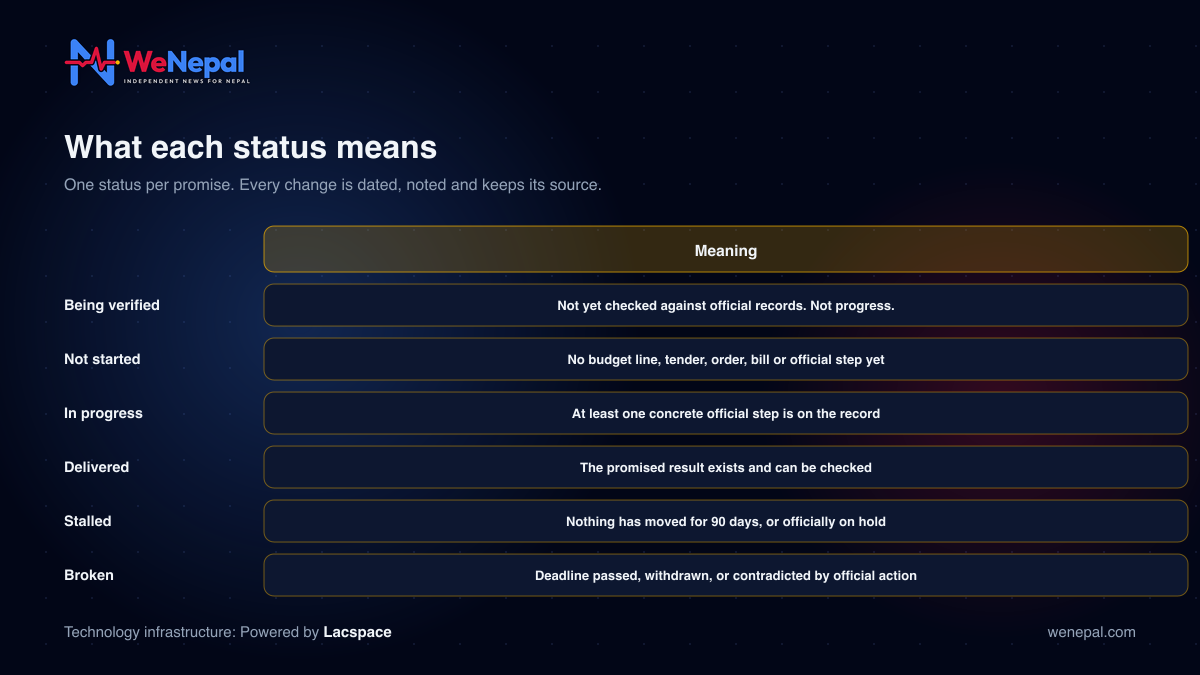
The six statuses
| Status | What it means |
|---|---|
| Being verified | The team has not yet checked this promise against official records. This is not progress |
| Not started | No public evidence of work yet: no budget line, tender, order, bill or official step |
| In progress | At least one concrete official step is on the record, such as money allocated, a tender issued or a bill tabled |
| Delivered | The promised result exists and can be checked, in the form it was promised |
| Stalled | Work began but nothing has moved for 90 days, or an official source says it is on hold |
| Broken | The deadline passed without delivery, the promise was formally withdrawn, or official action contradicts it |
Software helps. A person decides.
- Evidence is gathered. Each morning the newsroom system matches new stories to tracked promises and attaches them as possible evidence. It may draft a note, but it never changes a status.
- An editor decides. A status changes only with at least one primary source, such as a gazette notice, a budget document, a court order or an official release, or with two independent reports.
- Broken needs a second editor. A second, senior editor must approve it.
- History is kept. Every change is dated, carries a note and keeps its source. Earlier statuses stay visible. The past is never overwritten.
This is the same philosophy as the rest of the newsroom: automation does the legwork, rules limit it, and a person is accountable (How the WeNepal newsroom checks every story).
Fair to every government
WeNepal states that governments of every party are tracked in the same way, with the same definitions and evidence rules. The tracker does not score parties, predict outcomes or give opinions. The totals shown are real counts from its database; if data is not available, it shows nothing rather than an estimate. That is also why this article quotes no totals: they change every day, and the live page is the place to read them.
Radar: institutions in the news
Alongside the tracker sits Radar: a list of leaders and institutions, from the Federal Parliament and the Supreme Court to Nepal Rastra Bank, the provincial governments and the constitutional bodies, with how often each appears in WeNepal’s own coverage over the last eight weeks. The bars are real mentions and are hidden where there is not enough data.
How to use it
| If you are… | Try this |
|---|---|
| A voter | Open a promise you care about and read its history, not just its status |
| A student or researcher | Use the sources attached to each promise as a starting point |
| A journalist | Check the 100-days flag to see what was promised early |
| Disagreeing with a status | Send your reason and source; the outcome is recorded on the promise |
The tracker is at wenepal.com/tracker and in the Tracker tab of the app (The WeNepal app: Nepal in one app), where you can turn on alerts for updates. The full definitions are on the methodology page.
A note from the technology side
Lacspace provides the infrastructure the tracker runs on. We do not set statuses, add promises or see them before readers do. A tool like this only works if the people who build the servers have no hand on the scale, so we do not.
Keep reading: How the WeNepal newsroom checks every story · WeNepal: independent news for Nepal · The WeNepal app: Nepal in one app · Nepal news in two minutes: the Pulse
WeNepal is an independent news platform. Lacspace is its technology provider: it supplies the technology infrastructure and hosting, and has no say over what WeNepal covers or publishes. This article describes WeNepal as published on wenepal.com on 5 October 2026; features and details can change. WeNepal does not represent the Government of Nepal or any public body.
Frequently asked questions
What does the WeNepal governance tracker do?
It keeps a public record of specific promises made by Nepal’s federal government, ministries, provinces and local bodies, and shows where each one stands, with the evidence and sources behind every status.
Who decides a promise’s status?
A WeNepal editor, never software. A status changes only with a primary source or two independent reports, and marking a promise Broken needs a second, senior editor to approve it.
What does “Being verified” mean?
It means the team has not yet checked that promise against official records. It is not a judgement on progress and is never counted as started, in progress or delivered.
Is the tracker biased against one party?
WeNepal says every government is tracked with the same definitions and evidence rules, and that the tracker reports facts about whoever is in government. It does not score parties or give opinions.
How do I challenge a status?
Send your reason and the source through WeNepal’s contact page or to corrections@wenepal.com. The desk editor reviews every request and records the outcome on the promise.