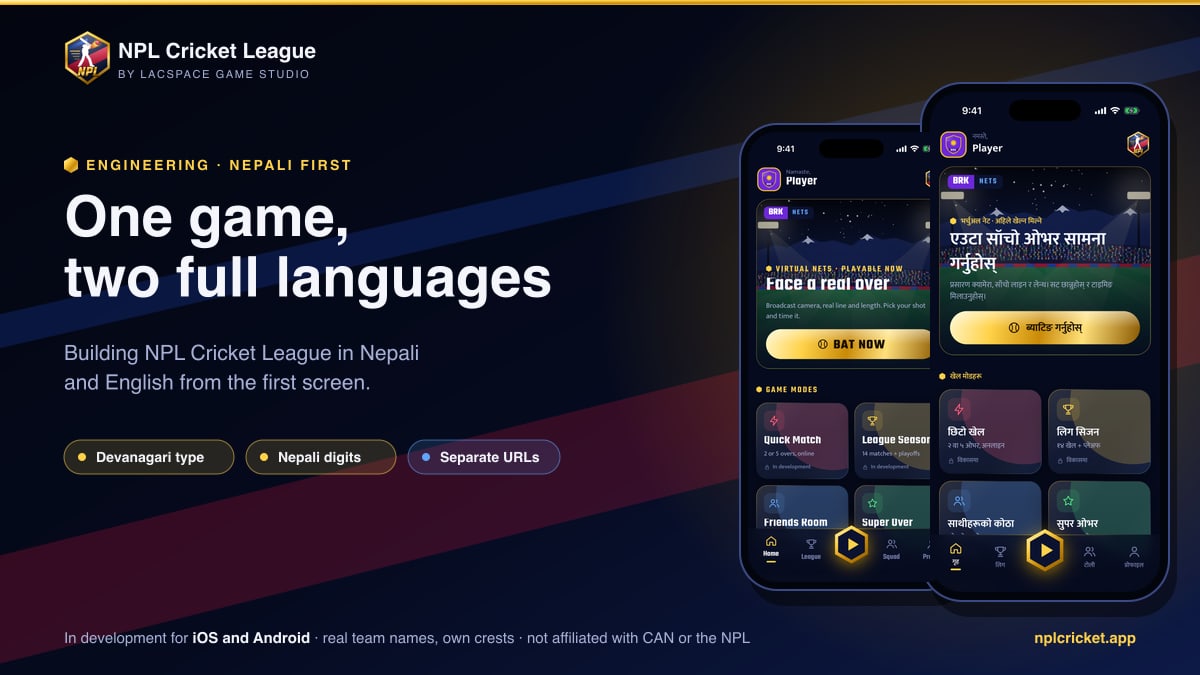
The quickest way to make an app "available in Nepali" is to translate the strings at the end. It is also the quickest way to make it feel foreign. For NPL Cricket League, we decided from the start that Nepali would be a complete language, with its own pages, its own type and its own numbers. Here is what that took, in the order we ran into it.
1. Two languages, two sets of addresses
On the website, English lives at nplcricket.app and Nepali at nplcricket.app/ne. Every page exists in both. Each page tells search engines about its twin, so a Nepali search finds the Nepali page. The sitemap lists every page in both languages. In the app, the language is the very first choice you make, before anything else is shown.
2. A display font without Devanagari
Our headline typeface, Teko, gives the game its sporty, condensed look, but it has no Devanagari letters. So display text switches face by language: Teko for English, and Mukta in a bold weight for Nepali. Mukta was designed for both scripts and sits well next to Teko. Nepali text also needs more line height than English, because vowel signs sit above and below the letters.
3. Never uppercase, never stretched
English labels in the game are uppercase with wide letter-spacing, a common sports style. Applied to Nepali, the same style breaks words apart. Devanagari letters join into conjuncts, and extra spacing pulls the half-letters away from the letters they belong to. So every label style has a Nepali rule: no case change and no added spacing.
4. Nepali digits
Scores, overs and ratings appear in Nepali digits (०१२३४५६७८९) in Nepali, and in Western digits in English. A small helper converts numbers wherever they are shown, so a score of 142 for 3 reads १४२/३.
5. The share-card bug
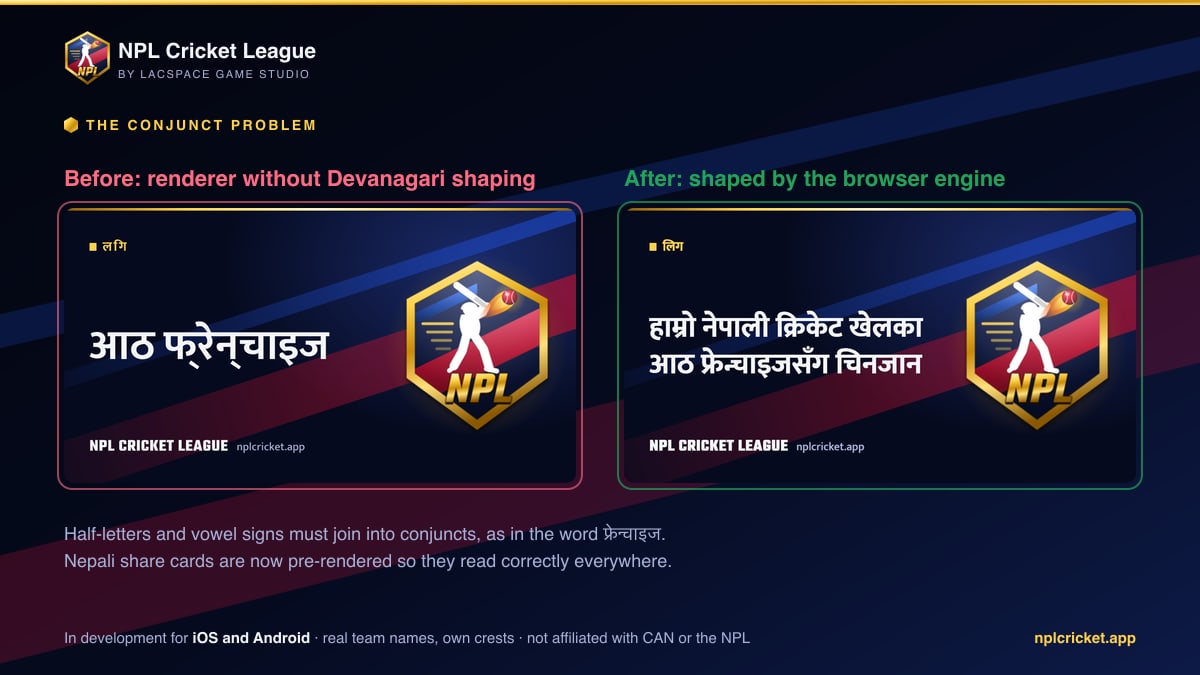
Every page has a social share card, an image that appears when a link is posted. The renderer we used draws text letter by letter and cannot do Devanagari shaping, the step that joins letters into conjuncts. English cards were perfect. Nepali cards came out with visible half-letter marks and vowel signs in the wrong place, which a Nepali reader notices at once.
The fix was to render the Nepali cards in a real browser engine, which shapes Devanagari correctly, and save them as images when the site is built. English cards are still drawn on demand. Nepali pages now point to their pre-rendered cards. When we add a Nepali page or article, we run one script and the new card is made.
6. One source of truth
Team names, cities, game venues and mottos exist once, with both languages side by side, and the website and the app read the same data. When a team’s name is set, it is right everywhere at once.
Nepali first is one of the promises behind the game. Read the announcement for the rest.
Keep reading: NPL Cricket League is coming · From one cricket game to a whole league · How we designed the Arena Hex · What NPL Cricket League will offer
NPL Cricket League is a game by Lacspace Game Studio, in development for iOS and Android as of 3 November 2026. Team names identify Nepal’s T20 franchises; the crests, kits and players shown are our own, and all players are fictional. It is not affiliated with, endorsed by or licensed by the Cricket Association of Nepal, the Nepal Premier League or its franchises. Features described here are plans and may change before launch.
Frequently asked questions
Which fonts support Nepali for a sports-style design?
NPL Cricket League uses Teko for English display text, which has no Devanagari, and switches to Mukta, which covers both Latin and Devanagari, for Nepali. Both are open-licence fonts.
Why should Nepali text not be uppercase or letter-spaced?
Devanagari has no case, and extra letter-spacing pulls half-letters away from the letters they join, breaking conjuncts. Nepali labels should keep normal spacing.
Why did Nepali share images look broken?
The image renderer used for social cards cannot shape Devanagari, so conjuncts and vowel signs were drawn incorrectly. The fix was to pre-render Nepali cards in a browser engine that shapes text correctly.
How should a bilingual Nepali and English website be structured?
Give each language its own URL (for example / and /ne), link each page to its other-language version with hreflang, and list both versions in the sitemap.