

In short
- 13 of Nepal's 90 stock brokers have a client app of their own; 77 have none that we could find.
- 12 are on Android, 4 on iPhone, and only 3 are on both.
- 11 of the 13 apps are client portals for ledgers and statements. One describes order placement, and it is the only one above 100K installs.
- 10 of the 12 Android apps come from one vendor's account and were last updated in late 2025.
Every licensed stock broker in Nepal gives clients a login to the shared trading system. Far fewer give them anything of their own. To put a number on that, we checked all 90 brokers on one day, 25 November 2026, and recorded three public facts for each: does the broker's website load, is there an Android app published for that broker, and is there an iPhone app.
This report gives the totals. It does not rank or name individual brokers. The aim is to describe the market, not to score anyone.
The headline numbers
Of 90 brokers, 13 have a client app of their own on at least one app store. The other 77 have none that we could find.
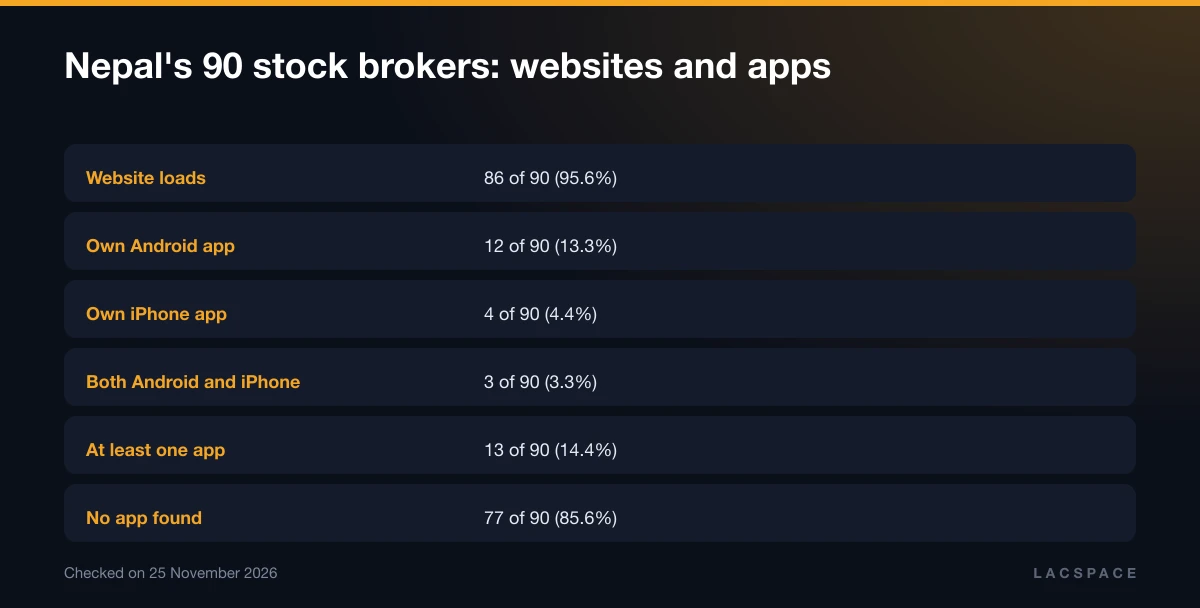
| Measure | Brokers | Share of 90 |
|---|---|---|
| Website loads | 86 | 95.6% |
| Own Android app | 12 | 13.3% |
| Own iPhone app | 4 | 4.4% |
| Both Android and iPhone | 3 | 3.3% |
| At least one app | 13 | 14.4% |
| No app found | 77 | 85.6% |
Almost every broker has a working website. Three sites did not load on the day and one could not be verified. The gap is in apps: about one broker in seven has one, and about one in thirty has one on both phone platforms.
What the apps do
We read each store description and sorted the 13 apps by what they say they do.
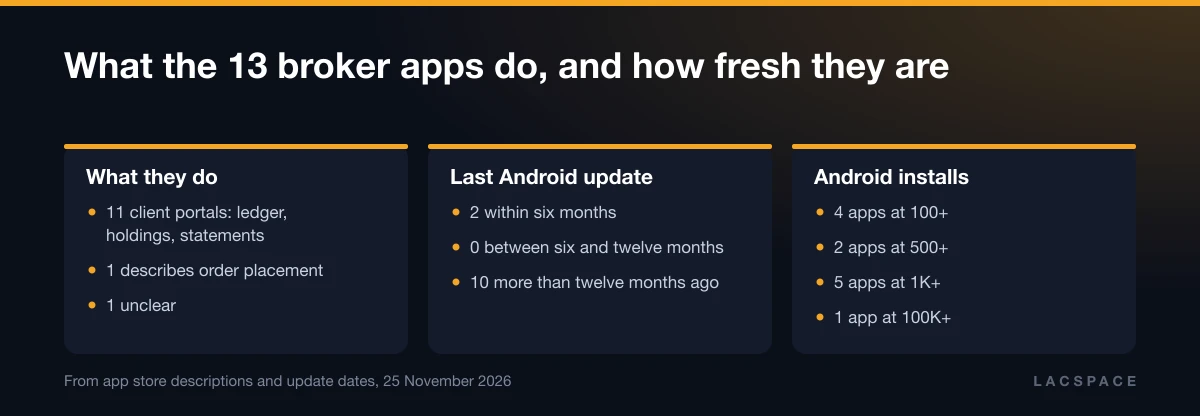
- 11 are client portals. They show the client's ledger, holdings, bills and statements. The client still places orders in the shared trading system.
- 1 describes order placement. It is the only app in the set that says clients can trade from it.
- 1 is unclear from its description.
So for most brokers that have an app, the app is a window on the back office. That is useful: a client who can see a ledger and a statement on a phone makes fewer calls to the branch. It is also a narrow start. Account opening, payments, alerts, support and research are mostly absent from the descriptions. Our guide to the broker back office explains the records these apps display.
How fresh the apps are
An app store shows the date each app was last updated. For the 12 Android apps:
- 2 were updated within the last six months. Both were updated in November 2026.
- 10 were last updated more than twelve months ago. All ten carry dates between 28 October and 3 November 2025.
A year without an update does not mean an app is broken. It does mean that the rule changes of 2026 reached clients through other channels, and that newer phone software has not been tested against a fresh build. Our article on why broker apps slow down on heavy trading days covers what regular maintenance protects against.
How many people use them
Google Play shows installs in bands, not exact counts. The 12 Android apps fall into four bands.
| Installs band | Android apps |
|---|---|
| 100+ | 4 |
| 500+ | 2 |
| 1K+ | 5 |
| 100K+ | 1 |
Eleven of the twelve are below ten thousand installs. One app stands far apart at 100K+, and it is the same app that describes order placement. The pattern suggests clients install an app when it lets them do the main thing they came for.
Ratings tell less than they seem to. Only 6 of the 12 Android apps show a rating at all; the others have too few reviews for the store to display one. Among the six, the median is 4.08 out of 5, with a range from 2.88 to 4.97.
Who builds them
The developer name on a store listing shows whose account published the app. Here the market is concentrated.
- 10 of the 12 Android apps are published from a single vendor's account, one listing per broker. Several share the same description sentence word for word. These are the ten apps last updated in late 2025.
- 2 brokers publish under their own name on both stores.
- A second vendor appeared on the iPhone store in November 2026 with an app for one broker and no Android listing yet.
A shared vendor is a sensible way to get an app quickly, and it is the model most brokers have chosen. The trade-off shows in the dates: when one vendor's release cycle pauses, ten brokers' apps pause together. And when the listing sits in the vendor's account, the broker does not hold the app, its reviews or its install base. Our comparison of building, buying and licensing broker technology lists the questions to ask about ownership and updates before signing.
Two smaller observations. Four broker websites link to a shared trading app as "their" app; because it is not published for any one broker, we did not count it. And three vendor listings that still appear in web search results returned "not found" on the store on the day, so they are not counted either.
What this means for a broker
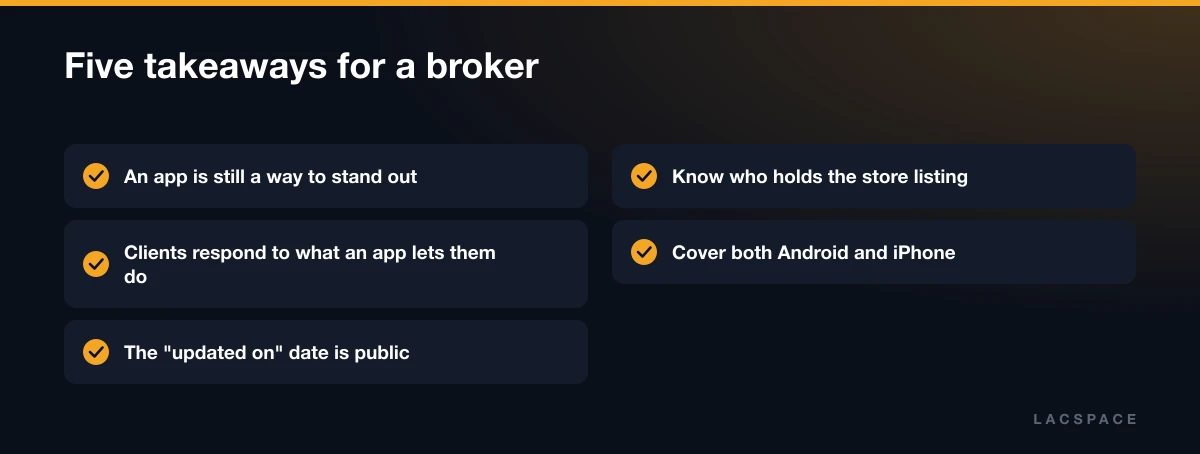
- An app is still a way to stand out. With 77 of 90 brokers having none, a working, current app is not yet the baseline. It will be.
- Clients respond to what an app lets them do. The one app with large adoption is the one that goes beyond showing a ledger.
- Freshness is visible. The "updated on" date is public. Clients, and anyone comparing brokers, can read it.
- Know who holds the listing. Ask whether the app is published under your account, who can update it, and what happens to it if the contract ends.
- Cover both platforms. Only three brokers are on Android and iPhone together.
For the terms used in this report, see the capital-market glossary.
How we counted
- The list. 90 brokers, from a public broker list checked against the securities regulator's list of stock brokers on the same day. Stock dealers were left out.
- Websites. Each address was opened with a real request on 25 November 2026.
- Apps. An app counts only if it is published for that one broker, with the broker's name in the app title or developer name. We looked for store links on the broker's website, then searched both stores. Facts were read from the store page itself.
- Not counted. The shared trading system login, shared trading apps, the depository's app, market-data apps, staff-only apps and listings that no longer load.
Limits of this report
"No app found" is the weakest kind of finding. We scanned each broker's homepage for store links, not every inner page, and an app published under an unrelated name could be missed. We re-checked a random ten of the 77 against both stores and found none, but the true number of brokers with an app could be slightly higher than 13.
The stores were read from outside Nepal with the Nepal storefront selected. Store descriptions say what an app claims to do; we did not install or test the apps. Everything here is a snapshot of one day, and listings change. If you run a brokerage and your app is missing from our count, tell us and we will correct the figures.
LSNEP is software for licensed capital-market firms, built by Lacspace. It is not a broker, exchange, depository or investment adviser, and nothing in this article is investment advice. Regulatory details are summarised from public sources and change by notice; confirm current requirements with NEPSE, SEBON and CDSC.
Frequently asked questions
How many stock brokers in Nepal have their own mobile app?
On 25 November 2026 we found 13 of 90 brokers with a client app published for that broker on at least one app store: 12 on Android and 4 on iPhone, with 3 on both.
Can I trade shares from a broker's own app in Nepal?
Mostly not yet. Of the 13 broker apps we found, 11 describe themselves as client portals for ledgers, holdings and statements, and only one describes placing orders. Clients of other brokers place orders in the shared trading system.
How many licensed stock brokers are there in Nepal?
Our count used 90 stock brokers, taken from a public broker list and checked against the securities regulator's list on 25 November 2026. Stock dealers were not included.
Does this report rank or name brokers?
No. It gives market totals only. It does not score, rank or name any individual broker.
Why does it matter when an app was last updated?
The date is public on the app store, and regular updates are how an app keeps up with rule changes and new phone software. Ten of the twelve Android broker apps were last updated between 28 October and 3 November 2025.
What did the count leave out?
The shared trading system login, shared trading apps that are not published for one broker, the depository's app, market-data apps, staff-only apps, and store listings that no longer load.