

In short
- The back office turns a matched trade into a posted ledger, a settled obligation and a payout, every trading day.
- CDSC runs settlement in a T+2 cycle: pay-in, tax and close-out calculation, then pay-out, all on the second day.
- Three reconciliations matter most: trades against the exchange, holdings against the depository, and money against the bank.
- SEBON's August 2026 directives put client-fund segregation, T+2 payout and complaint reporting on every broker's list.
A trade takes a second to match and two days to finish. Everything in between is the back office: posting the trade to the right client, working out fees and tax, making sure shares and money arrive, paying out, and proving all of it later to an auditor. Clients never see this work when it goes well. They see it at once when it does not.
This guide is for a broker's managing director or operations head. It explains what the back office does after a trade in Nepal, how the T+2 cycle runs, what has to be reconciled, and what to look for in back-office software. If any term is unfamiliar, our capital-market glossary defines it.
What the back office does after a trade
The trading system matches orders. The back office does the rest. On a normal day that means:
- Capture. Take the day's trades from the trading system and the floor sheet.
- Post. Put each trade on the right client's ledger, with commission, the SEBON fee and, on sales, the DP fee.
- Confirm. Issue a contract note to each client.
- Settle. Track what the firm must deliver and receive, in shares and in money, for each settlement.
- Pay out. Send sale proceeds to clients and record deposits from buyers.
- Reconcile. Check the firm's records against the exchange, the depository and the bank.
- Report. Produce the figures management, auditors and the regulator ask for.
The fee part is not small. Commission follows five slabs, from 0.36% down to 0.24% as the trade value rises (ShareSansar). One broker's published schedule adds a SEBON fee of 0.015% on equity trades and a DP charge of Rs 25 per scrip per transfer day, and shows the commission itself shared 79.4% to the broker, 20% to NEPSE and 0.6% to SEBON (Secured Securities). A back office has to apply all of that correctly on every line.
T+2 settlement, step by step
Nepal settles share trades on T+2: the second trading day after the trade date. SEBON approved the move from T+3 to T+2 in January 2021 (ShareSansar). CDSC, the clearing house and depository, describes the cycle in seven steps (CDSC settlement procedure):
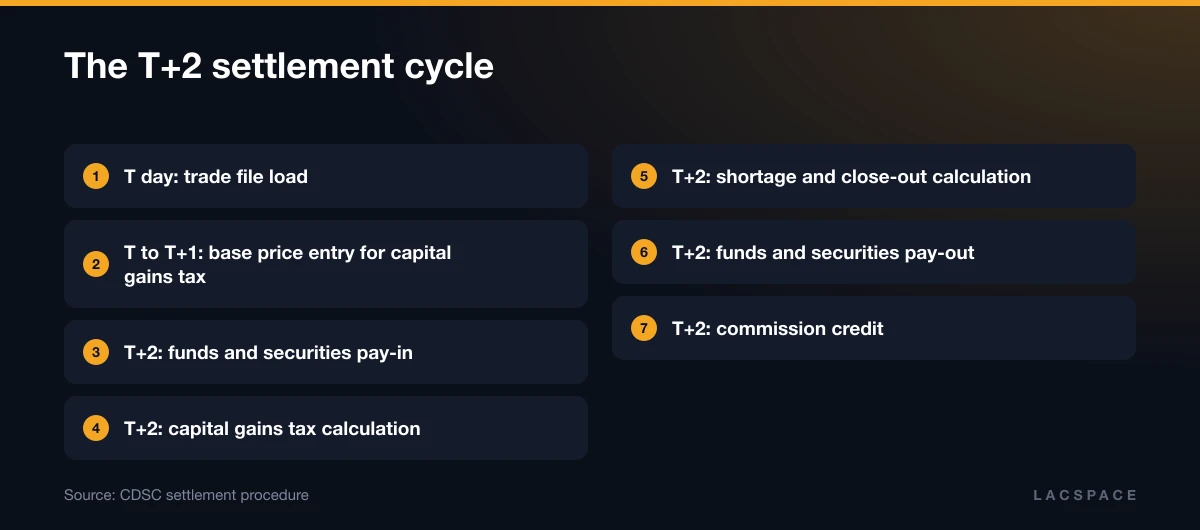
- T day: trade file load. The day's trades are loaded into the clearing system.
- T to T+1: base price entry for capital gains tax. The seller's cost is recorded so tax can be worked out.
- T+2: funds and securities pay-in. Buying brokers deliver money. Selling clients' shares are delivered.
- T+2: capital gains tax calculation.
- T+2: shortage and close-out calculation. Anything not delivered is identified.
- T+2: funds and securities pay-out. Sellers' brokers receive money. Buyers receive shares.
- T+2: commission credit.
Around those steps sits the client's own task. A seller must complete EDIS, the electronic delivery instruction, in MeroShare so the sold shares can move (ShareSansar). CDSC publishes the steps but not the cut-off times on that page, so confirm current timings with CDSC and your clearing bank.
| Day | In the market | In the broker's back office |
|---|---|---|
| T | Trade matched; trade file loaded at CDSC | Trades captured and posted to client ledgers; contract notes issued; sellers reminded to complete EDIS |
| T+1 | Base price entered for tax | Buyers' funds chased; sellers' EDIS status checked; exceptions listed |
| T+2 | Pay-in, tax and close-out calculation, pay-out, commission credit | Obligation paid or received; sale proceeds paid to clients; shortages and close-outs recorded |
Pay-in and pay-out
Pay-in is what goes into the clearing system: money from the buying side and shares from the selling side. Pay-out is what comes back: shares to buyers and money to sellers. The broker stands in the middle. It must have the buyer's money before pay-in, and it must pass the seller's money on after pay-out.
Two rules shape this. First, the regulations let a broker take an advance of up to 25% on a buy order, and not on a sell order (ShareSansar). The rest has to be collected in time for pay-in. Second, SEBON's directives of 26 August 2026 tell NEPSE and brokers to make sure investors receive their funds within the T+2 period (ShareSansar). A payout that leaves on the third or fourth day is now a compliance matter, not only a service one.
The client ledger
The client ledger is the running record of one client's money: every purchase, sale, deposit, payout and fee, and the balance after each. It answers the most common support question a broker receives, which is where the money is.
A good ledger has four properties. Each entry traces to a trade or a bank transaction. Balances are per client, never pooled. A mistake is corrected with a reversing entry, not by editing history. And the client can see the same ledger the staff see.
The second property is the serious one. In April 2026 SEBON suspended a broker's licence after finding that it had used one group of investors' money to settle other investors' trades and had allowed purchases without the required advance. It owed investors about Rs 5.11 billion as of March 2026 (ShareSansar). In August 2026 SEBON directed every broker to keep strictly separate bank accounts for client funds and its own funds (ShareSansar).
Reconciliation: NEPSE, CDSC and the bank
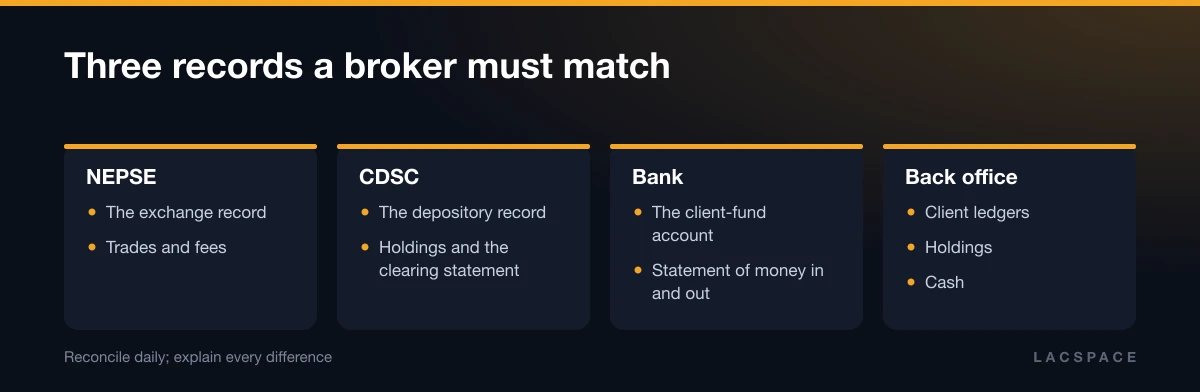
Reconciliation means comparing your own records with someone else's and explaining every difference. A broker has three outside records to match.
| What you reconcile | Against | What a difference usually means |
|---|---|---|
| Trades and trade values on client ledgers | The exchange's record of the day's trades | A trade posted to the wrong client, posted twice or not posted |
| Fees and commission charged | The exchange and regulator fee bills and the commission credit | A wrong slab or an out-of-date rate |
| Shares clients are shown as holding or owed | The depository record at CDSC | An EDIS not done, a transfer pending, or a bonus or right share not yet reflected |
| Settlement obligation paid and received | The clearing statement for that settlement | A shortage or a close-out |
| Client deposits and payouts | The client-fund bank account statement | A deposit not credited, a payout sent twice or a third-party payment |
The direction of travel is clear. SEBON's August 2026 directives call for holdings shown in the TMS to be reconciled in real time with the holdings recorded by CDSC, and for CDSC to integrate with the TMS through APIs (ShareSansar). Until those connections exist for every broker, the practical standard is a daily reconciliation with a named owner and a list of open differences that gets shorter, not longer.
When delivery fails: close-out
If a seller does not deliver sold shares by the T+2 deadline, the trade is closed out. Republica reports that the seller pays the buyer 20% of the transaction amount, and that 25% of that penalty goes to the government as tax. It counted 20,280 close-out cases in fiscal year 2025/26, with Rs 99.47 million settled by investors (Republica). The same report notes that the planned auction market, which would handle short deliveries differently, is not yet operating.
Most close-outs start with a missed EDIS. That makes them largely preventable. A back office that knows which sellers have not yet completed EDIS on T and T+1 can remind them by app and SMS while there is still time. Each avoided close-out is one fewer angry call.
Reports the regulator and auditors expect
Reporting duties have grown in 2026. Three are worth building into the daily routine, not assembling at month end:
- Complaints. Brokers must run a dedicated grievance unit and send SEBON the details of complaints and resolutions within three working days after each month ends (ShareSansar).
- IT audit. NEPSE's guidelines require an independent IT audit at least every two years, and within six months for a new broker. The audit covers back-office software for data accuracy and encryption, and expects audit trails that cannot be altered, separation of duties and off-site backups (ICT Frame).
- Client funds. With segregation now a directive, a broker should be able to show, for any day, that the client-fund bank balance matches the total owed to clients.
Brokers also file periodic financial reports with SEBON and NEPSE. The schedule is set by regulation and changes by notice, so keep a compliance calendar and confirm it against current circulars.
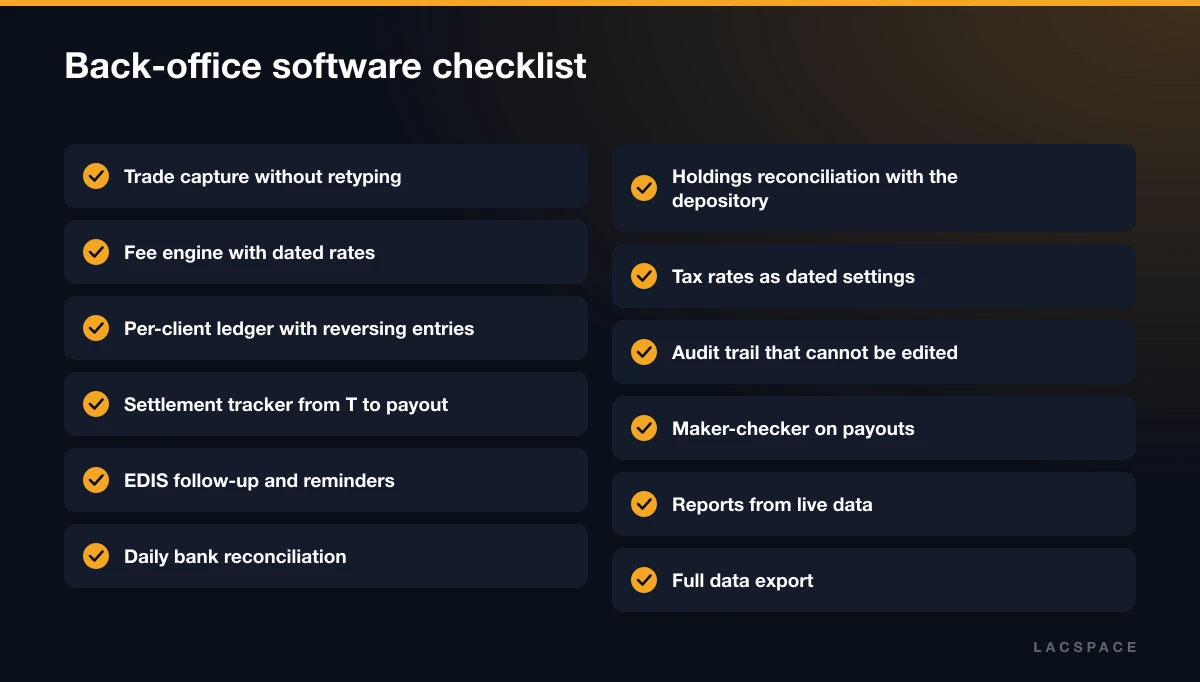
What to check in back-office software
| Area | What to check | Why it matters |
|---|---|---|
| Trade capture | Imports the day's trades from your trading system without retyping | Manual entry is where wrong-client errors begin |
| Fee engine | Slabs, SEBON fee and DP charge are settings you can change with a date | Rates change by notice; old trades must keep old rates |
| Client ledger | Per-client balances, reversing entries, visible to the client | Disputes end faster when both sides see the same record |
| Settlement tracker | Shows each settlement from T to payout, with exceptions flagged | T+2 payout is now a directive |
| EDIS follow-up | Lists sellers who have not delivered and sends reminders | Most close-outs are preventable |
| Bank reconciliation | Matches deposits and payouts to the client-fund account daily | Segregation has to be shown, not asserted |
| Holdings reconciliation | Compares client holdings with depository records and lists differences | This is where the regulator is heading |
| Tax handling | Capital gains tax rates are settings by date and investor type | Rates changed twice in 2026 |
| Audit trail | Every change records who, what and when, and cannot be edited | Expected by the IT audit guidelines |
| Roles and approvals | Maker-checker on payouts and ledger corrections | No single person should move client money alone |
| Reports | Complaint, settlement and client-fund reports produced from live data | Month-end should be an export, not a project |
| Data export | Full export of ledgers and documents in open formats | You should be able to leave a vendor with your records |
On tax: the individual rates on listed shares moved on 17 July 2026 and again on 22 September 2026 (Kharchapatra). A system where the rate is typed into a formula will be wrong the next time it changes.
Where LSNEP fits
LSNEP's back office module covers client ledgers, settlement tracking, commission and regulatory fees, contract notes and payouts across branches. It shares one record per client with the client app and the support desk, so a client can see settlement status on screen instead of calling. It runs beside the NEPSE-approved trading system a broker already uses and does not replace it. Connections to market infrastructure are used only where access is granted.
Brokers that lend on margin need the same ledger to carry the loan. That is covered in our margin trading checklist. For the wider picture, see the LSNEP introduction, or book a walkthrough on sample data.
LSNEP is software for licensed capital-market firms, built by Lacspace. It is not a broker, exchange, depository or investment adviser, and nothing in this article is investment advice. Regulatory details are summarised from public sources and change by notice; confirm current requirements with NEPSE, SEBON and CDSC.
Frequently asked questions
What does a broker back office do?
It handles everything after a trade is matched: posting trades to client ledgers, charging fees, issuing contract notes, settling with the clearing house, paying out to clients, reconciling records and producing reports.
How does T+2 settlement work in Nepal?
Trades are loaded at CDSC on the trade day. On the second trading day, funds and securities are paid in, capital gains tax and any close-out are calculated, and funds and securities are paid out.
What is pay-in and pay-out in share settlement?
Pay-in is the delivery of money by buyers and shares by sellers into the clearing system. Pay-out is the release of shares to buyers and money to sellers after settlement.
What is a close-out penalty in Nepal?
If a seller does not deliver sold shares by the T+2 deadline, the trade is closed out. Republica reports that the seller pays the buyer 20% of the transaction amount, with 25% of that penalty going to the government as tax.
What must a broker reconcile every day?
Trades against the exchange record, client holdings against the depository record, the settlement obligation against the clearing statement, and client deposits and payouts against the client-fund bank account.
Do brokers in Nepal have to keep client money separate?
Yes. SEBON directives reported on 26 August 2026 require brokers to keep strictly separate bank accounts for client funds and the broker's own funds.