
In short
- There are three routes: build with your own team, buy a system outright, or license a platform that a vendor runs for you.
- The purchase price is the smallest part. People, compliance and maintenance over several years decide the real cost.
- A few costs are fixed by rule and public: the NEPSE connection fee for an own TMS, the client fee cap and the two-yearly IT audit.
- The right route depends on trading volume, in-house skill and how much operational risk the board wants to carry.
Every broker in Nepal now faces the same decision in a different form. Clients expect an app. Regulators expect audit trails, reconciliations and reports. Margin lending needs systems of its own. The question is no longer whether to invest in technology but how: build it, buy it or license it.
This article sets out the three routes and the costs behind each. It gives no price list. Vendor prices in Nepal are rarely published, and a number without a source would not help a board decide. Where a figure is public, it is quoted with its source. Everything else is described in terms of what drives the cost, so you can put your own quotes into the frame.
The three routes
Build means hiring your own team and writing the software yourself. You own every line and every decision. You also own every fault and every deadline.
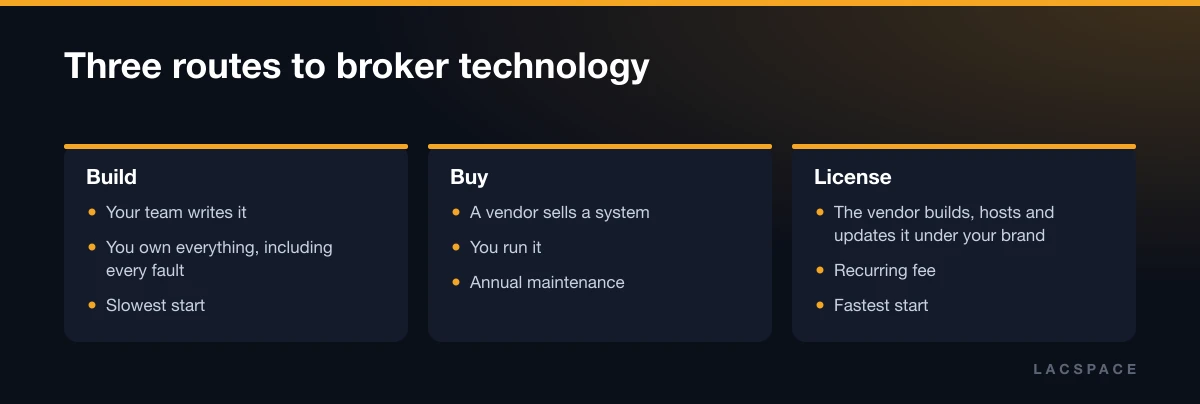
Buy means paying a vendor for a system, usually with an upfront fee and an annual maintenance contract. The software is installed for you, often on infrastructure you arrange. You control when to upgrade, and you carry the work of running it.
License means paying a recurring fee for a platform the vendor builds, hosts, secures and updates, carrying your brand. You start faster and need fewer technical staff. You depend on the vendor's roadmap and on the terms of the contract.
The routes can be mixed. A broker might stay on a shared trading system, license its client app and back office, and build one small tool that is unique to its business. The decision is made per system, not once for the whole firm.
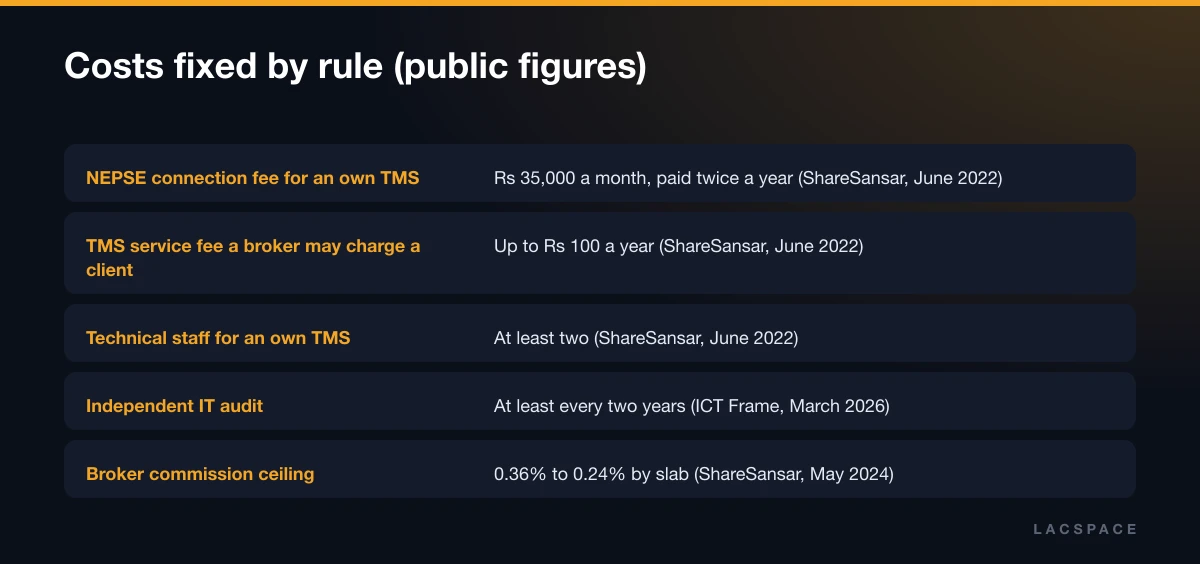
One boundary applies to all three. Anything that sends orders to the exchange needs NEPSE approval. Since June 2022 a broker may run its own trading management system (TMS), developed in-house or bought from a third party, if NEPSE finds it suitable (ShareSansar). Software around the trading system, such as the client app, onboarding, ledgers and support, does not replace the TMS. See what brokers need before applying for an own TMS.
Where the money goes: six cost categories
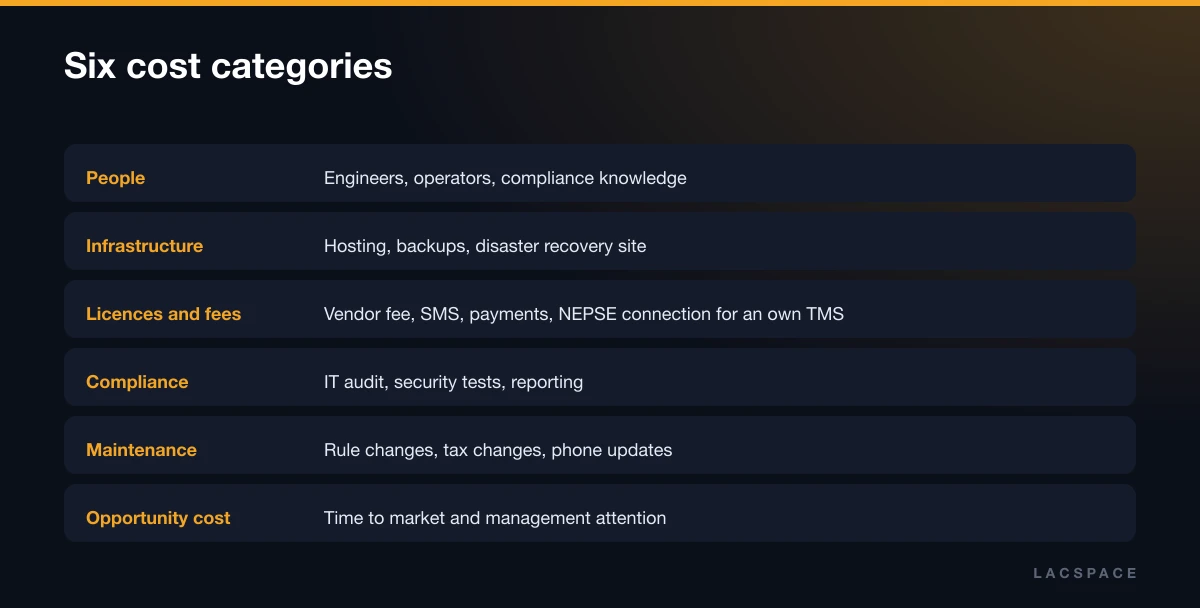
1. People
People are the largest cost on the build route and the most underestimated on the buy route. Building needs engineers, a designer, a tester, someone who understands settlement and compliance, and a manager to hold it together. It needs them for years, not for one project. Buying still needs staff who can run servers, apply updates and deal with the vendor. Even for an own TMS, the rules ask for at least two technical employees (ShareSansar). That is a minimum, not a comfortable number for market hours and leave cover.
2. Infrastructure
Servers, hosting, networks, backups and a second site for disaster recovery. The cost is not only the monthly bill. It is the risk of getting it wrong. In September 2026 a ransomware attack on a single data centre used by 72 brokers led NEPSE to suspend trading for a day (Kathmandu Post). Sharing one facility spreads the cost. It also concentrates the risk. Whichever route you choose, ask where the system runs, where the backup lives and when a restore was last tested.
3. Licences and fees
These are the visible costs: the vendor's licence or subscription, plus third-party charges such as SMS, payment gateways, app-store accounts and market-data access. Some fees are set by rule. A broker with its own TMS pays NEPSE Rs 35,000 a month for the connection, paid as a lump sum twice a year, and may charge clients a TMS service fee of no more than Rs 100 a year (ShareSansar). That cap matters for every route. The cost of technology cannot simply be passed to clients as a platform fee.
4. Compliance
Compliance is a cost of technology, not a separate budget. NEPSE's guidelines require an independent IT audit at least every two years, covering the trading system, back-office software, mobile apps, websites and the disaster recovery plan (ICT Frame). SEBON's August 2026 directives add separate client-fund accounts, a grievance unit with monthly reporting and payout within T+2 (ShareSansar). On the build route, your team pays for every one of these in design and testing time. On the license route, ask the vendor which of them the platform already covers and what evidence it gives your auditor.
5. Maintenance
Software is never finished. Rules change and the system must change with them. In 2026 alone, the trading rules were revised in April (ShareSansar) and the capital gains tax rates on listed shares changed on 17 July and again on 22 September (Kharchapatra). Each change means work: a fee table, a tax rule, a new screen, a new report. Phones also change. Each year's operating system updates can break an app that nobody has touched. Budget for maintenance every year, on every route. On the buy route, check what the annual contract includes and what is billed as a change request.
6. Opportunity cost
This is the cost that never appears on an invoice. It is the clients not won during the months a build takes. It is the managing director's attention spent on software decisions instead of the business. It is the margin licence that sits unused because the risk system is not ready. Speed has a value. So does focus.
What each rupee of technology has to be earned from
A broker's income per trade is capped. Commission runs from 0.36% on small trades down to 0.24% on the largest (ShareSansar). One broker's published schedule shows the broker keeping 79.4% of that commission, with 20% going to NEPSE and 0.6% to SEBON (Secured Securities). Turnover also rises and falls with the market. A technology plan with high fixed costs is comfortable in a strong year and painful in a weak one. That is an argument for costs that move with the size of the business where possible.
Build, buy or license: side by side
| Factor | Build | Buy | License |
|---|---|---|---|
| Upfront cost | Highest. A team is paid for many months before clients see anything | High. Purchase fee plus infrastructure | Lowest. Setup, then a recurring fee |
| Ongoing cost | Salaries, hosting, security, audits | Annual maintenance, hosting, in-house operators | Subscription; third-party charges as agreed |
| Time to first release | Longest | Medium. Depends on installation and customising | Shortest |
| Staff you need | A full product team | Operators and a vendor manager | A product owner and operations users |
| Control over features | Full | Limited to what the vendor sells or customises | Configuration and branding; roadmap shared with other clients |
| Who fixes a fault at 11:05 | Your team | Your team first, then the vendor | The vendor, under the service terms |
| Keeping up with rule changes | Your team, every time | Vendor update, which you must apply | Vendor update, applied for you |
| IT audit evidence | You produce all of it | Shared between you and the vendor | Vendor supplies its part; you supply yours |
| Risk if it goes wrong | Key people leave; project stalls | System ages; upgrades are skipped | Vendor dependence; exit terms matter |
| Who owns the client data | You | You | You, if the contract says so. Check it |
Questions to ask a vendor
Whether you buy or license, the answers to these questions tell you more than the price does.
- What exactly is included? List the modules, the number of users or clients, and the support hours. Ask what counts as a chargeable change.
- What is the total over three years? Setup, recurring fees, third-party charges, upgrades and expected increases, on one page.
- Who else runs this, and for how long? When brokers first applied for their own TMS, NEPSE asked that vendors offer a high-security system and have served at least ten stock-trading clients (Republica). Ask for references you can call.
- Where does it run, and where is the backup? Ask for the last tested restore and the plan for a data-centre failure.
- Is our data kept separate from other clients'? And who at the vendor can see it?
- What happens on a bad day? Who is on call during market hours, how fast do they respond, and how will you be told?
- How do rule changes reach us? A new fee, tax rate or report: how soon, and at whose cost?
- What will you give our IT auditor? Security test reports, access logs, backup records.
- Whose brand do clients see? And who owns the app-store listing and the domain?
- How do we leave? Full export of clients, ledgers and documents in open formats, with a notice period you can live with.
A vendor that answers the last question clearly is usually safe on the others.
When each route makes sense
Build suits a large broker with high trading volume, an existing technology team and a feature that no vendor offers. It also suits a group, such as a bank with a broking arm, that can share engineers across businesses. It rarely suits a firm hiring its first developer.
Buy suits a broker that wants the system on its own infrastructure, has staff to run it and expects few changes. It works best for stable, well-defined functions. It works less well for client-facing apps, which need frequent updates.
License suits most small and mid-sized brokers, and any broker that needs to move quickly. It turns a large fixed cost into a recurring one and puts security, updates and uptime on a specialist. The trade-off is dependence, which is why the contract, the service terms and the exit clause deserve as much attention as the demo.
A common sequence is to license the client-facing systems and back office first, learn what clients use, and consider building or an own TMS later with clean data and a clear view of costs.
How LSNEP approaches this
LSNEP is a licensed platform. Lacspace builds and runs it, and each brokerage uses it under its own name, colours and domain. It covers the client app, web portal, account opening, back office, margin module and support desk, beside the NEPSE-approved trading system the broker already uses. Terms are agreed per broker after a short discovery, based on the modules and the number of active clients, so this article quotes no LSNEP price.
To compare routes for your own firm, start with the comparison on lsnep.com and the digital readiness check. Then book a walkthrough and bring the ten questions above. For related reading, see how a broker back office works and preparing broker apps for heavy trading days.
LSNEP is software for licensed capital-market firms, built by Lacspace. It is not a broker, exchange, depository or investment adviser, and nothing in this article is investment advice. Regulatory details are summarised from public sources and change by notice; confirm current requirements with NEPSE, SEBON and CDSC.
Frequently asked questions
How much does broker software cost in Nepal?
Vendor prices are rarely published and depend on modules, client numbers and hosting. The reliable way to compare is the total over three years across people, infrastructure, licences, compliance and maintenance.
Should a broker build its own app or license one?
Building suits large brokers with an existing technology team and a need no vendor meets. Licensing suits most small and mid-sized brokers because it is faster to launch and needs fewer technical staff.
What does it cost to run an own TMS in Nepal?
Under the 2022 rules reported by ShareSansar, a broker pays NEPSE Rs 35,000 a month for the connection, needs at least two technical staff and may charge clients no more than Rs 100 a year. Vendor, hosting and staff costs are on top.
What is a white-label broker app?
It is an app built and run by a technology vendor but released under the brokerage's own name, colours and domain. Clients see the broker's brand, not the vendor's.
What should a broker ask a software vendor?
Ask what is included, the three-year total, references, where the system and backups run, how data is separated, who responds during market hours, how rule changes are delivered, what audit evidence is supplied and how you can export your data and leave.
Does LSNEP publish its prices?
No. Terms are agreed per broker after discovery, based on the modules used and the number of active clients.