
In short
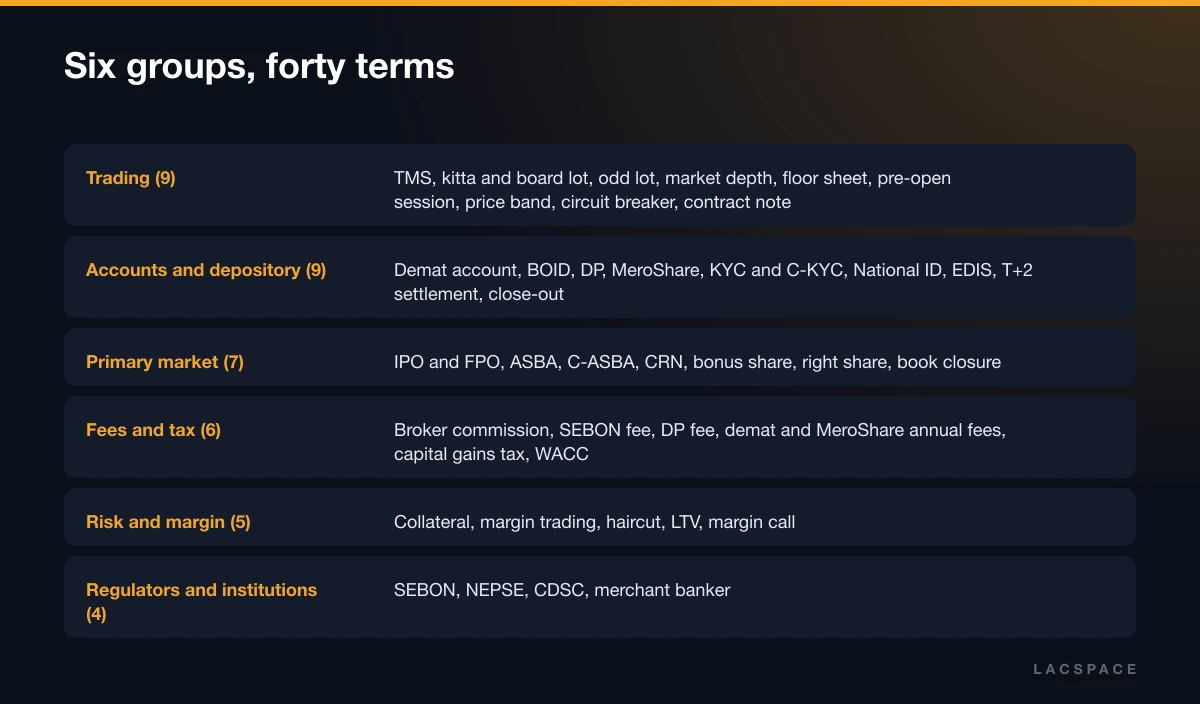
- Forty terms in six groups: trading, accounts and depository, primary market, fees and tax, risk and margin, and institutions.
- Every figure carries a source. Rates and rules change by notice, so treat the contract note and the current circular as final.
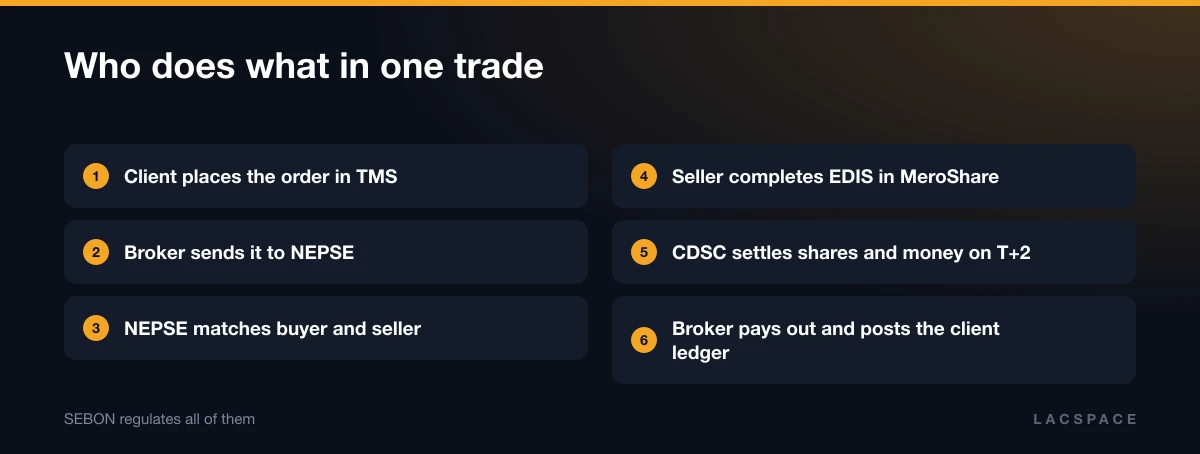
- Three institutions sit behind every trade: SEBON regulates, NEPSE matches orders, CDSC holds and settles the shares.
- Each term has its own anchor, so a broker can link a client straight to the definition they asked about.
Most questions a broker's support desk hears are vocabulary questions. A client asks why the money has not arrived, and the answer is T+2. A client asks why a sale was penalised, and the answer is EDIS. This glossary explains 40 terms in plain English, in the order a client usually meets them. Brokers are welcome to link clients to any single term. Each one has its own anchor.
Figures here come from public sources and are linked. Rates, limits and dates change by notice. The contract note from your broker and the current notice from NEPSE, SEBON or CDSC are always the final word.
Trading
TMS (Trading Management System)
The online system a client logs in to for placing buy and sell orders through a broker. Orders go from the TMS to NEPSE, where they are matched. Since June 2022 a broker may run its own TMS with NEPSE approval (ShareSansar). See our guide to running your own TMS.
Kitta and board lot
Kitta is the everyday word for one unit of a share. A board lot is the standard trading quantity. Under the trading regulations it is 10 units for shares with a face value of Rs 100 and 100 units for securities with a face value of Rs 10 (ShareSansar).
Odd lot
A quantity smaller than a board lot, for example 7 kitta of a Rs 100 share. Odd lots trade under separate rules. Since July 2025, NEPSE's website has shown buy and sell orders for odd lots in market depth (ShareSansar).
Market depth
The list of waiting buy orders and sell orders for one scrip, sorted by price. It shows how many shares are wanted or offered at each price, so a client can see how easily an order is likely to fill.
Floor sheet
The record of every trade done on the exchange in a session. Each line shows the scrip, the buying broker, the selling broker, the quantity and the price. Back offices use it to post trades to client ledgers.
Pre-open session
A short session before regular trading. Orders are collected and used to set the opening price. Since April 2026 the price band in this session is 5%, up from 2% (ShareSansar). Regular trading runs from 11:00 to 15:00 (Kathmandu Post).
Price band
The most a single share's price may move in one day, measured from the previous close. From 20 April 2026 the daily limit is 15%, up from 10% (ShareSansar). A share that reaches the limit is often said to have hit its circuit.
Circuit breaker
A market-wide halt triggered by a large move in the NEPSE index. Under the rules in force from 20 April 2026, a 5% index move in the first two hours pauses trading for 15 minutes, and an 8% move closes the market for the day (ShareSansar). More in NEPSE's new trading rules for 2026.
Contract note
The document a broker issues after a trade. It shows the scrip, quantity, price, commission, regulatory fees and the net amount. It is the client's proof of the trade and the figure that settles any dispute about charges.
Accounts and depository
Demat account
An account that holds shares in electronic form. It is opened through a depository participant. CDSC's website showed more than 8.1 million demat accounts in November 2026 (CDSC). Step by step: how to open a demat account in Nepal.
BOID (Beneficial Owner ID)
The unique number of a demat account. A client gives it when applying for a public issue, when linking a trading account and when receiving shares. It is to shares what an account number is to a bank.
DP (depository participant)
A firm licensed to open and maintain demat accounts on behalf of the depository. Many banks, merchant bankers and brokers are DPs. CDSC listed 124 licensed DPs in November 2026 (CDSC). See technology for merchant bankers, DPs and fund managers.
MeroShare
CDSC's online service for investors. A client uses it to see demat holdings, apply for public issues, and complete EDIS after a sale. A MeroShare login is separate from a TMS login.
KYC and C-KYC
Know Your Customer: the identity checks a firm must complete before opening an account. Centralised electronic KYC lets one KYC record serve a client's accounts at different institutions. SEBON brought it in from Kartik 5, 2077 (ShareSansar). In August 2026 SEBON told NEPSE to integrate C-KYC with TMS (ShareSansar).
National ID
Nepal's national identity card and number. It has been required for new trading accounts since 3 August 2025 (ICT Frame), and for new demat accounts and KYC updates from Shrawan 1, 2083 (ICT Frame). See national ID account opening, done digitally.
EDIS (Electronic Delivery Instruction Slip)
The instruction a seller gives in MeroShare to transfer sold shares for settlement. It has been available since October 2018 (ShareSansar). Missing it leads to a close-out. In August 2026 SEBON told CDSC to build Auto EDIS, so sellers would no longer complete it by hand (ShareSansar).
T+2 settlement
Settlement two trading days after the trade date (T). On T+2 the seller's shares and the buyer's money change hands through CDSC, and payout follows (CDSC). SEBON approved the move from T+3 to T+2 in January 2021 (ShareSansar). The full cycle is in our back-office guide.
Close-out
What happens when a seller does not deliver sold shares by the T+2 deadline. Republica reports that the seller pays the buyer 20% of the transaction amount, and that 25% of that penalty goes to the government as tax (Republica). The usual cause is a missed EDIS.
Primary market
IPO and FPO
An Initial Public Offering is a company's first sale of shares to the public. A Further Public Offering is a later sale by a company that is already listed. Both are applied for through MeroShare and a C-ASBA bank, not through a broker.
ASBA
Application Supported by Blocked Amount. The applicant's bank blocks the application money in the account until allotment. If no shares are allotted, the block is released. The money never leaves the account unless shares are allotted.
C-ASBA
Centralised ASBA. CDSC collects applications from all member banks in one system, verifies the bank account and BOID, and filters duplicate applications (ShareSansar). CDSC listed 43 banks in C-ASBA in November 2026 (CDSC).
CRN (C-ASBA Registration Number)
The number a bank issues when a client registers an account for C-ASBA. MeroShare asks for it with each public-issue application, to confirm which bank account the money should be blocked in. Ask your bank if you do not have one.
Bonus share
Extra shares given free to existing shareholders in proportion to their holding. The market price is adjusted down after book closure: the price before closure is divided by one plus the bonus percentage (ShareSansar). Try the bonus and right adjustment calculator.
Right share
New shares offered to existing shareholders in proportion to their holding, at a set price. The holder must apply and pay. The market price is also adjusted after book closure (ShareSansar).
Book closure
The date a company closes its shareholder register to decide who receives a dividend, bonus or right share. Shares bought too late to be on the register by that date do not carry the entitlement.
Fees and tax
Broker commission
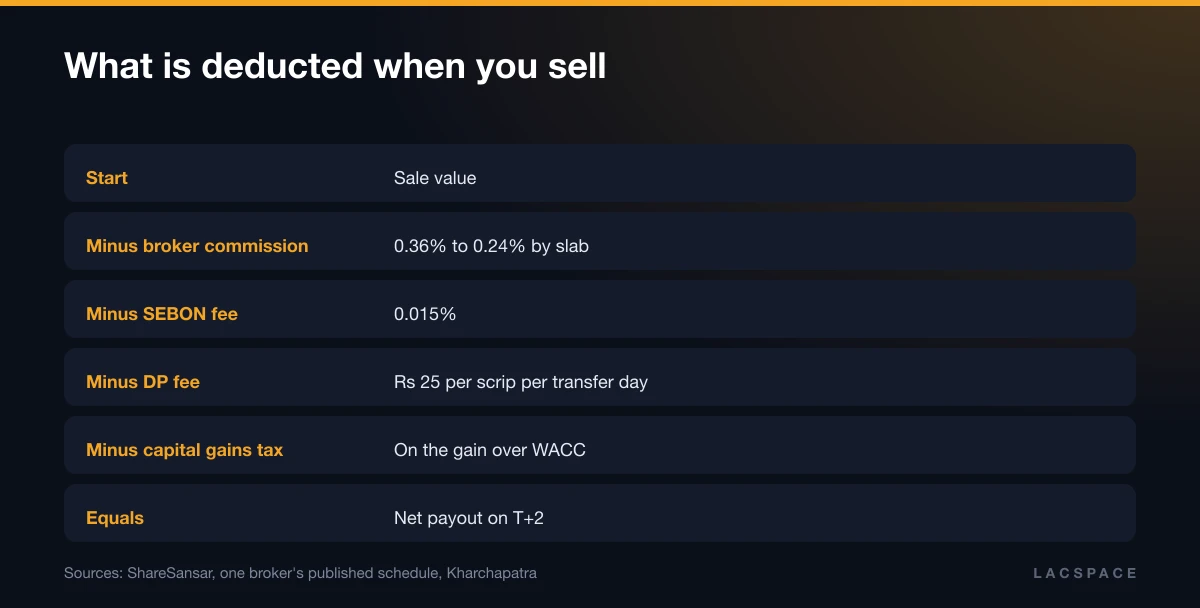
The fee a broker charges on each buy and each sell. SEBON sets the ceiling in slabs. Since 14 May 2024 it runs from 0.36% on trades up to Rs 50,000 down to 0.24% above Rs 1 crore (ShareSansar). One broker's published schedule shows a flat Rs 10 on trades up to Rs 2,500 (Secured Securities). Check any trade with the brokerage calculator.
SEBON fee
A regulatory fee charged on the trade value, on top of commission. A broker's published schedule gives it as 0.015% for equity shares (Secured Securities).
DP fee
A charge paid to the depository participant when shares leave a demat account on a sale. A broker's published schedule gives it as Rs 25 per scrip per transfer day (Secured Securities).
Demat and MeroShare annual fees
Yearly charges to keep the accounts active. NEPSE Trading reported Rs 100 a year for the demat account and Rs 50 a year for MeroShare in July 2026, with unpaid accounts frozen until renewed (NEPSE Trading).
Capital gains tax
Tax on the profit from selling listed shares. It is withheld when the sale settles. From 22 September 2026, resident individuals pay 5% if the shares were held 365 days or less and 3.75% if held longer, and entities pay 10% (Kharchapatra). The rates changed twice in 2026, so check the current notice. See the capital gains tax calculator.
WACC (weighted average cost)
In Nepal's share market, WACC means the average purchase cost per share of a holding. Capital gains tax is charged on the gain over this cost, not on the full sale value (Kharchapatra). It is commonly shown as WACC in MeroShare. It is not the corporate-finance term with the same initials. Work it out with the average cost calculator.
Risk and margin
Collateral
Money or shares a client places with a broker as security. In day-to-day trading it usually means the funds a client loads so that the TMS allows buy orders. The regulations let a broker take an advance of up to 25% on a buy order (ShareSansar). In margin lending it means the shares pledged against the loan.
Margin trading
Buying shares partly with money lent by the broker, with the shares held as security. As reported in March 2026, the investor puts in at least 30% and the broker lends the rest, and the broker needs permission from NEPSE and Nepal Rastra Bank (ShareSansar). See our margin trading checklist.
Haircut
The percentage a broker deducts from a share's market value when counting it as collateral. A bigger haircut means the broker lends less against that share. Haircuts allow for the chance that the price falls before the loan is repaid.
LTV (loan-to-value)
The margin loan as a percentage of the collateral's value. A rising LTV means the client's cushion is shrinking. Test your own numbers with the margin loan-to-value calculator.
Margin call
A demand from the broker to add money or reduce the position because the client's own share of the account has fallen too low. As reported, a call is made if that share falls below 20%, and the broker may sell if it falls to 15% (ShareSansar). Confirm the current terms with your broker.
Regulators and institutions
SEBON
The Securities Board of Nepal, the regulator of the securities market. It licenses brokers, merchant bankers and depository participants, approves public issues and sets rules such as commission ceilings.
NEPSE
Nepal Stock Exchange, the exchange where listed shares are bought and sold. It matches buy and sell orders, publishes prices and indices, and approves broker trading systems.
CDSC
CDS and Clearing Limited, the central depository. It holds shares in electronic form, clears and settles trades, and runs MeroShare and C-ASBA. Its website lists 92 clearing members (CDSC).
Merchant banker
A firm licensed by SEBON to manage public issues, underwrite them and act as share registrar. When a client applies for an IPO, a merchant banker is managing the issue behind the scenes.
How brokers can use this glossary
A glossary only helps if clients meet it at the moment they are confused. Three places work well:
- In the app and portal. Link a term beside the number it explains, for example T+2 beside a pending payout or WACC beside a tax line.
- In support replies. Save answers that link to the single term, so every agent explains EDIS or close-out the same way.
- In onboarding. Send new clients the handful of terms they will meet in the first week: TMS, BOID, collateral, T+2 and EDIS.
LSNEP keeps a longer, alphabetical capital-market glossary on lsnep.com, and a set of free calculators for fees, tax and average cost. New investors may prefer to start with buying a first share through demat, BOID, MeroShare and TMS.
LSNEP is software for licensed capital-market firms, built by Lacspace. It is not a broker, exchange, depository or investment adviser, and nothing in this article is investment advice. Regulatory details are summarised from public sources and change by notice; confirm current requirements with NEPSE, SEBON and CDSC.
Frequently asked questions
What is TMS in the Nepal share market?
TMS stands for Trading Management System. It is the online system a client logs in to for placing buy and sell orders through a broker, which are then matched at NEPSE.
What is the difference between BOID and CRN?
BOID is the unique number of your demat account, where shares are held. CRN is a number your bank issues for C-ASBA, used in MeroShare to confirm which bank account is blocked for a public-issue application.
What does T+2 settlement mean?
It means a trade settles two trading days after the trade date. On T+2 the seller delivers the shares, the buyer pays, and payout follows through CDSC and the broker.
What is EDIS in MeroShare?
EDIS is the Electronic Delivery Instruction Slip. After selling shares, the seller completes it in MeroShare so the shares can be transferred for settlement. Missing it can lead to a close-out penalty.
What is WACC in MeroShare?
WACC is the weighted average purchase cost per share of a holding. Capital gains tax is calculated on the gain over that cost when the shares are sold.
How much is broker commission in Nepal?
Since 14 May 2024 the commission ceiling runs in slabs from 0.36% on trades up to Rs 50,000 down to 0.24% on trades above Rs 1 crore, charged on both buy and sell. A SEBON fee and, on sales, a DP fee are added.