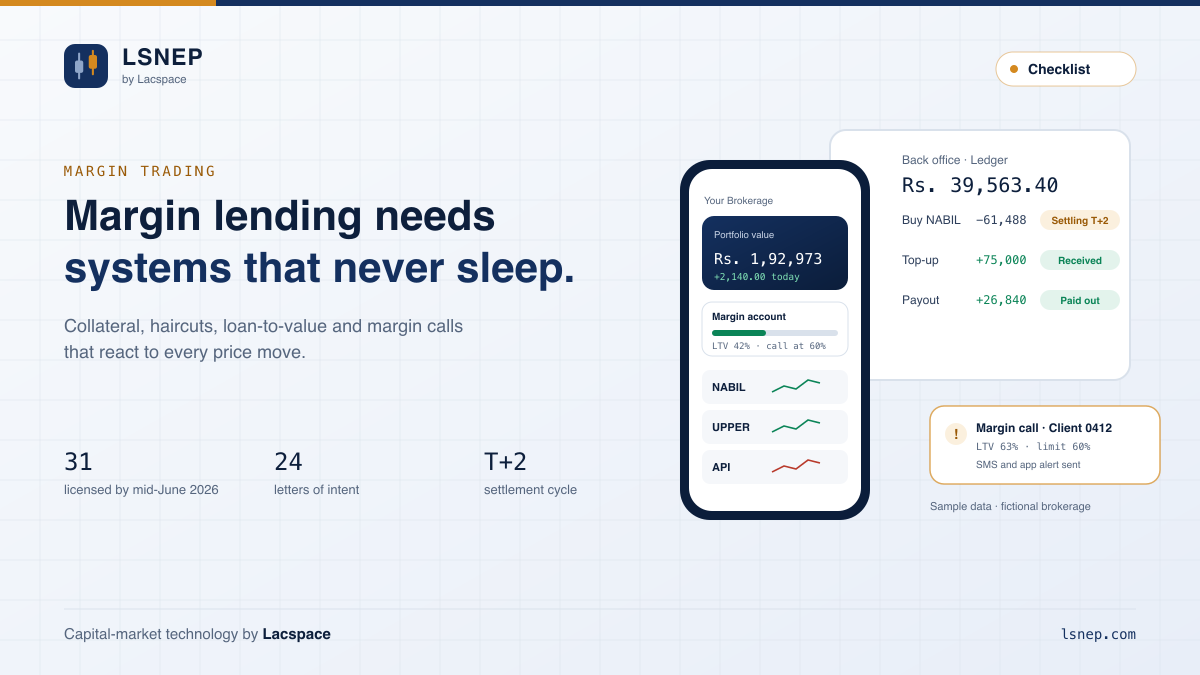
Every investor in Nepal reaches NEPSE through a chain of licensed firms. A broker takes the order. A depository participant holds the demat account. A merchant banker manages the public issue that brought the investor in, and often acts as share registrar afterwards. A fund manager runs the mutual fund or portfolio the investor chose instead of picking stocks. Each firm runs its own systems, and each hand-off is a place where investors wait, call or give up.
In short
- Brokers are LSNEP’s core focus, but the firms around them have the same building blocks underneath.
- Identity and KYC, CRM, payments, notifications, documents and audit can be built once and configured per firm.
- Each firm type adds its own workflows: issues and allotments, demat requests, SIPs and NAV, or live market pages.
- LSNEP is built to work with market infrastructure where access is granted; it does not claim connections it does not have.
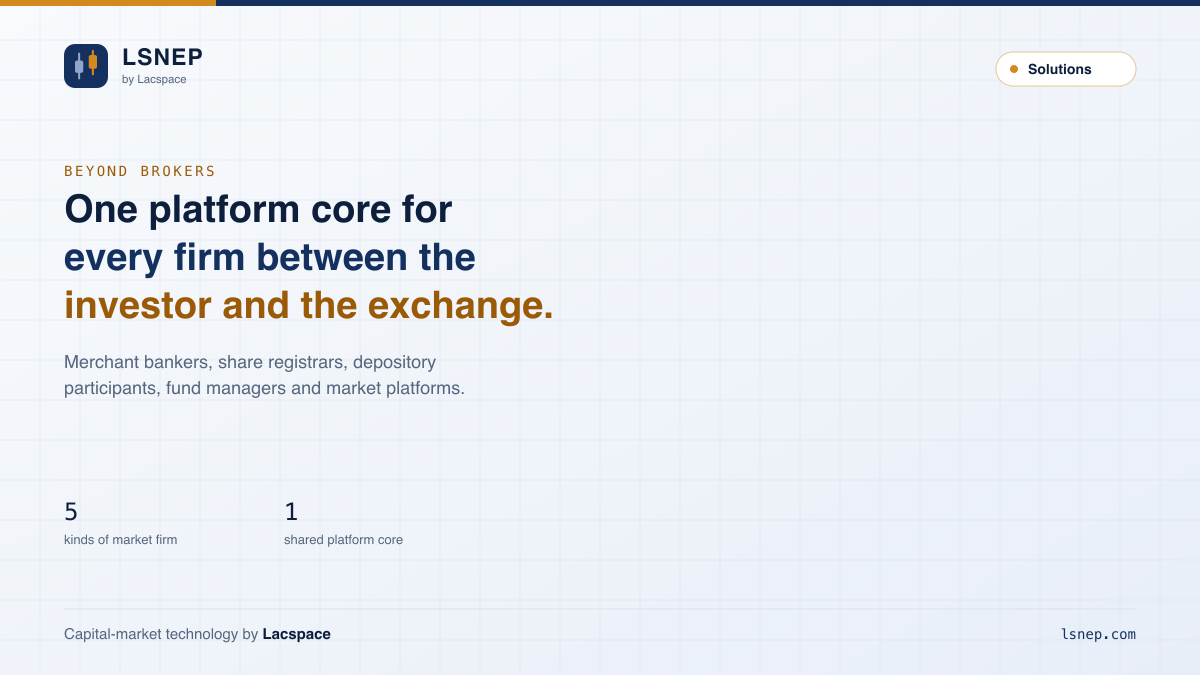
Five kinds of firm, one set of building blocks
Stock brokers
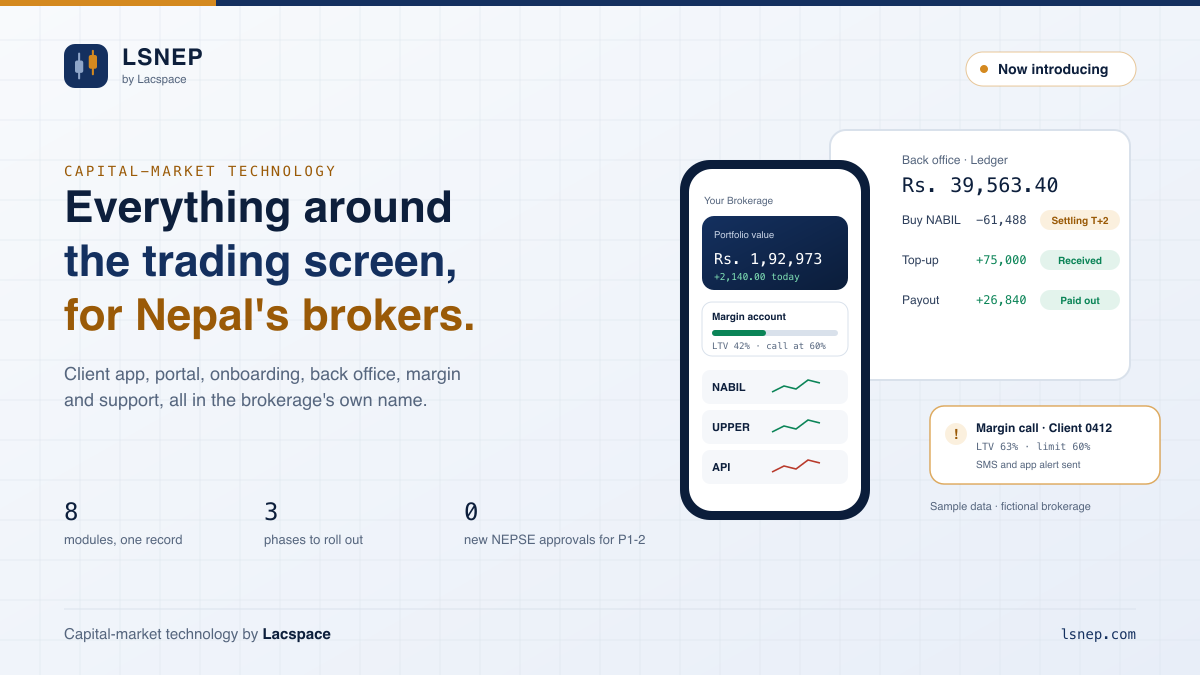
The core focus: a branded client app and portal, account opening with national ID, back office, margin and support. Our LSNEP introduction covers it in full.
Merchant bankers and share registrars
Public issues are the moment many Nepalis first become investors. Merchant bankers manage IPOs, FPOs and rights issues, and registrars keep shareholder records afterwards. The work that benefits most from better technology is investor-facing: clear issue pages, timely publication of allotment results, handling registrar requests such as name or address changes, and answering the flood of questions around each issue. Investors apply through Meroshare and C-ASBA; LSNEP does not change that, it handles the communication and service around it.
Depository participants
Many brokers and banks are also depository participants. Their queues are paper-heavy: new demat accounts, renewals, pledge and unpledge requests for margin, transfers and fee collection. A digital request desk with status tracking turns a branch visit into a few taps, and gives the DP a clean audit trail.
Fund managers and PMS
Mutual funds and portfolio managers need an investor portal: onboarding, SIP and unit requests, published NAV, statements and portfolio reports. Clients increasingly expect to see their holdings on a phone, not wait for a printed statement.
Market data and learning platforms
Live market pages, charting, screeners, paper trading and learning are what bring new investors into the market in the first place. Lacspace has built these for years, in its own app StockYatra and in ShareRocketPro, Share Rocket Pro Pvt. Ltd.’s product, for which Lacspace is the technology partner and digital infrastructure provider. See what those builds taught us.
Workflows by firm type
| Firm | Typical workflow LSNEP supports |
|---|---|
| Merchant banker | Issue page opens, investors ask questions, results are published, refunds and listing are communicated |
| Share registrar | Shareholder requests received, verified, approved and confirmed, with status visible to the investor |
| Depository participant | Demat opening, KYC, renewal, pledge and unpledge, transfer, each with a tracked request |
| Fund manager | Investor onboarding, SIP mandate, unit allotment, NAV publication, statements |
| Market platform | Live market pages, charts and screeners, practice trading, learning and alerts |
None of these workflows replaces market infrastructure. Allotment is decided by the issue process, demat records sit with CDSC, NAV is calculated by the fund. LSNEP handles the investor experience, requests, records and communication around them, which is where most of the waiting and phone calls happen today.
What investors notice
Investors rarely see the difference between a broker, a DP and a registrar. They see whether they could open an account quickly, whether they knew their IPO result on time, whether a pledge request went through before a margin call, and whether their fund statement arrived. Firms that give investors clear status and fast answers earn trust across the whole chain, and that trust brings clients back for the next issue, the next fund and the next trade.
The shared core
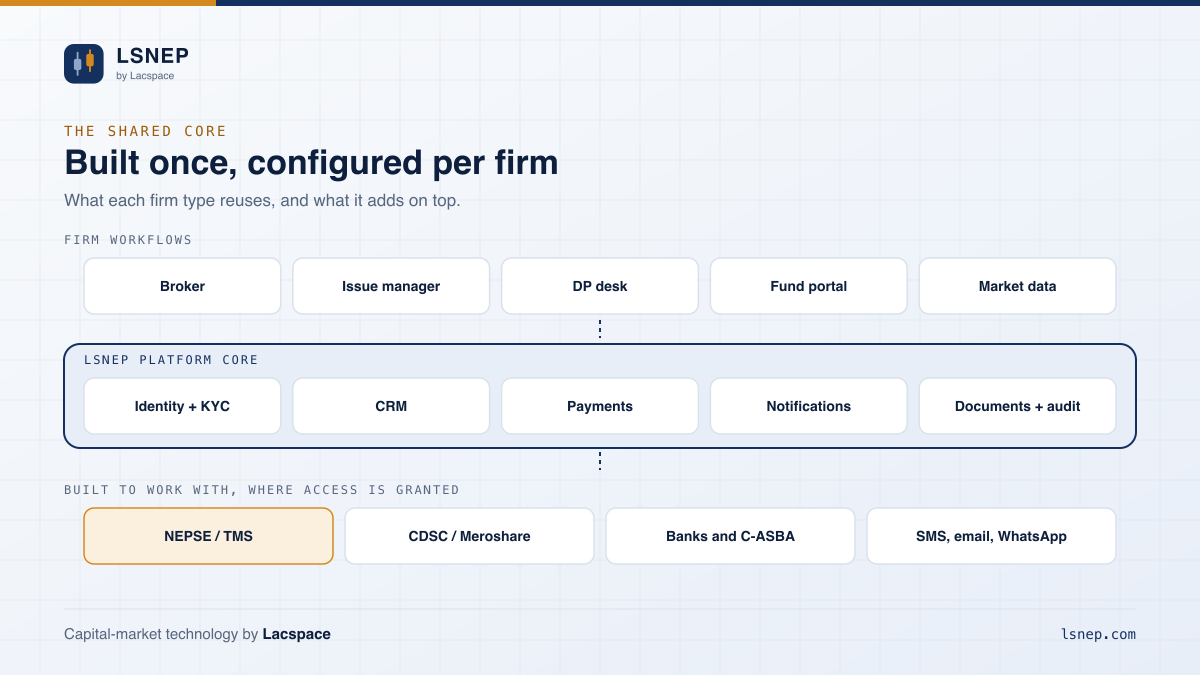
| Building block | Used by |
|---|---|
| Identity and KYC | Every firm that opens accounts or onboards investors |
| CRM | Brokers, fund managers and issue managers tracking leads and requests |
| Payments | Top-ups, fees, payouts, SIP collections |
| Notifications | Margin calls, allotment results, NAV updates, request status |
| Documents and audit | Contract notes, statements, approvals, regulator-ready records |
Building these once matters for more than cost. When the same identity and audit layer runs across a firm’s products, compliance reviews get easier, data stays consistent and new services launch faster.
Why one partner helps
Many firms in Nepal’s market are related: a broker that is also a DP, a bank group with a merchant banking arm and a fund manager. A shared platform core lets one investor identity, one support desk and one audit trail span those businesses, while each keeps its own brand and workflows.
How a non-broker firm gets started
The path mirrors the one for brokers. A short discovery maps the firm’s current systems, regulatory duties and the requests that cause the most waiting. The first release usually puts the investor-facing pieces live: a website or portal, digital requests with status tracking, notifications and a support desk. Back-office workflows and reporting follow once the front end is stable. Because the platform core is shared, a firm that starts with one business line, a DP desk for example, can add another, such as a broker app or a fund portal, on the same identity and audit layer later.
Terms are agreed per firm after discovery, based on the workflows and the number of active investors involved.
More on LSNEP: Introducing LSNEP · National ID account opening, done digitally · What building market platforms taught us · Margin trading: a technology checklist
LSNEP is software for licensed capital-market firms, built by Lacspace. It is not a broker, exchange, depository or investment adviser, and nothing in this article is investment advice. Regulatory details are summarised from public reporting and change by notice; confirm current requirements with NEPSE and SEBON.
Frequently asked questions
Is LSNEP only for stock brokers?
No. Brokers are the core focus, and the same platform core also serves merchant bankers and share registrars, depository participants, fund managers and portfolio managers, and market-data or learning platforms.
What can LSNEP do for merchant bankers?
Investor-facing issue pages, publication of allotment results, registrar request handling and investor support. Investors still apply through Meroshare and C-ASBA.
What can LSNEP do for depository participants?
A digital request desk for demat opening, renewals, pledge and unpledge, transfers and fee collection, with status tracking and an audit trail.
What can LSNEP do for fund managers?
An investor portal and app for onboarding, SIP and unit requests, published NAV, statements and portfolio reports.
Is LSNEP connected to CDSC or NEPSE?
LSNEP is built to work with market infrastructure where access is granted. It does not replace the broker’s NEPSE-approved trading system and does not claim connections or approvals it does not have.
What is the shared platform core?
Identity and KYC, CRM, payments, notifications, documents and audit, built once and configured for each firm type.