Nepal's stock brokers are being asked to do more in 2026 than at any time since online trading arrived: lend on margin, open accounts with national ID, hold more capital and keep clients trading when a vendor's system goes down. Most of that work happens around the trading screen, not on it. That is the gap LSNEP is built for.
In short
- LSNEP is capital-market technology by Lacspace, designed for Nepal’s stock brokers and the market firms around them.
- Eight modules share one record per client: client app, web portal, account opening and CRM, support desk, back office, margin trading, market insights and, later, a web trading portal.
- Phase 1 and 2 modules run alongside the NEPSE-approved trading system a broker already uses, so they need no new NEPSE approval.
- Everything carries the brokerage’s own name, colours and domain.
What LSNEP is
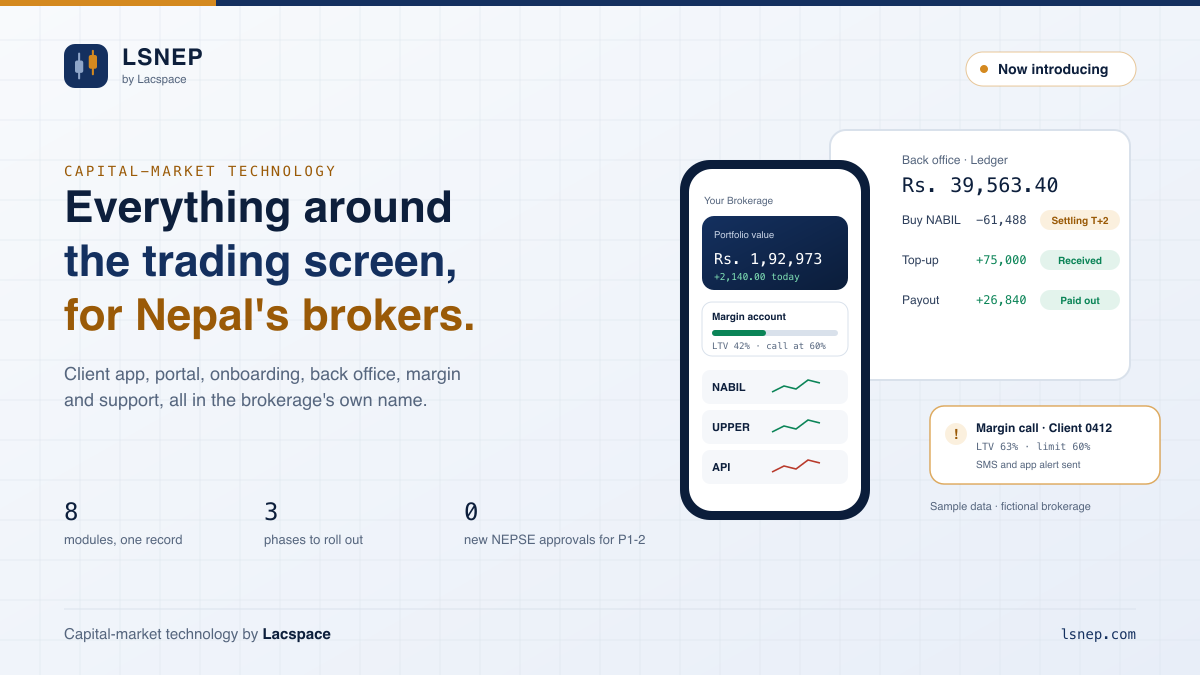
LSNEP is a single platform that covers what a client sees and what a broker's team runs behind the scenes. A client downloads an app in the brokerage's name, opens an account with national ID, tops up from a bank or wallet, follows portfolio, ledger and settlement status, and gets margin and price alerts. The broker's staff work from one back office for ledgers, settlement, fees, payouts, margin and support tickets.
It is built by Lacspace, a global technology company that already runs market platforms used by Nepal's investors, including its own trading-education app StockYatra and ShareRocketPro, Share Rocket Pro Pvt. Ltd.’s product, for which Lacspace is the technology partner and digital infrastructure provider. LSNEP brings that engineering to licensed brokers.
Eight modules, one record per client
Brokers usually stitch together a website from one vendor, KYC forms on paper, ledgers in spreadsheets and support on personal phones. LSNEP replaces the stitching with modules that share the same client record, so a lead becomes an application, an account, a funded client and a support history without being typed in twice.
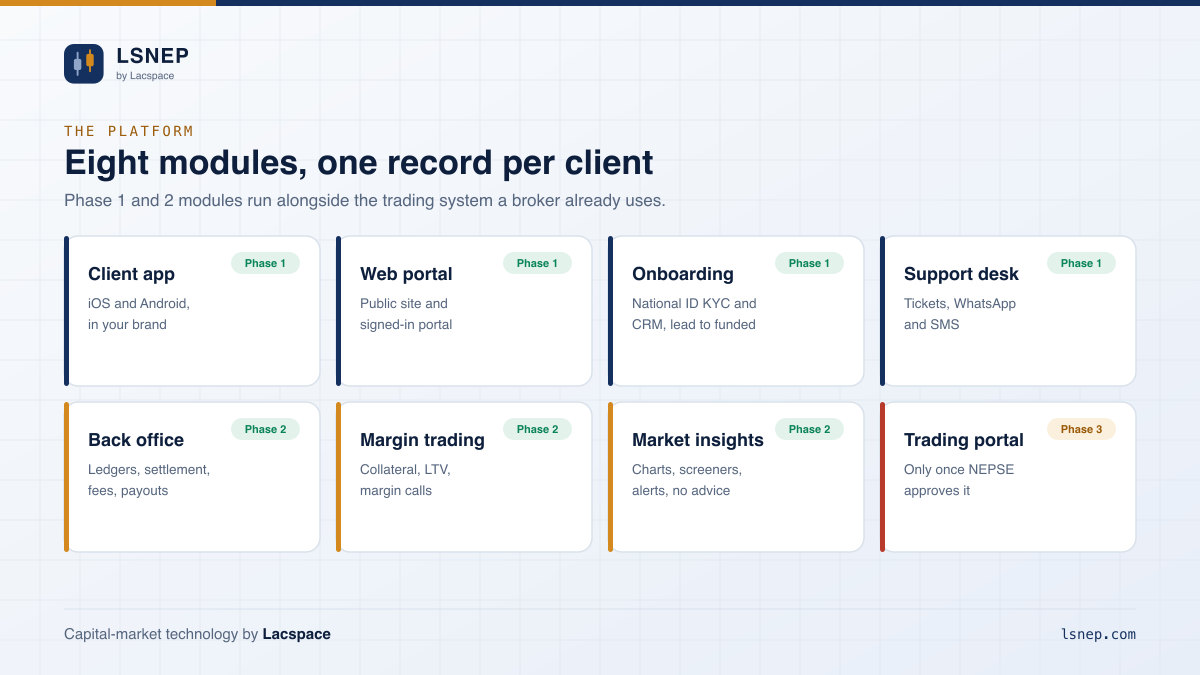
| Module | What it does | Phase |
|---|---|---|
| Client app | iOS and Android app in the broker’s brand: portfolio, ledger, T+2 settlement status, top-ups, contract notes, alerts | 1 |
| Web portal and website | A fast public website plus a signed-in client portal that mirrors the app | 1 |
| Account opening and CRM | Digital KYC with national ID, demat and bank details; every lead tracked to funded | 1 |
| Support desk | Tickets from app, WhatsApp and SMS with an owner, a status and a reply time | 1 |
| Back office | Client ledgers, settlement tracking, commission and regulatory fees, payouts across branches | 2 |
| Margin trading | Collateral valuation, haircuts, loan-to-value limits and automatic margin calls | 2 |
| Charts and market insights | Candlestick charts, indicators, screeners and alerts inside the app, without advice | 2 |
| Web trading portal | Lacspace’s own order screen and trading system, offered only once NEPSE approves it | 3 |
It wraps around the trading system, it does not replace it
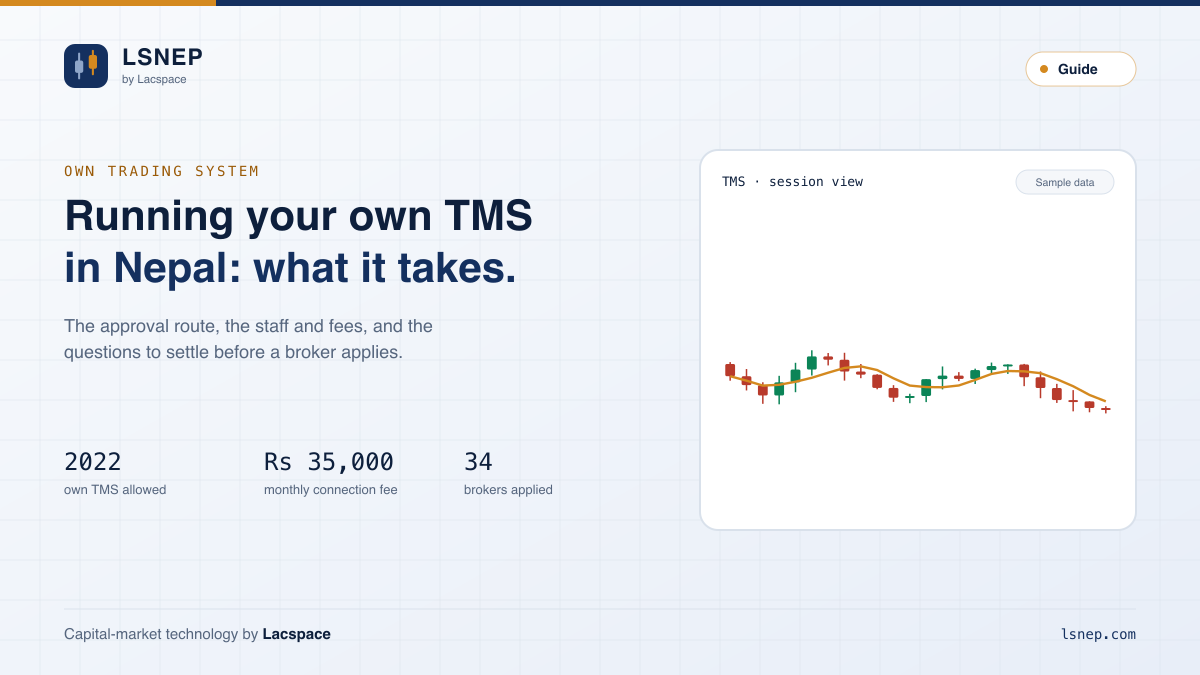
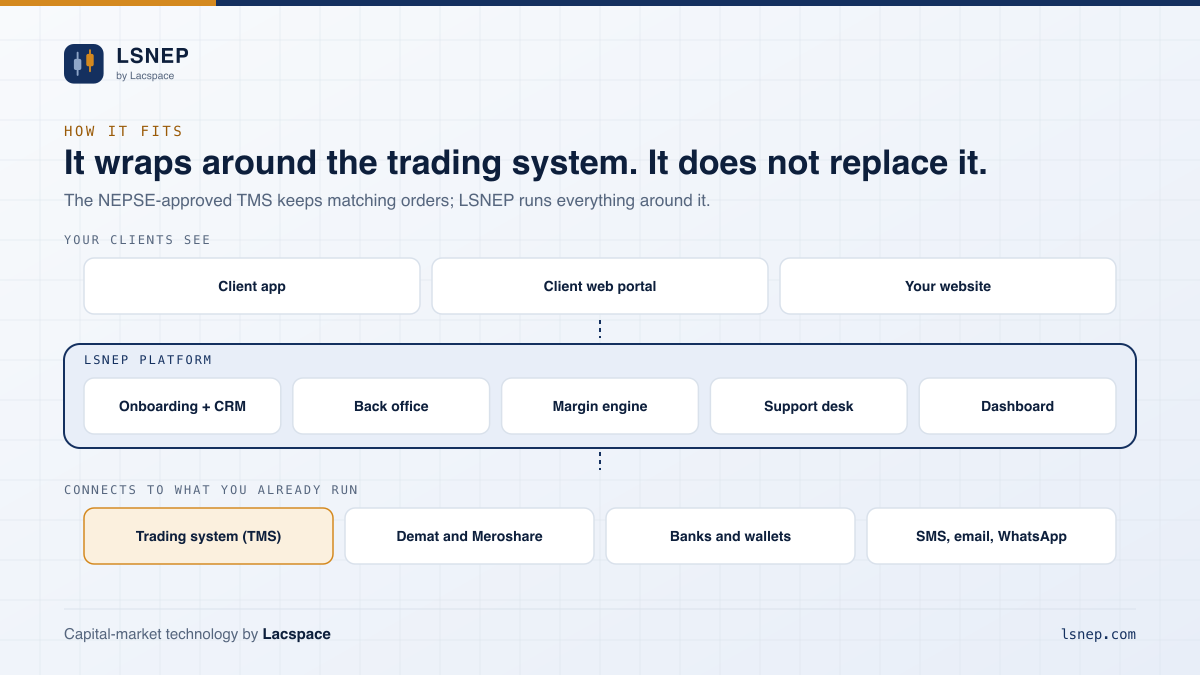
Every broker in Nepal places orders through a trading management system (TMS) approved by NEPSE. LSNEP does not touch order matching. The TMS keeps doing what it does today, and LSNEP handles the client experience, onboarding, records, risk and support around it. That is why the Phase 1 and Phase 2 modules need no new NEPSE approval.
What clients get, and what staff get
A brokerage platform has two audiences, and most systems serve only one well. LSNEP is designed from both sides.
For the brokerage’s clients
- One app for portfolio, holdings, ledger and settlement status, so the question “where is my money?” is answered on screen instead of by phone.
- Top-ups through banks and wallets, payout requests, contract notes and statements, all in one place.
- Price alerts, margin alerts and an IPO calendar, with notifications that reach clients before a problem becomes urgent.
- Support chat that becomes a ticket with an owner, so nothing is lost between branches and phones.
For the brokerage’s team
- One client record shared by onboarding, back office, margin and support, instead of four systems that disagree.
- Roles for branches, compliance and the risk desk, with two-factor sign-in and an audit trail of who changed what.
- A management dashboard showing new accounts, funded clients, open tickets and exposure, without assembling spreadsheets.
- Reports for auditors and the regulator produced from the same records the team works with every day.
What LSNEP is not
LSNEP is software for licensed firms. It is not a broker, an exchange, a depository or an investment adviser. It does not hold client money or securities, it does not match orders, and the market insights inside a broker’s app show data and charts without giving buy or sell advice. Being clear about that boundary is part of what makes it safe for a regulated business to adopt.
Why now
Four forces have made technology the decision of the year for Nepal's brokers:
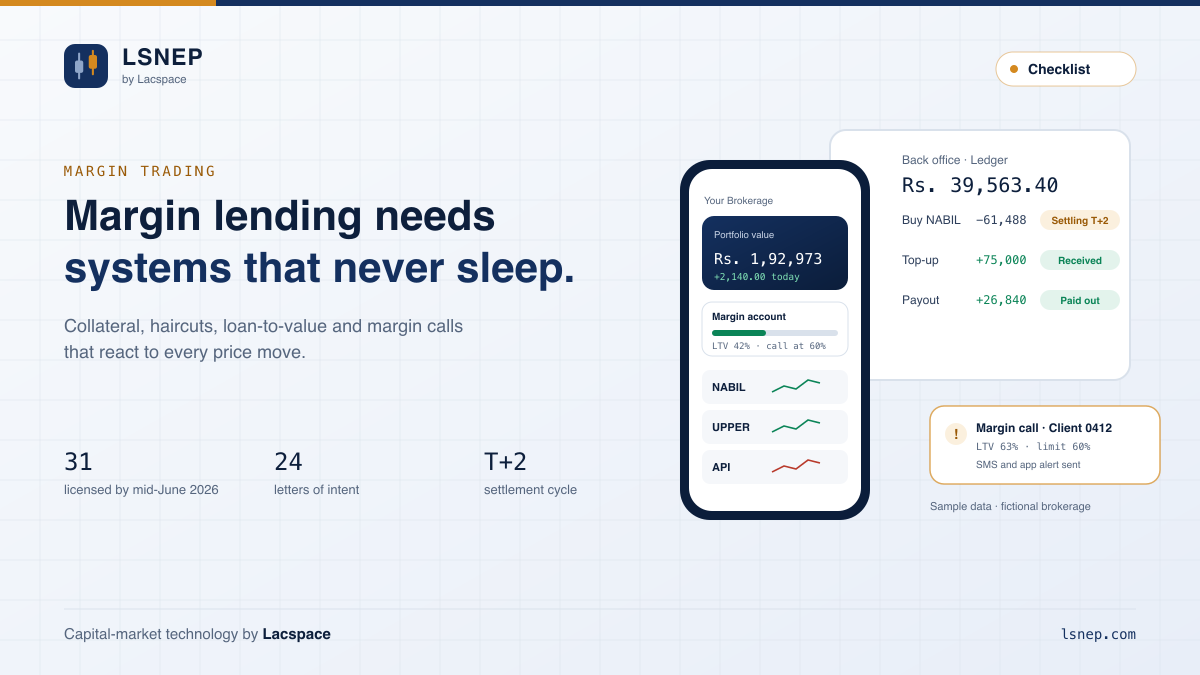
- Margin trading. By mid-June 2026, 31 brokers held a margin licence and 24 more had letters of intent. Lending against shares needs systems that react to every price move. See our margin trading checklist.
- National ID onboarding. Since 3 August 2025, a national ID has been required to open a trading account (ICT Frame). See how to make it fully digital.
- Resilience. On 25 January 2026, a malfunction in one vendor’s TMS stopped 13 brokers from trading (ShareSansar).
- Thinner margins per trade. Commission slabs set since May 2024 run from 0.36% down to 0.24% as trade value rises, so each client relationship has to be served more efficiently.
How a brokerage starts
LSNEP rolls out in phases so that clients get something useful early, and the back office moves only once the front end is stable.
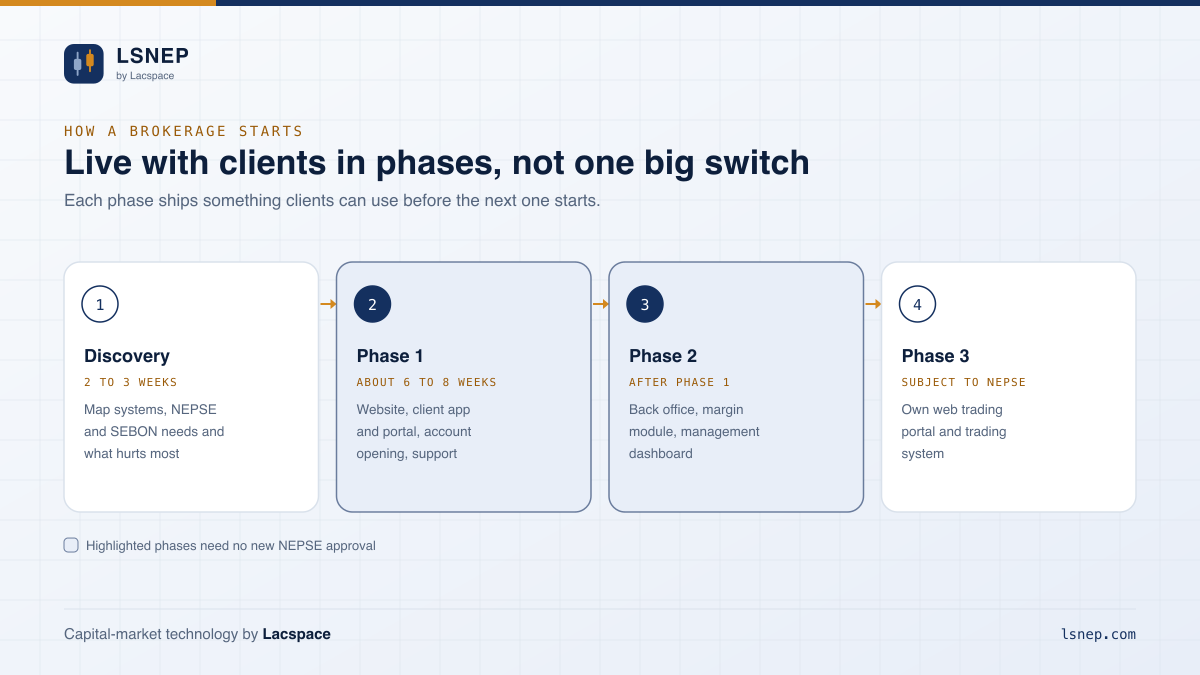
- Discovery (2 to 3 weeks): map current systems, NEPSE and SEBON requirements and the biggest pain points.
- Phase 1 (about 6 to 8 weeks): website, client app and portal, account opening, CRM and support desk.
- Phase 2: back office, margin module and a management dashboard.
- Phase 3, subject to NEPSE approval: an own web trading portal and trading system.
Built for more than brokers
The same platform core, identity and KYC, payments, documents, notifications and audit, also serves merchant bankers and share registrars, depository participants, fund managers and market-data or learning platforms. We cover that in technology beyond brokers.
More on LSNEP: Own TMS in Nepal: what brokers need · Margin trading: a technology checklist · National ID account opening, done digitally · Technology for merchant bankers, DPs and fund managers · What building market platforms taught us
LSNEP is software for licensed capital-market firms, built by Lacspace. It is not a broker, exchange, depository or investment adviser, and nothing in this article is investment advice. Regulatory details are summarised from public reporting and change by notice; confirm current requirements with NEPSE and SEBON.
Frequently asked questions
What is LSNEP?
LSNEP is capital-market technology by Lacspace: a branded client app, web portal, digital account opening, back office, margin trading and support desk for Nepal's stock brokers, all on one platform with one record per client.
Does LSNEP replace a broker’s TMS?
No. LSNEP runs alongside the NEPSE-approved trading system a broker already uses. The TMS keeps matching orders; LSNEP handles the client experience, onboarding, records, risk and support around it.
Does LSNEP need NEPSE approval?
The Phase 1 and Phase 2 modules do not need new NEPSE approval because they do not replace the trading system. Lacspace’s own web trading portal is a later phase and will be offered only once NEPSE approves it.
Whose brand do clients see?
The brokerage's. The app, portal and website carry the broker's name, colours and domain.
Is LSNEP only for stock brokers?
Brokers are the core focus, but the same platform core also serves merchant bankers and share registrars, depository participants, fund managers and market-data or learning platforms.
How do brokers get started?
Book a 30-minute walkthrough at lsnep.com/contact. LSNEP is shown on sample data, and terms are agreed per broker after discovery.