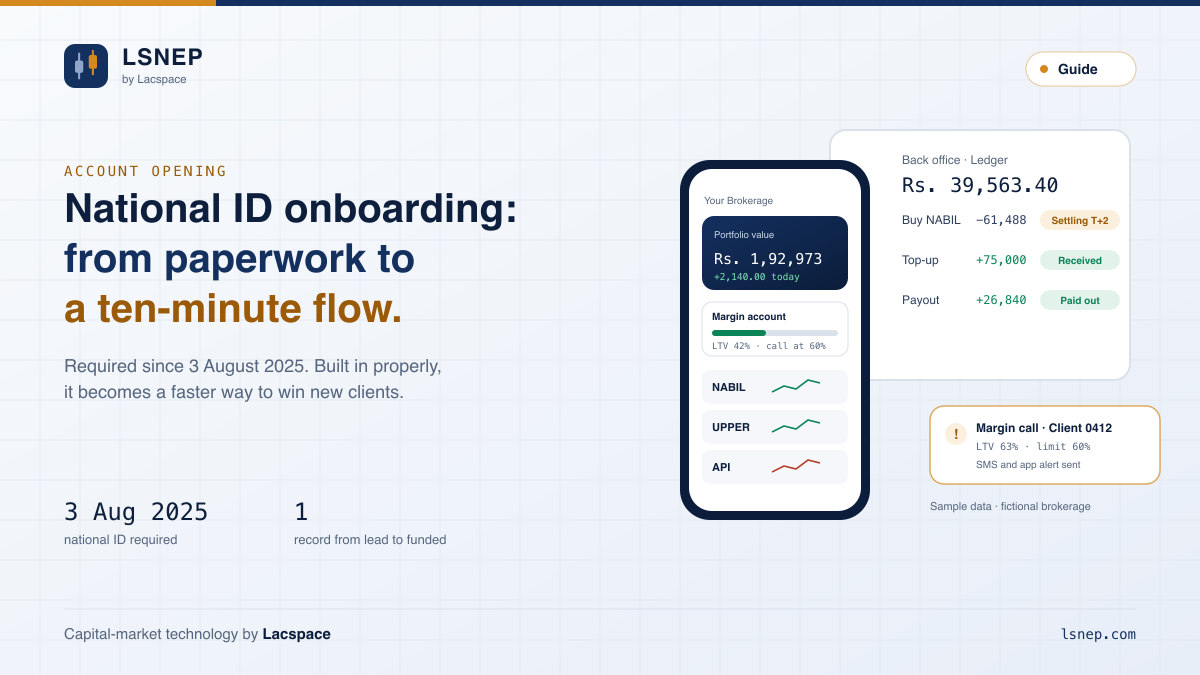
Opening a trading account in Nepal has long meant forms, photocopies and a trip to a branch. Since 3 August 2025, a national ID has been required to open a trading account, and brokers with their own trading systems were told to build it in (ICT Frame). The rule is a compliance requirement. It is also an opportunity: brokers that turn it into a clean, digital flow can win clients at the moment they decide to invest, often after hearing about an IPO.
In short
- A national ID has been required to open a trading account since 3 August 2025.
- A digital flow can capture identity, demat and bank details in one sitting, with review and audit built in.
- The measure that matters is how many applicants finish, not how many start.
- Every lead should be tracked from first visit to funded account.
What changed in August 2025
National ID details now sit at the centre of a new trading account. For brokers, that means account opening has to collect and verify national ID information reliably, alongside the demat details clients already hold through Meroshare and the bank account used for settlement and payouts. If you are new to these pieces, our explainers on how to open a demat account in Nepal and buying a first share through demat, BOID, Meroshare and TMS cover the investor side.
A digital account opening in six steps
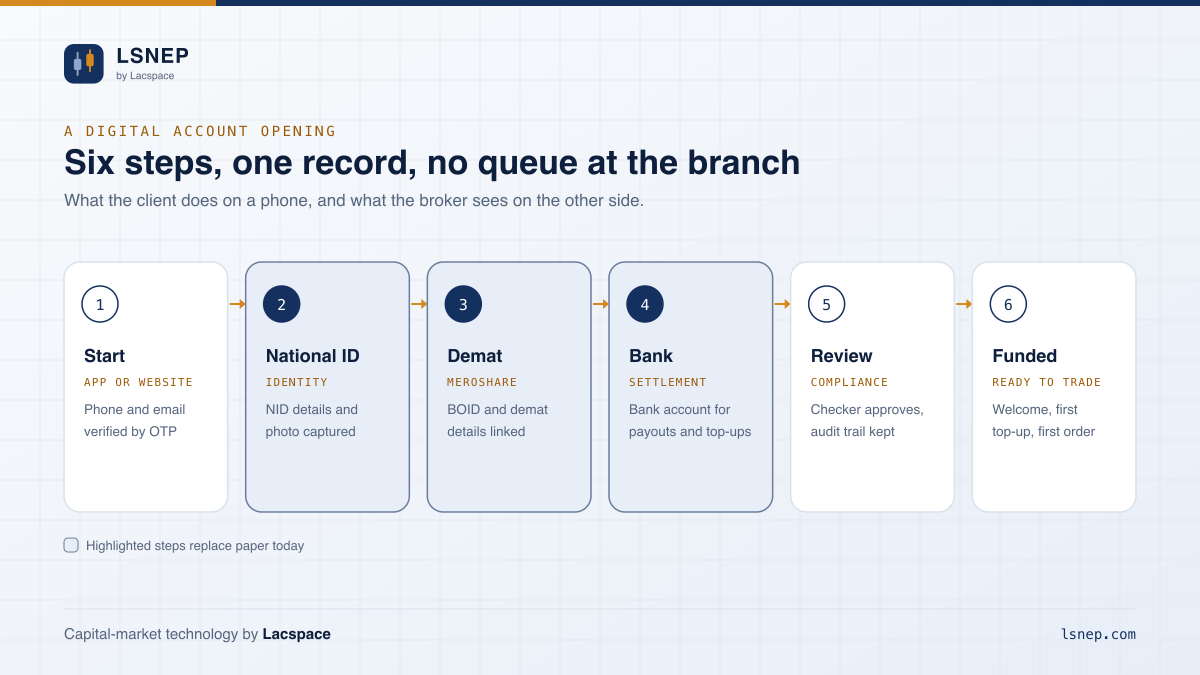
- Start. The applicant begins in the broker’s app or website; phone and email are verified by OTP.
- National ID. National ID details and a photo are captured, with clear guidance on what is needed.
- Demat. BOID and demat details are linked, so the broker can match holdings later.
- Bank. The settlement bank account is added for payouts and top-ups.
- Review. A compliance checker reviews the application; every decision is logged with who made it and when.
- Funded. The client is welcomed, makes a first top-up and is ready to place a first order.
What good digital onboarding looks like
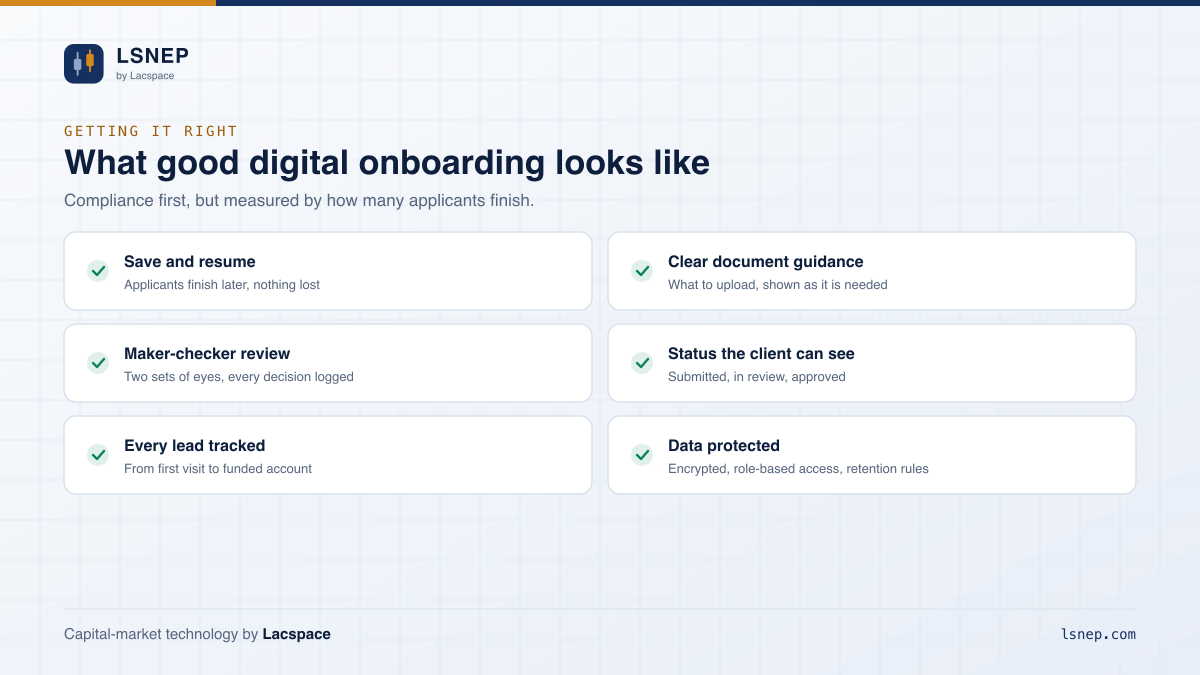
- Save and resume. People start on a phone and finish later. Nothing should be lost.
- Clear document guidance. Show what to upload when it is needed, with examples of what passes.
- Maker-checker review. Two sets of eyes on every approval, with the reason recorded.
- Status the client can see. Submitted, in review, more information needed, approved.
- Every lead tracked. Where applicants drop out tells a broker exactly what to fix.
- Data protected. Identity data encrypted, access by role, and retention rules followed.
Measure the funnel, not the form
A broker can comply with the rule and still lose most applicants to a confusing form. The useful numbers are the share of visitors who start, the share who finish, the time to approval and the share who fund their account. A CRM attached to onboarding turns those into a daily view, and makes it obvious when a step is costing clients.
| Stage | What to watch |
|---|---|
| Visit to start | Is the call to action clear on the website and app? |
| Start to submitted | Which step loses people: identity, demat or bank? |
| Submitted to approved | How long does review take, and why are applications returned? |
| Approved to funded | Does the welcome flow explain how to top up and place a first order? |
Protecting identity data
National ID data is among the most sensitive information a broker holds. A digital flow should be built so that protecting it is the default, not an afterthought:
- Encrypt identity documents and details in storage and in transit.
- Limit access by role: the staff who review applications see what they need; others do not.
- Log every view and change of an applicant’s record, so questions can be answered later.
- Keep data only as long as regulation and policy require, and make deletion on a valid request possible.
- Never send identity documents over personal messaging apps or email attachments.
Do not forget assisted onboarding
Not every client will finish on a phone alone. Older investors, first-time users and clients in areas with patchy connectivity may want help. The same digital flow should work at a branch counter, with a staff member guiding the applicant on a tablet and the record going into the same review queue. That keeps one process, one audit trail and one set of rules, whether the client opened the account at home or with help.
Why it matters for growth
New investors often arrive in waves, around popular public issues and market rallies. A broker that can open an account the same day, on a phone, catches those waves. A broker that needs a branch visit often loses them to one that does not. The national ID requirement raises the bar for everyone, so the brokers who make it painless stand out.
How LSNEP helps
LSNEP’s account opening and CRM module runs this flow in the broker’s own brand: national ID, demat and bank details captured in one sitting, maker-checker review with an audit trail, status for the client, and every lead tracked from first visit to funded account. It feeds the same client record used by the client app, back office and support desk.
For brokers that also act as depository participants, the same record can carry demat requests later, so the client who opened a trading account does not have to repeat their details for a pledge or a transfer.
More on LSNEP: Introducing LSNEP · Own TMS in Nepal: what brokers need · Margin trading: a technology checklist · Technology for merchant bankers, DPs and fund managers
LSNEP is software for licensed capital-market firms, built by Lacspace. It is not a broker, exchange, depository or investment adviser, and nothing in this article is investment advice. Regulatory details are summarised from public reporting and change by notice; confirm current requirements with NEPSE and SEBON.
Frequently asked questions
Is a national ID required to open a trading account in Nepal?
Yes. Since 3 August 2025, a national ID has been required to open a trading account, as reported by ICT Frame.
Can trading accounts be opened fully online?
A broker can run a digital flow that captures national ID, demat and bank details and routes the application to compliance review. The exact checks are set by regulation and the broker’s own policy.
What is maker-checker review?
Maker-checker means one person prepares or checks an application and a second person approves it, with both actions recorded. It reduces errors and creates an audit trail.
Why do applicants drop out of account opening?
Common reasons are unclear document requirements, long forms that cannot be saved and resumed, and no visible status after submission. Tracking each step shows where to fix the flow.
Does digital onboarding need a new TMS?
No. Account opening and CRM run alongside the broker’s existing NEPSE-approved trading system.
How does LSNEP handle onboarding?
LSNEP’s account opening and CRM module captures national ID, demat and bank details in the broker’s brand, supports maker-checker review with an audit trail, shows status to the client and tracks every lead to a funded account.