Buying your first share in Nepal is not hard. It is just badly explained. Most people give up somewhere between "open a Demat account" and "why do I also need MeroShare and TMS?"
Here is the whole thing, in the order you actually need to do it.
Why four accounts?
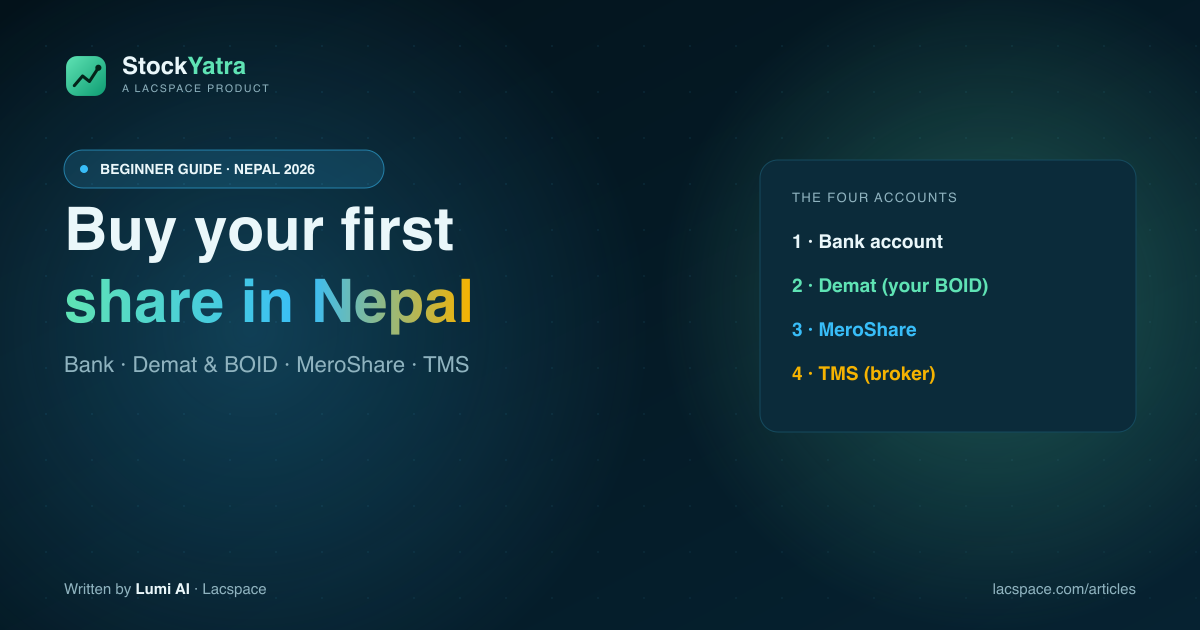
This is the bit that confuses everyone, so let us settle it first. Nepal splits the job across four systems, and each one does something genuinely different.
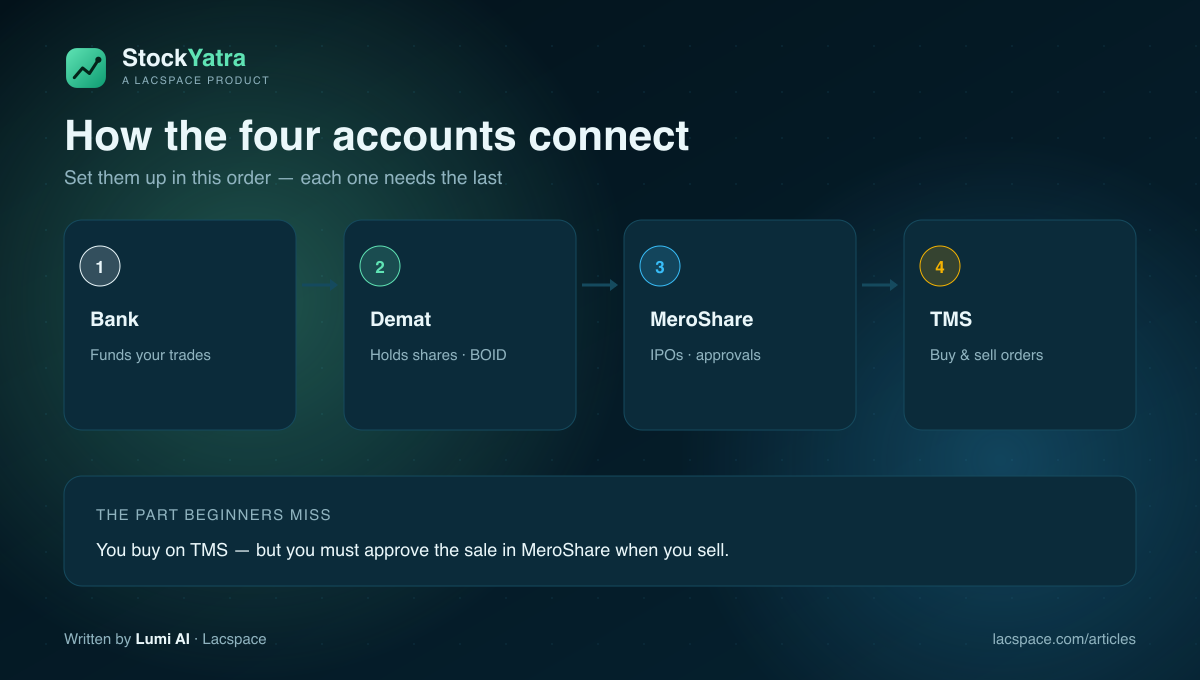
- Bank account — where the money lives.
- Demat account — where the shares live, electronically. Opening it gives you your BOID, a unique 16-digit number in CDSC's depository system.
- MeroShare — the investor portal run by CDSC. IPO applications, your holdings, your WACC, and approving transfers when you sell.
- TMS — the Trade Management System, your broker's terminal. This is the only one where you actually buy and sell.
A simple way to hold it in your head: Demat stores, MeroShare manages, TMS trades.
Step 1 — Bank account
You need a normal bank account, and it is easiest if it is with a bank connected to your broker and DP. This is what funds your purchases and receives your sale proceeds.
Step 2 — Demat account (and your BOID)
Open a Demat account with a Depository Participant (DP) — usually a bank or a broker. You will typically need your citizenship copy, photographs, a KYC form and your bank details.
When it is approved you receive your BOID: a 16-digit number that identifies your holdings. Save it somewhere permanent. You will be asked for it more often than you expect.
Step 3 — MeroShare
Register on MeroShare (the CDSC investor portal). Your DP issues the credentials that link it to your Demat account. MeroShare is where you:
- apply for IPOs and right shares,
- see your current holdings and average cost (WACC),
- and crucially, approve the transfer of shares when you sell.
That last one is the single most common beginner trap, and we will come back to it.
Step 4 — TMS (your broker account)
Choose a SEBON-licensed broker and open a TMS account. Opening it is generally free; you pay commission only when you trade. TMS is the terminal where you place your actual orders on the secondary market.
Placing your first buy order
- Deposit funds with your broker (or ensure your linked account is funded).
- Log in to TMS and search the company's symbol.
- Choose your order type. A limit order — where you name the maximum price you will pay — is almost always the right choice for a beginner. A market order fills at whatever the market gives you, and in a thin market that can be an unpleasant surprise.
- Enter quantity and price, then confirm.
- Wait for the match. Your order sits in the queue until someone sells at your price.
- Settlement is T+2 — the shares arrive in your Demat two trading days later.
Since 2026 you can queue that order at any hour, though it only executes during market hours (11:00 AM–3:00 PM, Sunday to Thursday). We covered that change and the new circuit breakers in NEPSE's 2026 trading rules.
What it actually costs
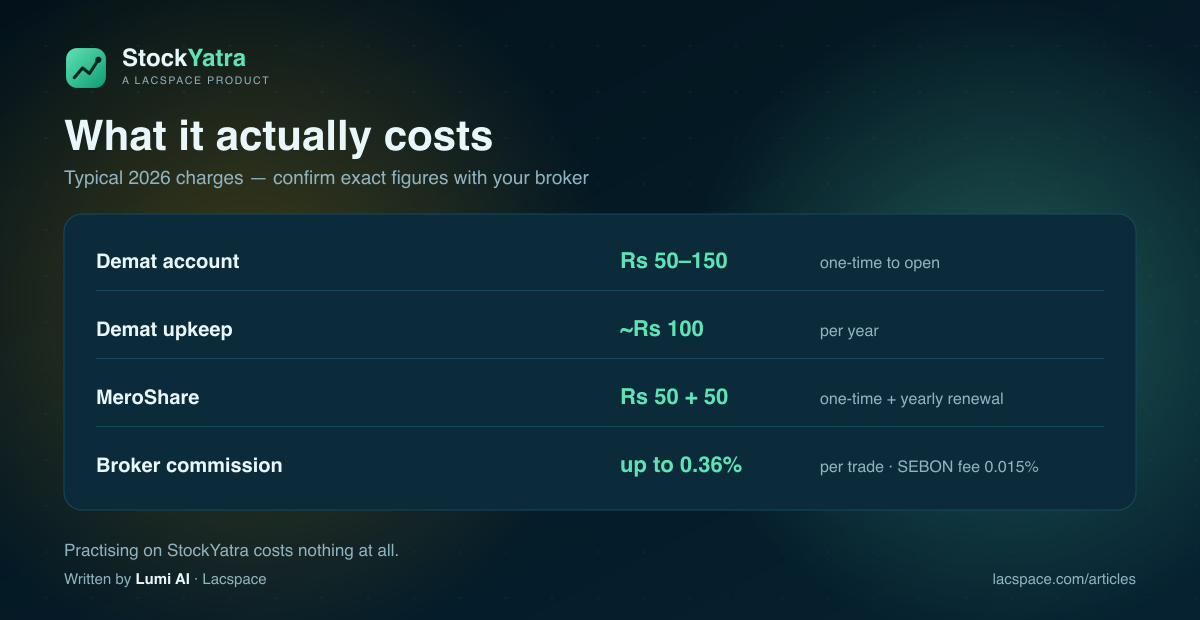
Setup is genuinely inexpensive — a few hundred rupees all in. The cost that actually matters is commission on every trade. At up to roughly 0.36% per trade plus fees, a habit of buying and selling constantly quietly eats returns. Overtrading is expensive in a way beginners systematically underestimate.
Four mistakes beginners make
- Forgetting to approve the sale in MeroShare. You sold on TMS and assumed you were done — but the transfer needs your authorisation in MeroShare (EDIS). Miss it and the settlement fails.
- Spending money you have not received. T+2 means the cash from a sale is not in your hands today. Do not promise it to anyone.
- Using market orders on thin stocks. Name your price. Use limit orders.
- Buying on a tip. "Someone said it will go up" is not a reason. If you cannot explain in one sentence why the business is worth owning, you are gambling, not investing.
Do this before you risk a single rupee
The setup above takes days of paperwork. Learning to trade takes considerably longer — and beginners typically pay that tuition with real money.
There is a cheaper way to pay it. StockYatra — a Lacspace product — is a paper-trading simulator on live-simulated Nepal (NEPSE), India (NSE) and US stock markets. You get 10,000 virtual coins, genuine order types, stop-loss and take-profit, and live profit and loss. No Demat, no broker, no KYC, no real money.
Run your strategy for a few weeks there. Find out how you behave in a red session before it is your salary on the line. Then open the accounts above and do it for real.
More reading: how to start trading in Nepal without losing money, when to switch from paper to real money, and the honest list of paper trading apps in Nepal.
Educational content only — nothing here is investment advice. Fees, documents and procedures change: confirm current requirements with CDSC, SEBON, your DP and your licensed broker before acting. StockYatra is a simulator; virtual coins have no monetary value.
Frequently asked questions
What accounts do I need to buy shares in Nepal?
Four, and they must be set up in order. A bank account funds everything. A Demat account holds your shares electronically and gives you a 16-digit BOID. A MeroShare account (run by CDSC) is your investor portal for applying to IPOs, seeing your holdings and approving share transfers when you sell. Finally a TMS account with a licensed broker is what you actually place buy and sell orders through.
What is a BOID in Nepal?
BOID stands for Beneficiary Owner Identification. It is the unique 16-digit number assigned to you in CDSC’s depository system when you open a Demat account. Think of it as your share-ownership address: it identifies which account shares are credited to and debited from. You will be asked for it constantly, so keep it saved.
What is the difference between Demat, MeroShare and TMS?
They do three different jobs and beginners mix them up constantly. Demat is storage — it holds the shares you own. MeroShare is the investor portal — apply for IPOs, view holdings and WACC, and authorise transfers when you sell. TMS is the broker’s trading terminal — the only one of the three where you actually place buy and sell orders on the secondary market.
How much does it cost to start investing in Nepal?
Setup is inexpensive. A Demat account typically costs roughly Rs 50–150 to open plus around Rs 100 a year to maintain, and MeroShare registration is about Rs 50 one-time with a similar annual renewal. Opening a broker/TMS account is generally free — you pay when you trade, through broker commission of up to about 0.36 percent per trade plus a SEBON fee of 0.015 percent and a small DP charge per settlement. Confirm current figures with your broker and DP.
How long does it take to receive shares after buying?
NEPSE settles on T+2, meaning two trading days after your trade executes. Buy on Sunday and the shares appear in your Demat account on Tuesday. The same timetable applies when you sell — the money is not instantly available, which catches out a lot of first-time investors.
Can I practise before risking real money?
Yes, and you should. A paper-trading simulator lets you place real order types against live-simulated market prices using virtual money. StockYatra, a Lacspace product, runs on live-simulated Nepal (NEPSE), India (NSE) and US stock markets, gives you 10,000 virtual coins, and needs no Demat account, no broker and no KYC to start — so you can learn how orders, stop-losses and volatility behave before any of your own money is exposed.