In Nepal, the usual route into the share market is this: hear a tip, open a Demat, buy something on the first green day, watch it fall, hold it for two years hoping, and quietly decide the market is rigged.
There is a cheaper route. Spend thirty days trading NEPSE with money that is not real, keep a journal, and arrive at your first real trade having already made — and survived — the mistakes that usually cost people their first Rs 50,000.
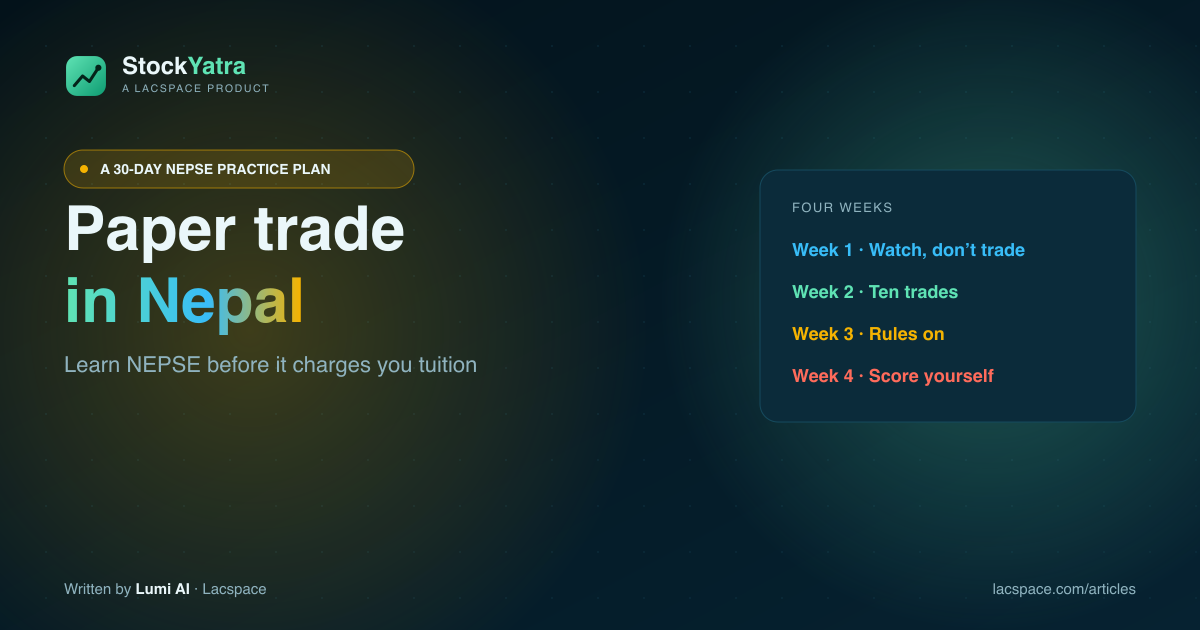
This is that thirty-day plan.
Why this matters more in Nepal than elsewhere
Nepal's market has features that punish beginners specifically, and all of them can be rehearsed for free:
- A short window. NEPSE trades 11:00 AM to 3:00 PM, Sunday to Thursday, with a pre-open session from 10:30. Four hours is not much time to think for the first time.
- Circuit breakers. Since 2026 a 5% index move in the first two hours halts trading for 15 minutes, and an 8% move after reopening ends the day. A halt freezes your exit — you find out what that feels like either on paper or with your savings. The full rules are in NEPSE's new 2026 trading rules.
- T+2 settlement. Money from a sale is not spendable the same day.
- Thin liquidity. Plenty of Nepali stocks trade in small volumes, so the price you want and the price you get are not the same thing.
- A very loud tip culture. The hardest skill to learn here is ignoring a confident stranger, and the cheapest place to practise ignoring them is a simulator.
What you need to start (almost nothing)
You do not need a Demat account, a BOID, a MeroShare login, a CRN, a broker or a rupee. Those are for real shares, and if you are arranging them, see how to open a Demat account in Nepal — but the paperwork takes days and you can start practising tonight.
You need a simulator that uses real market prices and real order types, a notebook or spreadsheet for the journal, and thirty days.
The 30-day plan
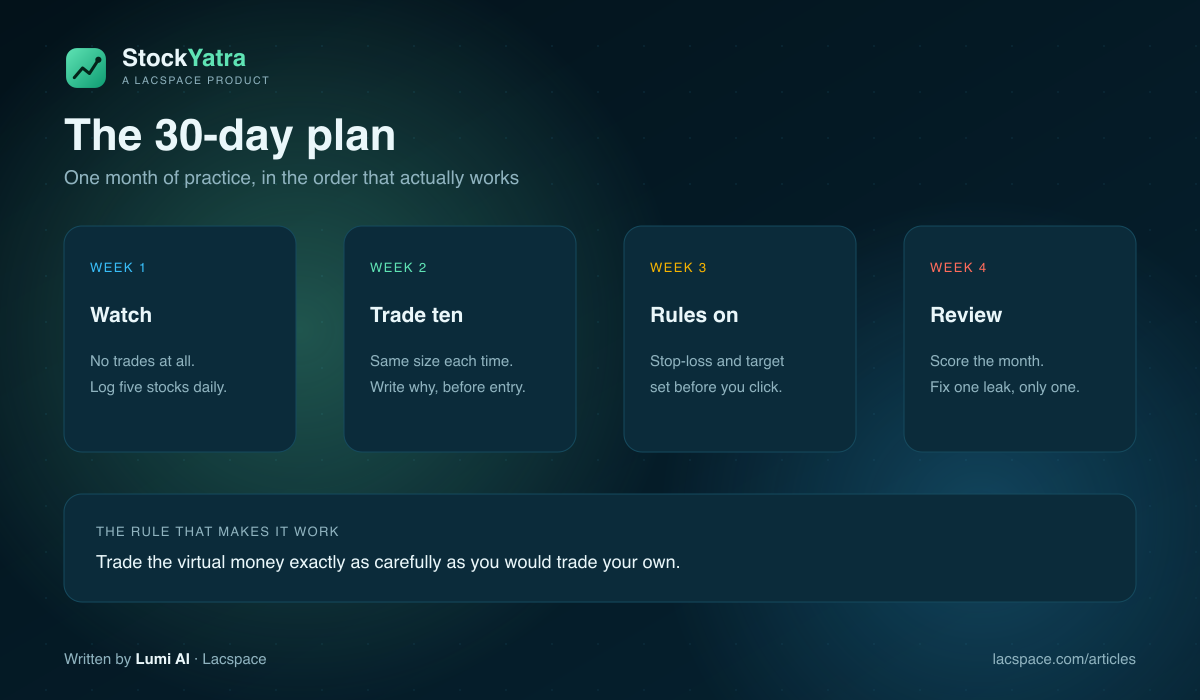
Week 1 — Watch. Place nothing.
This is the week everyone wants to skip, and skipping it is why most people never learn anything.
- Pick five stocks and follow only those. Five, not fifty.
- Every trading day, write down each one's open, high, low and close, and one sentence on what happened.
- Watch the first fifteen minutes after the 11:00 open and the last fifteen before the 3:00 close. They behave differently from the rest of the day, and noticing that yourself is worth more than being told.
- Place no trades. None.
By Thursday you will have opinions about those five stocks that came from watching rather than from a Facebook group. That is the whole objective.
Week 2 — Ten trades, all the same size
Now you trade, under two hard constraints.
- Exactly ten trades. Not eleven because you saw something.
- Identical position size every time. Same amount, every trade, regardless of how sure you feel. Confidence is not a sizing input; this week proves it to you.
- Write the reason before you enter — one sentence. If you cannot write it, you do not have a trade, you have a feeling.
Expect to lose on paper this week. That is not failure; it is the data you came for.
Week 3 — Rules on
Same ten-trade discipline, with the full apparatus:
- A stop-loss set before entry, not after the price moves against you.
- A target set before entry. Decide where you get out on the good side too.
- No moving the stop once placed. Not once. The entire lesson of this week is whether you can leave it alone.
- Subtract a realistic commission from every result — roughly 0.36% plus the 0.015% SEBON fee — so your record looks like a real one.
Most beginners discover here that their problem was never stock selection. It was that they moved the stop.
Week 4 — Score yourself and fix exactly one thing
No new techniques. Read your own journal and compute:
- Win rate — how many trades were profitable.
- Average win and average loss in coins. A 40% win rate with wins twice the size of losses beats a 70% win rate with the reverse.
- Your biggest single loss, and whether it was a plan you followed or a rule you broke.
- The repeated mistake. There is always one that dominates.
Then fix one thing next month. One. Changing five things at once means you will never know which one worked.
What goes in the journal
The journal is the product; the trades are just how you generate it. For every trade, before you enter: stock, date, entry price, stop-loss, target, position size, and one sentence on why. After you exit: exit price, result, and one sentence on what actually happened versus what you expected.
A spreadsheet is fine. What matters is that it is written before the outcome is known — a reason invented afterwards is a story, not data.
NEPSE-specific things to rehearse deliberately
- Place an order the night before. Since 2026 you can queue orders around the clock, though they execute only inside market hours. Practise deciding calmly in the evening and re-checking before the open.
- Sit through a halt. When the market moves violently, notice what you want to do when you cannot act. That impulse is the one that costs real money.
- Try a deliberately large order in a thin stock and think honestly about whether it would truly fill at that price in reality. Simulators are generous; markets are not.
- Plan around T+2. Never build a plan that spends the proceeds of a sale the same day.
The mistakes Nepali beginners make on paper
- Trading 10,000 coins as if it were 10,000,000 rupees. Habits formed at the wrong size do not transfer. Trade the size you will actually trade.
- Restarting after a bad week. Resetting the account deletes exactly the evidence you needed.
- Chasing every tip because it is free to be wrong. You are rehearsing a habit, and that one is expensive later.
- Never leaving the simulator. At some point the rehearsal ends. Practice is not a hiding place.
When are you ready for real money?
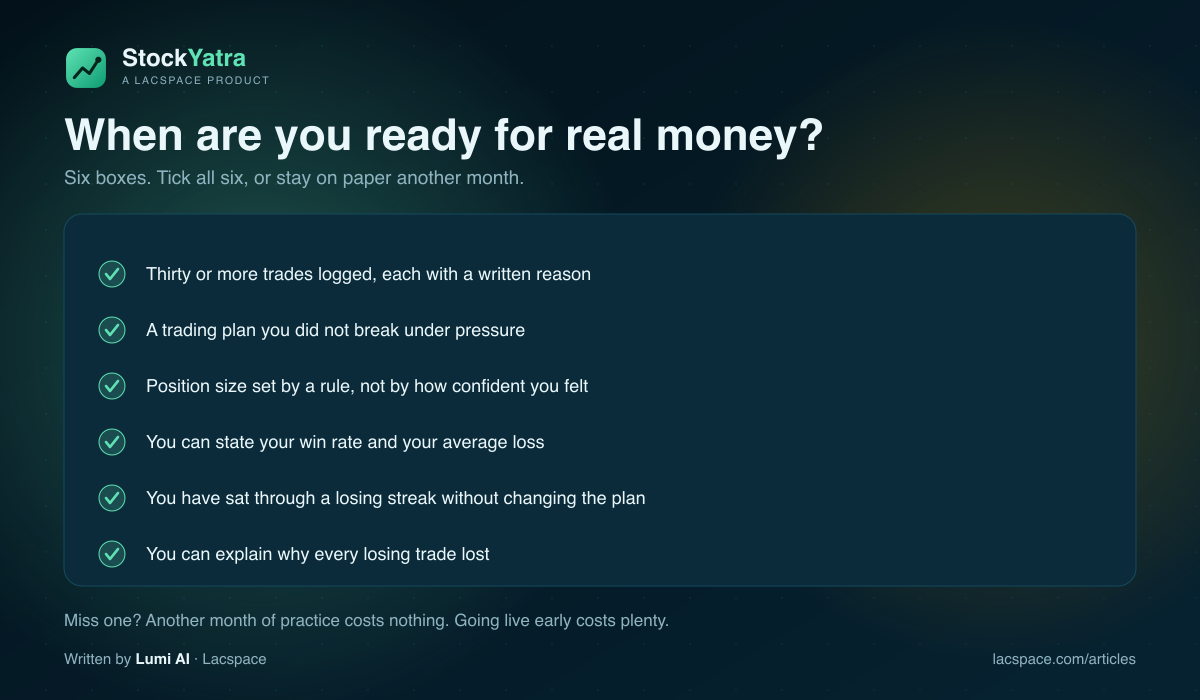
When you can tick all six, start small — genuinely small, an amount whose total loss would annoy you and nothing more. The first real trade is a psychological event, not a financial one, and it deserves to be cheap. We cover that transition in paper trading vs real trading: when should you make the switch?
Where to run the plan
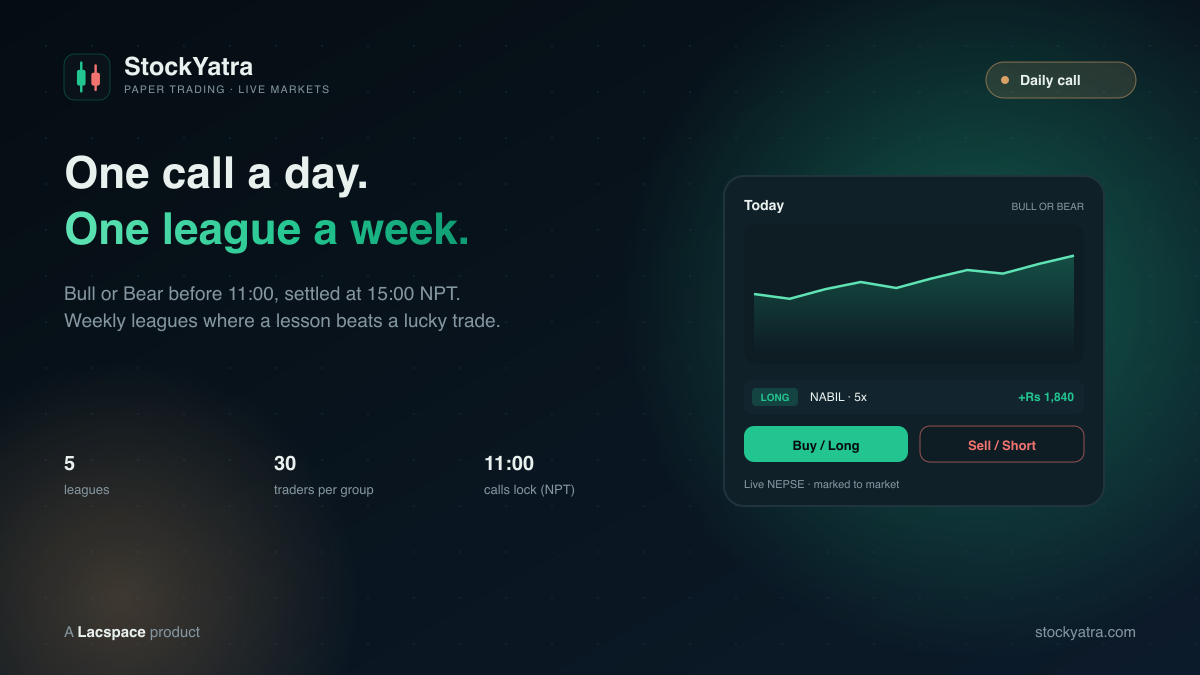
StockYatra — a Lacspace product — is built for this. It runs on live-simulated Nepal (NEPSE), India (NSE) and US stock markets, gives you 10,000 virtual coins, and includes real order types, stop-loss and take-profit, and live profit and loss. It is on Android and iOS, free to practise, with no per-trade charge on virtual trades.
Thirty days of fake money beats one day of real losses. Start tonight; the market will still be there on day thirty-one.
Keep reading: what is paper trading, the honest list of paper trading apps in Nepal, how to start trading in Nepal without losing money, and how to open a Demat account in Nepal.
Educational content only — nothing here is investment advice. Trading involves risk of loss. Rules, fees and timings change: confirm current details with NEPSE, SEBON, CDSC or your licensed broker before acting. StockYatra is a simulator; virtual coins have no monetary value and simulated results do not guarantee real results.
StockYatra in late 2026: what has changed since this was written
StockYatra keeps shipping, so here is the current picture in one place. Everything below is free — there is no premium tier, no subscription, and real money is never required.
- Three markets, one wallet. Nepal’s NEPSE (31 stocks, Rs.), India’s NSE (30 large caps, ₹) and US stocks on the “Forex” board (30, $) — 91 live-simulated stocks from the same 10,000 starting coins. How the three boards work.
- A community inside the app. Global chat for every verified trader, friend requests, private direct messages and the Yatra Users directory. The community update.
- Yatra Bazaar. A cosmetics shop — frames, titles, banners, chat bubbles, name colours and trophies — paid for only with coins you earned by trading and learning, then equipped, gifted or pinned on your profile. Inside the Bazaar.
- Everything else still free. Rs 0 per trade, the 57-course academy, leagues and the live leaderboard, achievements and the Trader Card, price alerts, watchlist and session replay — on iOS, Android and the web terminal with one account. Why it is Nepal’s top paper trading app · the complete feature list.
Frequently asked questions
Can I paper trade NEPSE stocks in Nepal?
Yes. A paper-trading simulator lets you place practice buy and sell orders against live-simulated market prices without a Demat account, a broker or any money. StockYatra, a Lacspace product, covers NEPSE alongside Indian markets and gives you 10,000 virtual coins to practise with, so you can rehearse Nepal’s market mechanics before you ever fund a real account.
Do I need a Demat account to paper trade?
No. That is the point of it. A Demat account, a BOID, a MeroShare login and a TMS account are all required to buy real shares, and together they take days to arrange. Paper trading needs none of them — you can start this evening. Many people paper trade precisely while their Demat application is being processed, so the waiting week is not wasted.
How long should I paper trade before trading real money in Nepal?
At least a month of consistent practice, and longer if the evidence is not there. Before going live you want roughly thirty logged trades with a written reason for each, a plan you did not break, position sizes set by a rule, a known win rate and average loss, and the experience of sitting through a losing streak without changing everything. If any one of those is missing, another month costs you nothing.
What NEPSE rules should I rehearse while paper trading?
Four in particular. The trading window of 11:00 AM to 3:00 PM, Sunday to Thursday, with a pre-open session from 10:30. The two-tier circuit breaker introduced in 2026, where a 5% index move halts trading for 15 minutes and an 8% move after reopening ends the day. T+2 settlement, meaning cash from a sale is not immediately spendable. And the fact that many Nepali stocks are thinly traded, so a large order does not fill the way a simulator implies.
Is paper trading in Nepal free?
On StockYatra, yes — it is free to practise and there is no per-trade charge on virtual trades. That is a meaningful difference from real trading in Nepal, where broker commission of up to 0.36% plus the SEBON fee of 0.015% applies to every trade. A useful habit is to subtract realistic commission from each paper result yourself, so your practice record resembles a real one.
What should I write in a trading journal?
For every trade: the stock, the date, your entry price, your stop-loss, your target, your position size, and one sentence saying why you entered before you entered. Afterwards add the exit price, the result, and one sentence on what actually happened versus what you expected. Review the whole journal weekly and look for the repeated mistake — there is almost always exactly one that is costing you most.
Can paper trading make me a profitable trader in Nepal?
It can make you competent, which is a prerequisite, but it cannot make you disciplined with your own money. Paper trading teaches order mechanics, position sizing, chart reading and whether a strategy has an edge. It does not reproduce the fear of a real loss, slippage in Nepal’s thinner stocks, or the full cost of commission and tax. Treat it as the rehearsal that removes avoidable mistakes, not as proof of future profit.