Almost every guide to opening a Demat account in Nepal stops at the moment the account is activated. That is exactly where new investors get stuck — holding a live Demat account that cannot buy anything, cannot apply for an IPO, and quietly expires a year later because nobody mentioned the renewal.
This guide covers the whole thing: choosing a DP, the documents, what your 16-digit BOID actually means, the two extra steps that make the account usable, what it costs to run, and the one deadline that silently switches it off.
What a Demat account is — and what it is not
Demat is short for dematerialised. Before it existed, owning shares in Nepal meant owning a physical certificate you had to store, and physically hand over when you sold. A Demat account replaces that paper with an electronic record held centrally by CDSC (CDS and Clearing Limited).
So a Demat account is a vault. It holds what you own.
It is not a trading account. It does not let you place a buy order, and it does not by itself let you apply for an IPO. Those are separate systems — TMS for trading and MeroShare for public issues — and both of them hang off your Demat. That split is the single biggest source of confusion for beginners, and we walk through the full chain in how to buy your first share in Nepal.
Who can open one
- Any Nepali citizen aged 16 or above, with a citizenship certificate.
- Minors — opened in the child's name, operated by a guardian, using the birth certificate plus the guardian's citizenship.
- Joint holders — allowed, with documents for every holder. Note that a joint Demat complicates IPO applications, so most people keep an individual account.
- NRNs and foreign nationals — permitted under specific rules, using a passport and NRN identification. Ask your DP about the current conditions before you travel to a branch.
Step 1 — Choose your Depository Participant (DP)
You do not open a Demat account with CDSC directly. You open it through a Depository Participant: a bank, financial institution or capital company licensed to act on CDSC's behalf. There are around 54 institutions acting as DPs across Nepal, between them covering thousands of branches, so access is rarely the problem. Choosing well is.
What actually differs between DPs:
- Whether they open the account online. The good ones let you do everything from your phone; others still want you at a counter.
- Speed of activation. Three days at a responsive DP, over a week at a slow one.
- Whether they also issue your CRN. If your DP is the same bank that holds your account, the C-ASBA registration is usually one conversation instead of two.
- Renewal convenience. Some DPs sell multi-year or lifetime renewal, which removes the annual deadline problem permanently.
- Support when something breaks. This matters far more than the Rs 50 difference in opening fee. You will need them one day, for a blocked account or a transfer.
Practical advice: open the Demat at the same bank where you keep the account you will actually fund trades from. One institution, one KYC, one CRN, one phone number to call.
Step 2 — Gather the documents
Nothing exotic, but missing one item is the usual reason an application sits idle:
- The DP's account opening form, completed and signed.
- A copy of your citizenship certificate (both sides) — passport for foreign nationals.
- Two passport-size photographs, recent.
- Your bank account details — account number, branch, and often a cancelled cheque or a statement copy.
- Your PAN, where the DP requests it.
- For a minor: birth certificate plus the guardian's citizenship.
Carry the originals if you are applying in person. If you are applying online, photograph the documents flat, in daylight, with all four corners visible — blurred or cropped uploads are the number one cause of a rejected application.
Step 3 — Apply, and wait a few days
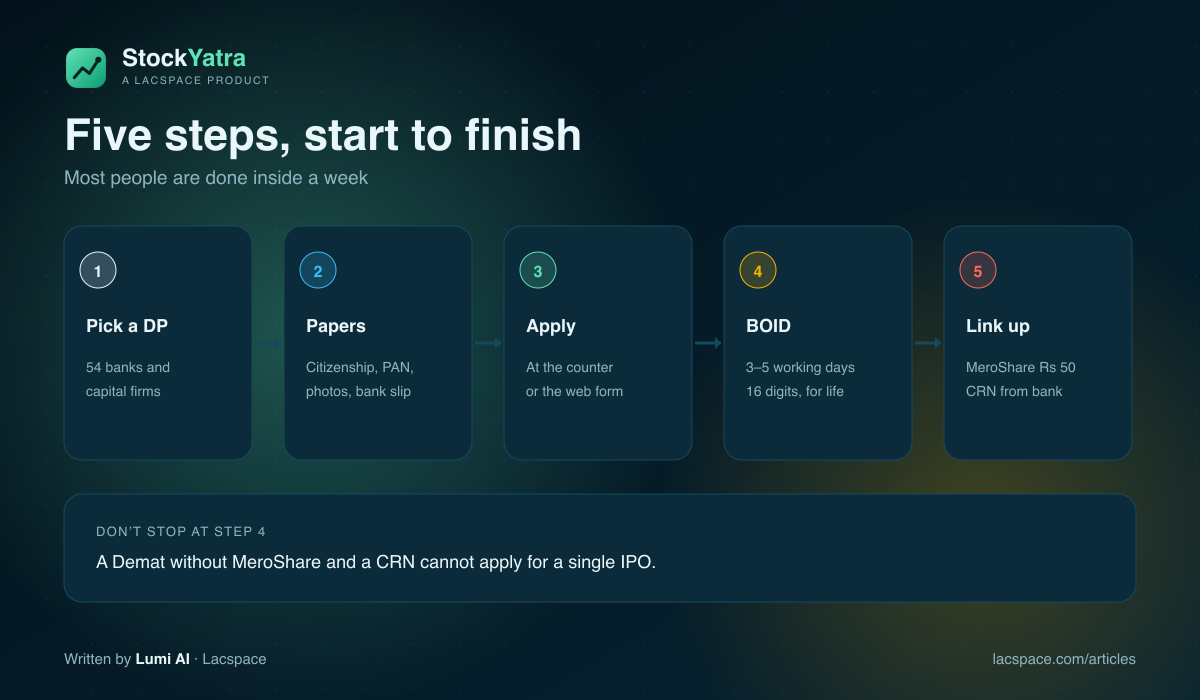
Submit at the branch or through the DP's online form. You will also set a signature specimen and nominate a beneficiary — do fill in the nomination. It costs nothing now and saves your family a great deal of difficulty later.
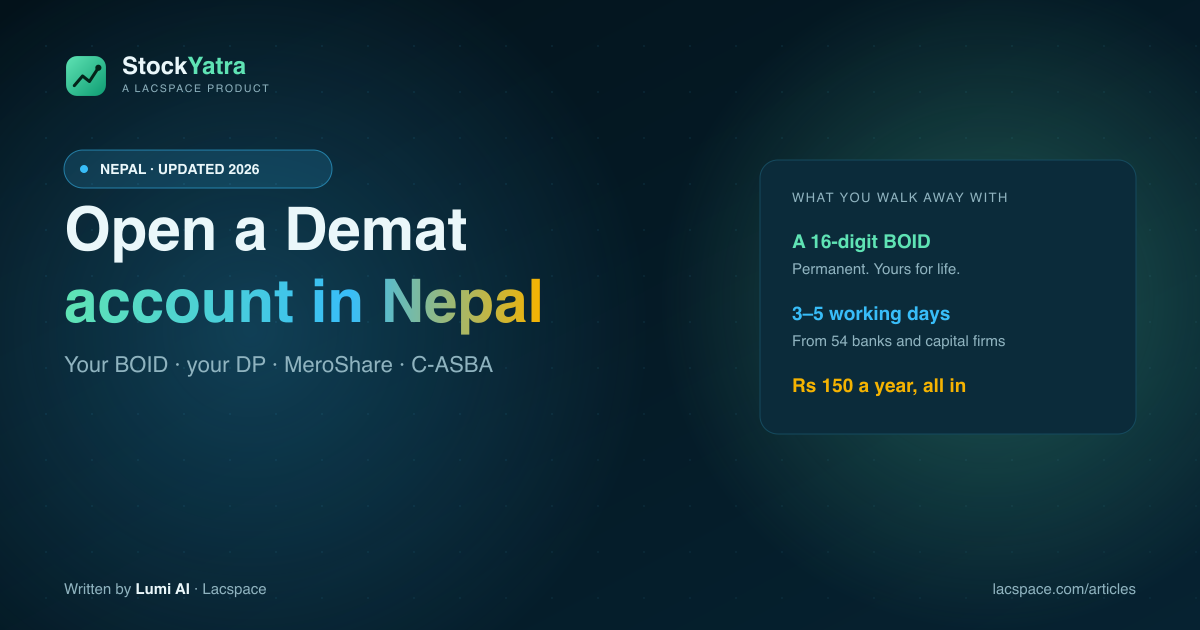
Activation typically takes three to five working days. When it completes, you get your BOID.
Step 4 — Understand your BOID
Your BOID — Beneficial Owner Identification number — is a 16-digit code, and it is your permanent identity in Nepal's share market. Every IPO allotment, every trade, every dividend is tagged to it.
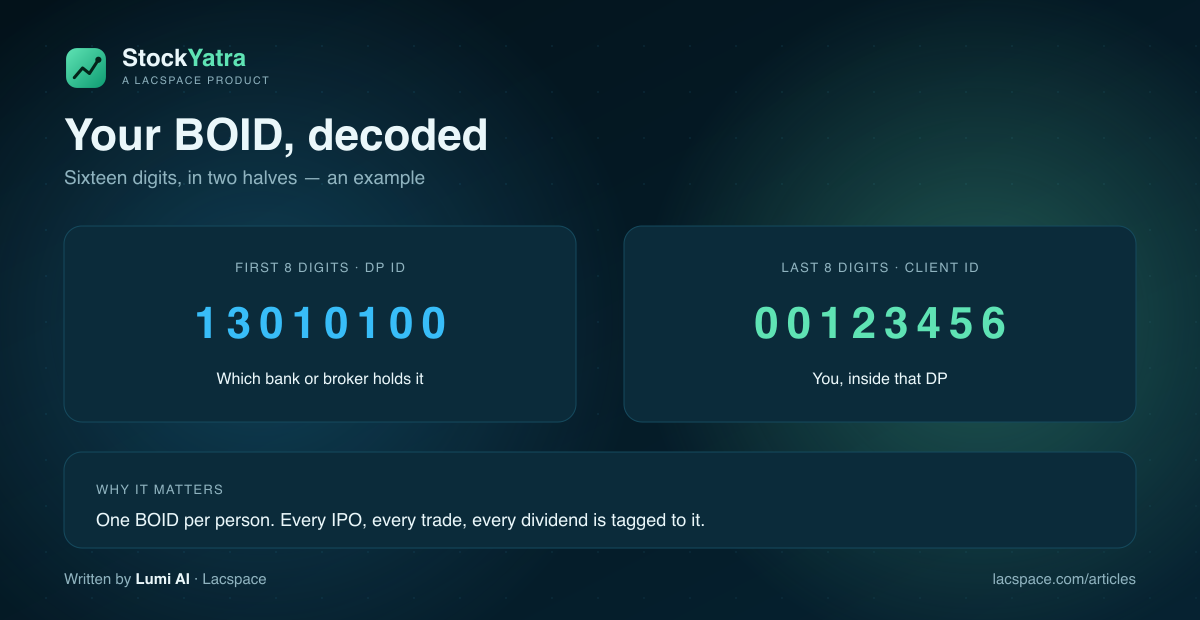
It splits cleanly in two:
- First 8 digits — the DP ID. Which bank or capital company holds your account. Everyone at the same DP shares these eight digits.
- Last 8 digits — your client ID. You, inside that DP.
Lost it? It is on the confirmation your DP issued, on your MeroShare profile page, and on any IPO allotment message you have ever received. Your DP will also read it out to you after verifying your identity. Save it somewhere you will find it in two years — you will be asked for it far more often than you expect.
Step 5 — The step most people skip: MeroShare and your CRN
This is where the guides usually stop and the confusion starts. A Demat account on its own cannot apply for an IPO. Two more things have to exist:
- MeroShare — the CDSC portal where you apply for public issues, see your holdings, and approve shares when you sell them. Register through your DP. It costs about Rs 50 to register and roughly Rs 50 a year after that.
- A CRN — your C-ASBA Registration Number, issued by your bank, not your DP. C-ASBA stands for Centralized Application Supported by Blocked Amount: instead of sending money away when you apply for an IPO, the bank simply blocks the amount in your account until the allotment is decided. The CRN is what ties your bank account to your BOID so that blocking can happen.
No CRN, no IPO applications. If you have ever heard someone say "I have a Demat but I still cannot apply", this is always why.
And if you intend to buy and sell on the secondary market rather than only chase IPOs, you need a third thing: a TMS account with a licensed broker. That one is usually free to open.
What it actually costs to run
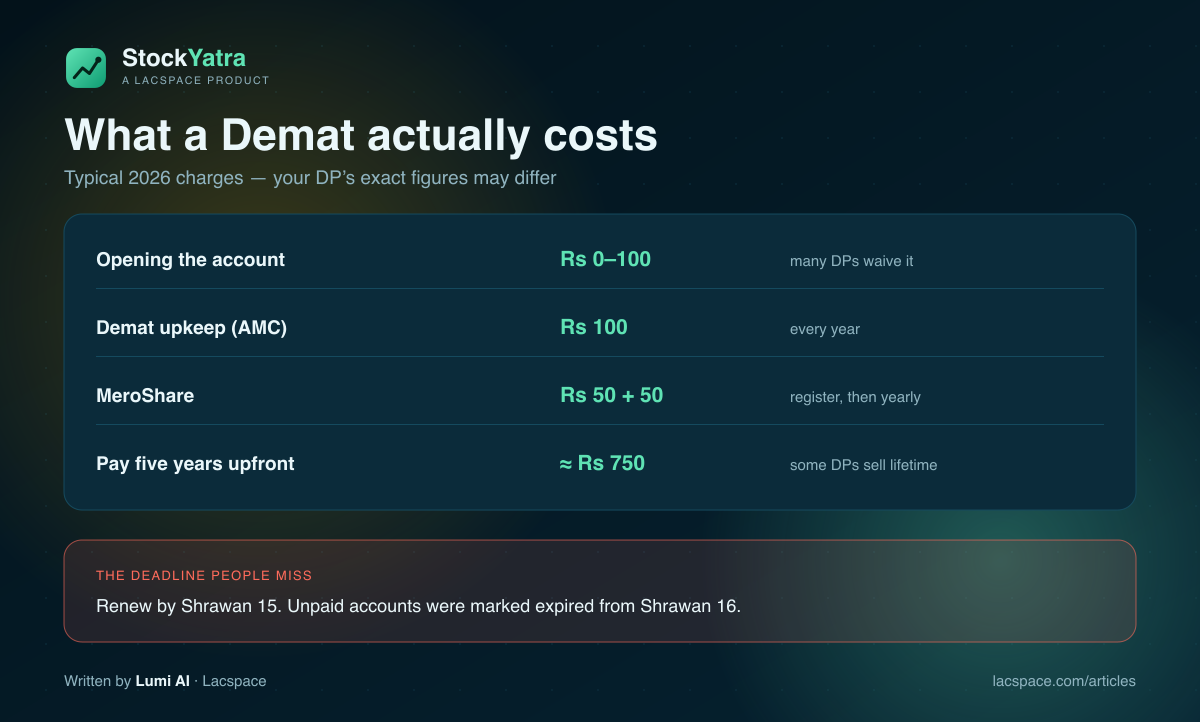
The headline number is small: about Rs 150 a year for the Demat maintenance charge plus MeroShare. Opening is free or near enough at most DPs. Several DPs will take around Rs 750 for five years in advance, and a few sell lifetime renewal for roughly Rs 1,000 — worth considering purely to remove the annual deadline from your life.
Trading costs are separate and much larger in practice: broker commission of up to 0.36% depending on trade size, plus the SEBON fee of 0.015%, plus capital gains tax on profits. Confirm current rates with your broker — they change.
The renewal deadline that switches accounts off
Here is the part that catches thousands of investors every single year.
Your Demat and MeroShare fees are annual, and CDSC enforces the deadline. The renewal window closes in mid-Shrawan, and accounts that have not paid are marked expired shortly afterwards. In 2026 the deadline was Shrawan 15, and unpaid accounts began being blocked from Shrawan 16.
An expired account is not lost — you simply pay and it reactivates. But while it is expired you cannot apply for public issues, and a transfer can be held up at precisely the wrong moment. Two defences:
- Set a calendar reminder for Ashad, a month before the deadline, every year.
- Or pre-pay several years at once and stop thinking about it.
Why applications get delayed or rejected
- Blurred or cropped document photos on an online application. Shoot flat, in daylight, all corners visible.
- Signature mismatch with your bank records. Sign the way you actually sign at the bank, not a careful new version.
- Name spelled differently across citizenship, bank account and form. It must match exactly, including middle names.
- An expired or unlinked bank account, which then blocks the CRN step later.
- An existing Demat you forgot about. One person, one BOID — if you opened one years ago, reactivate it rather than opening a second.
Use the waiting week properly
Your account takes a few days. Most people spend that time reading price predictions on social media. There is a far better use for it.
A paper-trading simulator needs no Demat, no BOID, no broker and no money. StockYatra — a Lacspace product — runs on live-simulated Nepal (NEPSE), India (NSE) and US stock markets and hands you 10,000 virtual coins with real order types, stop-loss and take-profit, and live profit and loss.
Learn which button does what while the stakes are zero. Then, when the BOID lands, your first real trade is not also your first trade ever.
Keep reading: how to buy your first share in Nepal, NEPSE's new 2026 trading rules, and how to paper trade in Nepal.
Educational content only — nothing here is investment advice. Charges, deadlines and procedures change: confirm current details with CDSC, SEBON, your Depository Participant or your licensed broker before acting. StockYatra is a simulator; virtual coins have no monetary value.
Frequently asked questions
How do I open a Demat account in Nepal?
Pick a Depository Participant — any of the banks, financial institutions or capital companies licensed by CDSC — then submit the application form with a copy of your citizenship certificate, passport-size photographs, your PAN if you have one, and your bank account details. Many DPs now accept the whole thing online. The account is usually activated in three to five working days, at which point you receive your 16-digit BOID. After that, register for MeroShare and get a CRN from your bank, or you will not be able to apply for IPOs.
What documents are required to open a Demat account in Nepal?
A completed DP application form, a copy of your citizenship certificate (passport for foreign nationals or NRNs), two recent passport-size photographs, your bank account number or a cheque copy for the account you will use, and your PAN where the DP asks for it. For a minor, add the birth certificate and the guardian’s citizenship; for a joint account, documents for each holder. Take the originals with you if you apply in person.
How much does a Demat account cost in Nepal?
Opening is cheap and often free — most DPs charge between nothing and about Rs 100. The recurring cost is the annual maintenance charge of roughly Rs 100 a year, plus Rs 50 a year for MeroShare, so about Rs 150 a year in total. Some DPs let you pre-pay around five years at once for roughly Rs 750, and a few sell a lifetime renewal for about Rs 1,000. Broker commission on actual trades is separate.
What is a BOID number and where do I find mine?
BOID stands for Beneficial Owner Identification number. It is the 16-digit code CDSC issues when your Demat account is activated, and it is your permanent identity in Nepal’s share market. The first eight digits identify your Depository Participant; the last eight identify you within that DP. You can find it on the account confirmation your DP gives you, on your MeroShare dashboard under your profile, or by asking your DP directly.
What is a CRN and do I really need one?
CRN is your C-ASBA Registration Number — C-ASBA meaning Centralized Application Supported by Blocked Amount. Your bank issues it, and it links your bank account to your Demat account so the bank can block the application money when you apply for an IPO instead of transferring it away. Without a CRN you can hold shares but you cannot apply for a single public issue, which is why so many new investors are stuck after opening the Demat and wondering what went wrong.
What happens if I do not renew my Demat account?
It stops working. CDSC requires the annual fee to be paid by mid-Shrawan each year, and accounts that have not paid are marked expired shortly after — in 2026 the deadline was Shrawan 15 and unpaid accounts began being blocked from Shrawan 16. An expired account cannot apply for IPOs and will hold up transfers. Renewal is inexpensive and can be done online through MeroShare or your DP, so set a yearly reminder for Shrawan.
Can I practise the share market before my Demat account is ready?
Yes, and it is the sensible use of that waiting week. A paper-trading simulator needs no Demat, no BOID and no broker. StockYatra, a Lacspace product, runs on live-simulated Nepal (NEPSE), India (NSE) and US stock markets and gives you 10,000 virtual coins, so you can learn order types, stop-losses and position sizing while the paperwork clears — and arrive at your first real trade already knowing which button does what.