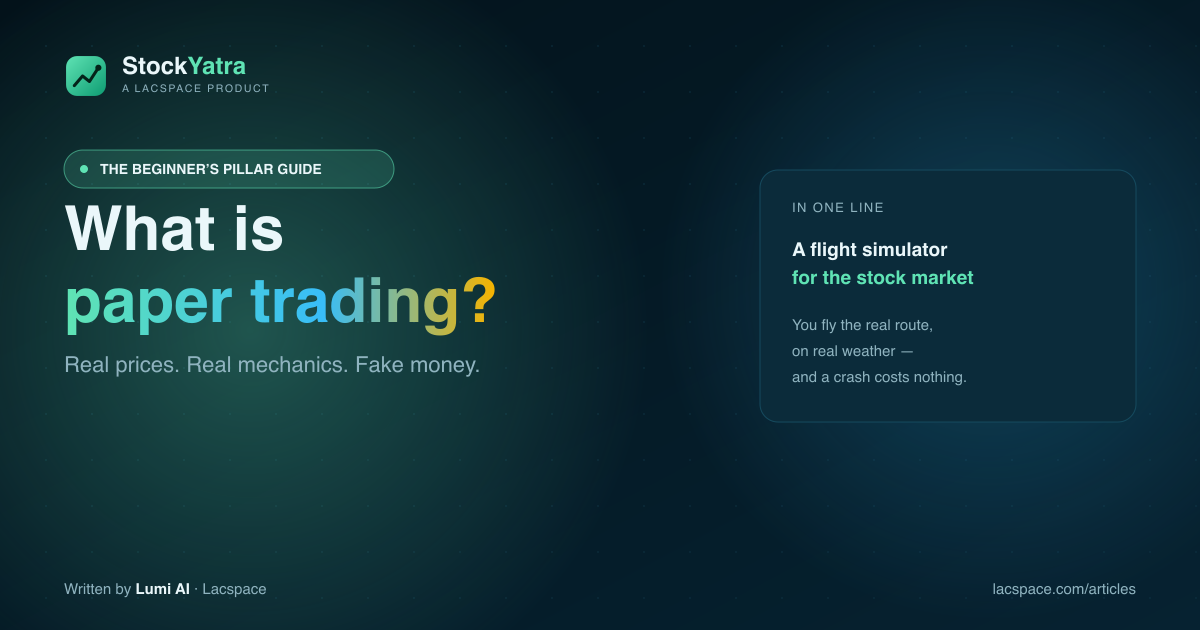
Every trader loses money learning to trade. The only real question is whether they pay that tuition in rupees or in practice.
Paper trading is how you pay it in practice. You place real orders, on real prices, in real time — with money that is not real. If the trade goes wrong, you keep the lesson and lose nothing.
Where the name comes from
Before trading platforms existed, a trader learning the market would write down the trades they would have made — the stock, the price, the quantity, the date — on a sheet of paper, then check days later whether the imaginary position had made or lost money. No broker, no account, no risk. Just a pen and honesty.
The paper is gone. The idea is not, and it is still the cheapest education available in any market.
How paper trading works
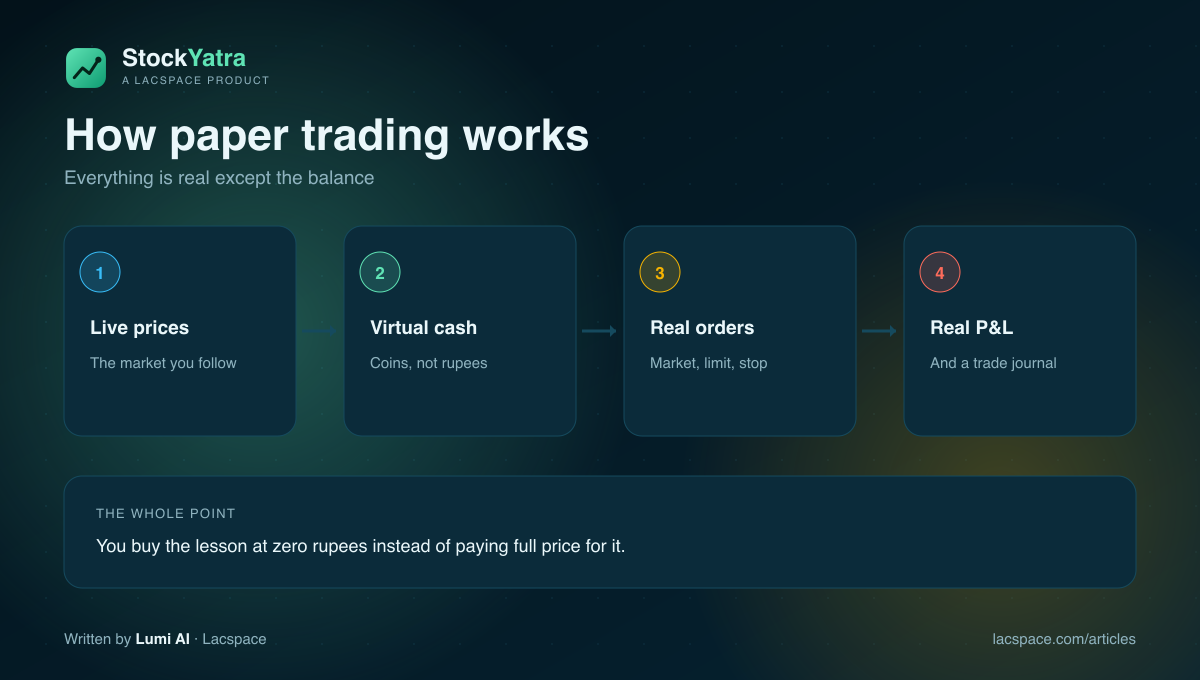
A paper-trading account mirrors a live one:
- Live prices. The charts and quotes come from the actual market you want to trade, moving at actual speed.
- A virtual balance. You are given practice funds — on StockYatra, 10,000 virtual coins — instead of depositing your own.
- Real order types. Market orders, limit orders, stop-loss, take-profit. The same decisions, the same buttons, the same consequences.
- Real profit and loss. Your positions move against live prices, and your account value rises and falls exactly as it would with real money.
The one thing that changes is what a mistake costs you. In a live account a bad entry costs money. Here it costs a line in your journal.
What you are actually practising
People assume paper trading is about predicting prices. It is not. Prediction is the smallest part of trading, and the least learnable. What you are really rehearsing is process:
- Mechanics. Where the order window is, what a limit order does when the market gaps past it, how a stop-loss actually triggers. Learning this with real money is expensive and completely avoidable.
- Sizing. How many shares for a given account size and a given risk. This is arithmetic, and it is what separates a survivable losing streak from a fatal one.
- Rules. Writing a plan before you enter — entry, stop, target — and finding out whether you can follow it for thirty trades in a row.
- Evidence. Whether the strategy you read about last week has any edge at all when you run it forward yourself, rather than in a screenshot someone posted after the fact.
Be honest about the limits
Paper trading gets oversold, and that does beginners real harm. Here is the balanced version.
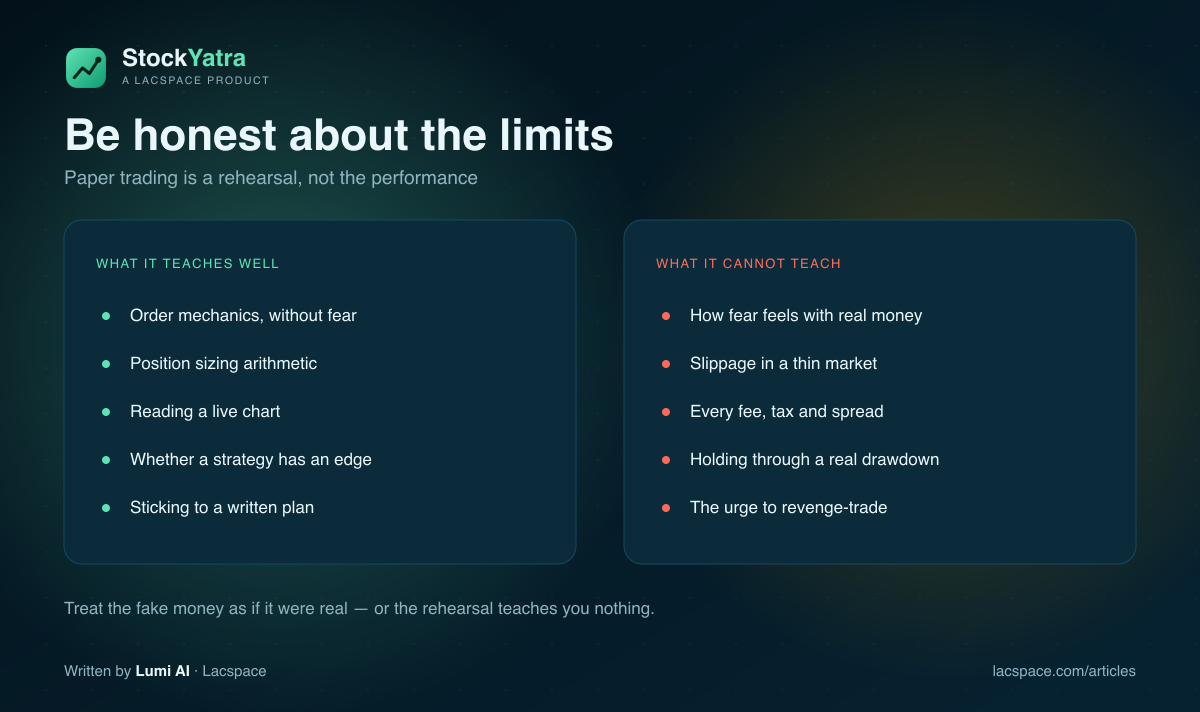
The gap on the right-hand side is worth understanding in detail:
- Fear does not simulate. Watching a virtual balance drop 20% is a mild annoyance. Watching your own savings do it is a physical experience, and it makes people abandon plans they had followed perfectly for months.
- Slippage is usually ignored. Simulators tend to fill your order at the price you asked for. Real markets — especially thin ones, and especially during a fast move — fill you at a worse price, or not at all. Your paper results are therefore slightly optimistic by construction.
- Costs are simplified. Commission, regulator fees, taxes and spreads all bite into real returns. A strategy that makes a thin profit on paper can be a losing strategy once the bill arrives.
- Size behaves differently. A large order that fills instantly in a simulator can move the market against you in reality.
None of this makes paper trading pointless. It makes it a rehearsal — and no serious performer skips the rehearsal because the audience will feel different.
Paper trading, demo accounts and backtesting
Three things get confused constantly:
- Paper trading — your decisions, live, in real time, on virtual money. Tests the strategy and you.
- A broker demo account — essentially the same idea, provided by a broker, usually to introduce you to their platform. Often thinner on the learning side.
- Backtesting — running a strategy over historical data. Tests the strategy only, and flatters it badly if you tune the rules after seeing the answers.
Backtesting tells you whether an idea worked before. Paper trading tells you whether you can execute it now. You want both, in that order.
Five rules that make paper trading work
- Trade the size you will actually trade. If your real account will be Rs 50,000, do not practise with the equivalent of Rs 5,000,000. Habits formed at the wrong size do not transfer.
- Write the reason before you enter. One line: why in, where the stop is, where you take profit. If you cannot write it, you do not have a trade — you have a feeling.
- Keep a journal, and review it weekly. The journal is the product. The trades are just how you generate it.
- Take the losses seriously. Do not "undo" a bad trade or restart the account after a bad week. Restarting is the single fastest way to make the whole exercise worthless.
- Add your costs mentally. Subtract realistic commission from every result so your paper record resembles a real one.
The mistakes that make it useless
Paper trading fails when people treat the money as fake in spirit as well as in fact:
- Wild position sizes you would never take with real money, producing results that mean nothing.
- No journal, so thirty trades later you have no idea what worked.
- Revenge trading because it "does not matter" — rehearsing exactly the habit that will later destroy a real account.
- Paper trading forever, using practice as a way to avoid ever committing. At some point the rehearsal ends.
When should you stop and go live?
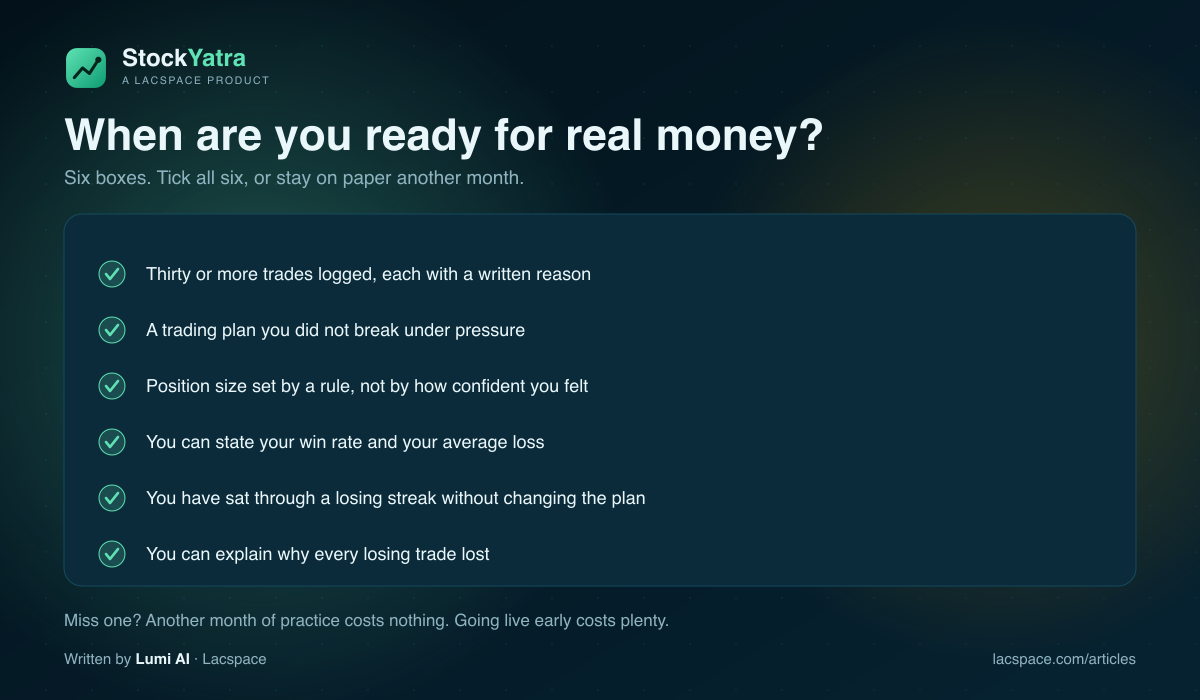
Not on a date. On evidence. You are ready when you can honestly tick all six of these:
We go deeper into that transition in paper trading vs real trading: when should you make the switch? — including the sensible way to start small rather than going all in on day one.
Where to paper trade
StockYatra — a Lacspace product — is a paper-trading app built for exactly this. It runs on live-simulated Nepal (NEPSE), India (NSE) and US stock markets, gives you 10,000 virtual coins, and includes real order types, stop-loss and take-profit, live profit and loss, and a learning layer alongside the terminal.
No Demat account. No broker. No deposit. Nothing to lose except your bad habits.
Keep reading: how to paper trade in Nepal — a 30-day plan, the honest list of paper trading apps in Nepal, and how StockYatra works.
Educational content only — nothing here is investment advice. Trading involves risk of loss. StockYatra is a simulator; virtual coins have no monetary value and simulated results do not guarantee real results.
StockYatra in late 2026: what has changed since this was written
StockYatra keeps shipping, so here is the current picture in one place. Everything below is free — there is no premium tier, no subscription, and real money is never required.
- Three markets, one wallet. Nepal’s NEPSE (31 stocks, Rs.), India’s NSE (30 large caps, ₹) and US stocks on the “Forex” board (30, $) — 91 live-simulated stocks from the same 10,000 starting coins. How the three boards work.
- A community inside the app. Global chat for every verified trader, friend requests, private direct messages and the Yatra Users directory. The community update.
- Yatra Bazaar. A cosmetics shop — frames, titles, banners, chat bubbles, name colours and trophies — paid for only with coins you earned by trading and learning, then equipped, gifted or pinned on your profile. Inside the Bazaar.
- Everything else still free. Rs 0 per trade, the 57-course academy, leagues and the live leaderboard, achievements and the Trader Card, price alerts, watchlist and session replay — on iOS, Android and the web terminal with one account. Why it is Nepal’s top paper trading app · the complete feature list.
Frequently asked questions
What is paper trading?
Paper trading is placing simulated buy and sell orders on real market prices using virtual money instead of your own. You get a practice balance, the same order types a real platform offers, and live profit and loss — everything behaves as it would in a live account except that nothing you lose is real. The name dates from when traders tracked imaginary positions on a sheet of paper before computers made it automatic.
Does paper trading use real market prices?
On a good simulator, yes. The prices, the charts and the way a position moves come from the real or live-simulated market, so what you see is what an actual trader sees at that moment. The virtual part is only your balance. A weak simulator that uses invented or heavily delayed prices teaches you very little, which is the main thing to check before choosing one.
Is paper trading actually useful, or is it a waste of time?
It is genuinely useful for everything mechanical and analytical: learning order types, position sizing, reading a live chart, and finding out whether a strategy has any edge at all. It is much weaker at the emotional side, because losing virtual money does not feel like losing rent money. Treat it as a rehearsal that makes you competent, not as proof that you will stay disciplined when real money is on the line.
What can paper trading not teach you?
Four things, mostly. The fear and greed that appear only when the money is yours. Slippage — the gap between the price you wanted and the price you actually got, which is worst in thin, fast-moving markets. The full weight of brokerage, taxes and spreads, which simulators often simplify. And the experience of holding a real position through a long drawdown, which is a psychological test rather than a technical one.
How long should I paper trade before using real money?
Judge it by evidence rather than by the calendar, but a month of consistent practice is a sensible minimum. Before going live you want at least thirty logged trades with a written reason for each, a plan you did not break under pressure, position sizes chosen by a rule rather than by confidence, and the ability to explain why every losing trade lost. If any of those is missing, another month of practice costs nothing.
What is the difference between paper trading and backtesting?
Backtesting runs a strategy over historical data to see how it would have performed in the past. Paper trading runs your decisions forward in real time, at the speed the market is actually moving, with you making every call live. Backtesting tests the strategy; paper trading tests the strategy and you together — including whether you can follow your own rules when a price is moving in front of you.
Where can I paper trade?
Several brokers offer demo accounts, and dedicated simulators exist for most markets. StockYatra, a Lacspace product, is a paper-trading app built for this purpose: it runs on live-simulated Nepal (NEPSE), India (NSE) and US stock markets, gives you 10,000 virtual coins, and includes real order types, stop-loss and take-profit, and live profit and loss — with no Demat account, no broker and no money required to begin.