For years, almost every broker in Nepal reached the exchange through the same kind of trading management system (TMS). Since June 2022, a broker can run its own instead, if NEPSE approves it. The idea is attractive: control over the client experience, the release schedule and the integrations. It also moves responsibility for every session-day outage onto the broker. This guide sets out what the rules ask for and what to settle before applying.
In short
- Own TMS has been allowed since June 2022, subject to NEPSE approval.
- Reported conditions include two technical staff, a Rs 35,000 monthly connection fee to NEPSE and a client fee cap of Rs 100 a year.
- 34 brokers applied to run their own TMS; a January 2026 vendor outage stopped 13 brokers in one day.
- The decision is less about software and more about who runs it, and what happens at 11:05 on a bad day.
What the rules say
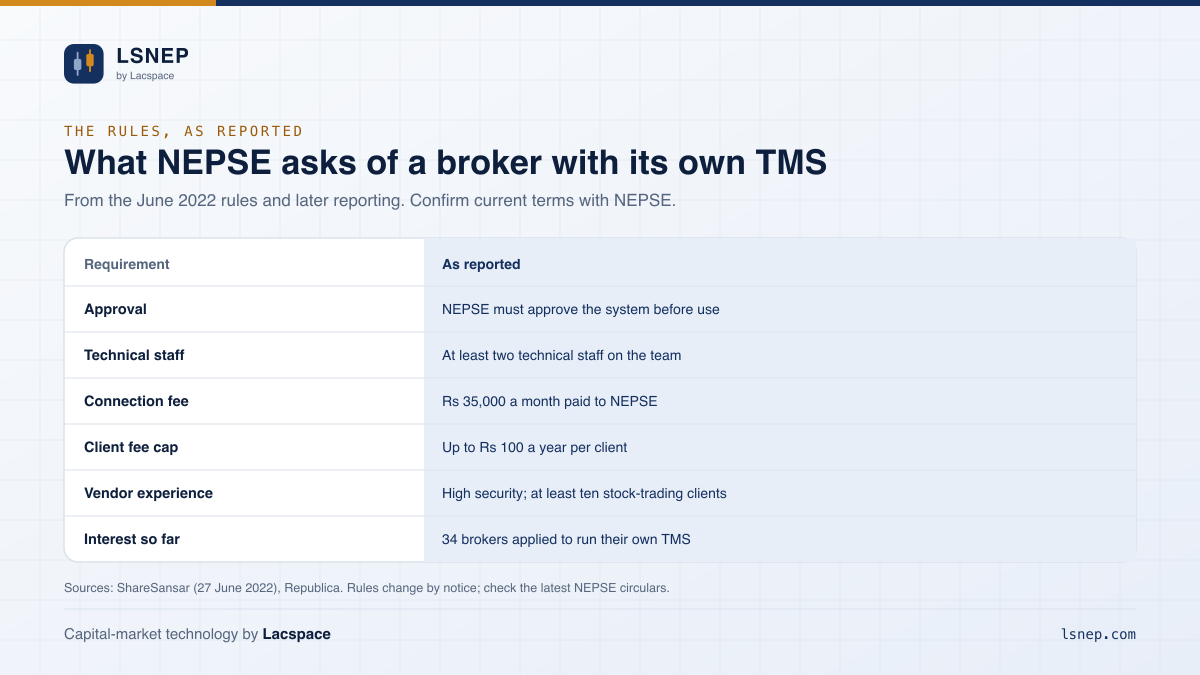
When NEPSE opened the door in June 2022, ShareSansar summarised the conditions: the system must be approved by NEPSE before use; the broker must employ at least two technical staff; it pays NEPSE Rs 35,000 a month for the connection; and it may charge clients up to Rs 100 a year. Reporting at the time also described vendor criteria, a high standard of security and experience serving at least ten stock-trading clients. Republica reported that 34 brokers applied to run their own system.
Why the question came back in 2026
On 25 January 2026, a malfunction in one vendor’s TMS stopped 13 brokers from trading on a day the market rose sharply. For those firms' clients, the reason did not matter: their broker could not take orders. Afterwards, boards asked two questions. Would our own system have done better? And if we keep a shared vendor, what is our plan when it fails?
Both are fair. An own TMS gives control, but it does not make outages disappear; it makes them yours. A well-run shared system with a clear service commitment can be the safer choice for a smaller firm. The right answer depends on staff, budget and appetite for operational risk.
Eight questions to answer before applying
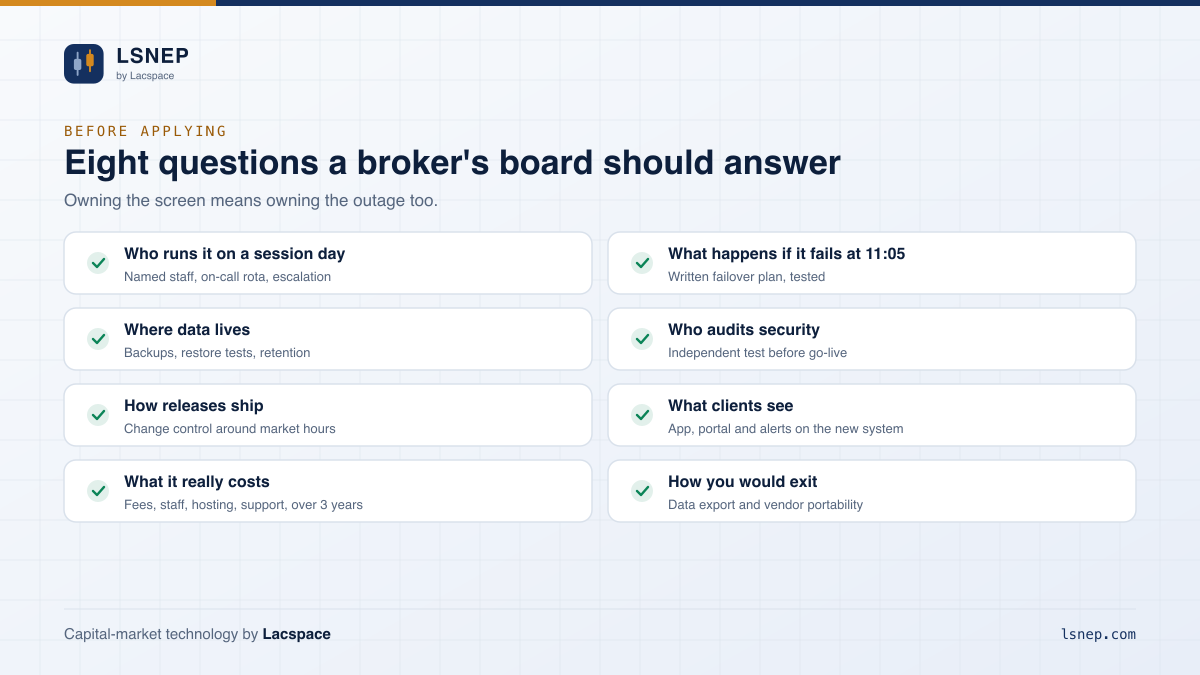
- Who runs it on a session day? Name the people, the on-call rota and the escalation path. Two technical staff is the minimum the rules describe, not a comfortable number.
- What happens if it fails at 11:05? Write the failover plan, test it, and decide how clients are told.
- Where does data live? Order, client and audit data need backups, tested restores and a retention policy.
- Who audits security? Plan an independent security test before go-live and after major releases.
- How do releases ship? Change control should keep risky deployments away from market hours, Sunday to Thursday 11:00 to 15:00.
- What do clients see? A new TMS is only as good as the app, portal and alerts in front of it.
- What does it really cost? Add the connection fee, staff, hosting, support and the vendor licence over three years, then compare with the Rs 100 a year a client may be charged.
- How would you exit? Insist on data export and portability before signing with any vendor.
Shared vendor or own system: a fair comparison
Neither path is right for every firm. The honest comparison looks at control, risk and cost together.
| Factor | Shared vendor TMS | Own TMS |
|---|---|---|
| Control over releases and features | Limited to the vendor’s roadmap | Full, within NEPSE’s approval |
| Who carries an outage | Shared with every broker on the vendor | The broker alone |
| Staff needed | Fewer in-house technical staff | At least two technical staff, plus on-call cover |
| Fixed costs | Vendor fees | Rs 35,000 a month to NEPSE plus staff, hosting and licence |
| Client fee | As agreed with the vendor | Up to Rs 100 a year per client, as reported |
| Speed to change the client experience | Depends on the vendor | Faster, if the team is in place |
For a large broker with a strong technology team, an own TMS can be a real advantage. For many others, the bigger and faster win is a better client experience and back office around whichever TMS they use. The two are not exclusive: the work done on the client side carries over if a broker later moves to its own system.
Plan the session-day playbook
Whatever the choice, every broker should have a written playbook for a trading-system failure during market hours. It should say who declares an incident, how clients are told within minutes through the app, SMS and the website, what staff tell callers, and how orders and complaints are reconciled afterwards. The January 2026 outage showed that the cost of an incident is measured in client trust as much as in missed trades. A broker with a clear message and a working status page keeps that trust far better than one that goes silent.
The part that does not need a new TMS
Most of what clients notice about a broker happens outside the order screen: how fast they can open an account, whether their ledger makes sense, how quickly a payout lands, whether a margin call arrives before it is too late, and whether anyone answers the phone. All of that can be modernised without changing the trading system. This is where LSNEP starts: a client app, portal, onboarding, back office, margin and support that run beside whichever NEPSE-approved TMS a broker uses, today or after a switch.
| Decision | Needs a new TMS? | Needs NEPSE approval? |
|---|---|---|
| Branded client app and portal | No | No |
| Digital account opening with national ID | No | No |
| Back office, ledgers and payouts | No | No |
| Margin collateral and calls (with a margin licence) | No | No new approval for the software |
| Own order screen and trading system | Yes | Yes |
A sensible order for many brokers is to fix the client experience and back office first, then decide on an own TMS with clean data and a clear picture of costs. Lacspace’s own trading portal for LSNEP is a later phase, offered only once NEPSE approves it.
More on LSNEP: Introducing LSNEP · Margin trading: a technology checklist · National ID account opening, done digitally · What building market platforms taught us
LSNEP is software for licensed capital-market firms, built by Lacspace. It is not a broker, exchange, depository or investment adviser, and nothing in this article is investment advice. Regulatory details are summarised from public reporting and change by notice; confirm current requirements with NEPSE and SEBON.
Frequently asked questions
Can a broker in Nepal run its own TMS?
Yes. Since June 2022, brokers may use their own trading management system if NEPSE approves it.
What does NEPSE require for an own TMS?
Reported conditions include NEPSE approval of the system, at least two technical staff, a Rs 35,000 monthly connection fee paid to NEPSE, and a cap of Rs 100 a year on what clients can be charged. Confirm the current terms with NEPSE.
How many brokers applied for their own TMS?
Republica reported that 34 brokers applied to run their own trading system.
What happened in the January 2026 TMS outage?
On 25 January 2026, a malfunction in one vendor’s TMS stopped 13 brokers from trading, as reported by ShareSansar.
Do I need a new TMS to launch a branded app?
No. A client app, portal, digital onboarding and back office can run alongside the NEPSE-approved TMS a broker already uses, without new NEPSE approval.
Does LSNEP offer an own TMS?
LSNEP’s own web trading portal and trading system are a later phase, offered only once NEPSE approves them. Earlier phases work with the broker’s existing TMS.