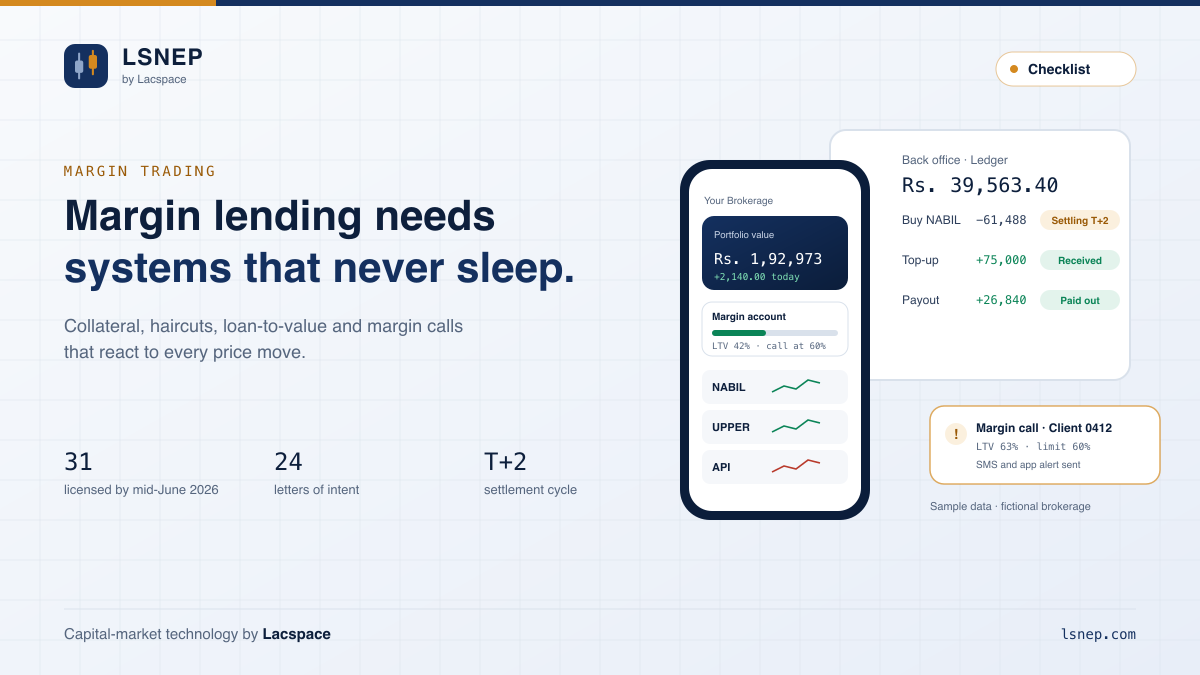
Margin trading changes what a broker is. Instead of only executing orders, a margin broker lends money against shares, which puts market risk on its own balance sheet. NEPSE began licensing brokers for margin trading in fiscal 2082/83, and by mid-June 2026, 31 brokers held a licence while 24 more had letters of intent. Capital and written policy come first. Right behind them come the systems, because a margin book moves with every tick.
In short
- 31 brokers were licensed for margin trading by mid-June 2026, with 24 more holding letters of intent.
- A margin book needs live collateral valuation, per-scrip haircuts, loan-to-value limits and automatic margin calls.
- Spreadsheets fail exactly when it matters: on a falling day, during the session.
- Clients should see their own loan-to-value and call level, not learn about it by phone.
Capital, policy, then systems
Margin lending sits within a broker's wider obligations, including the capital tiers set for different kinds of firm (reported as Rs 20 crore for limited-function brokers, Rs 60 crore for full-function brokers that add margin trading and other services, and Rs 150 crore for stock dealers). Before the first loan, a broker also needs a board-approved margin policy covering eligible scrips, haircuts, loan-to-value limits, concentration limits, call deadlines and what happens when a call is not met.
The technology’s job is to apply that policy consistently, in real time, with a record of every decision.
What happens when a price moves
Picture a pledged scrip falling during the session. In a well-run margin book, five things happen without anyone opening a spreadsheet:
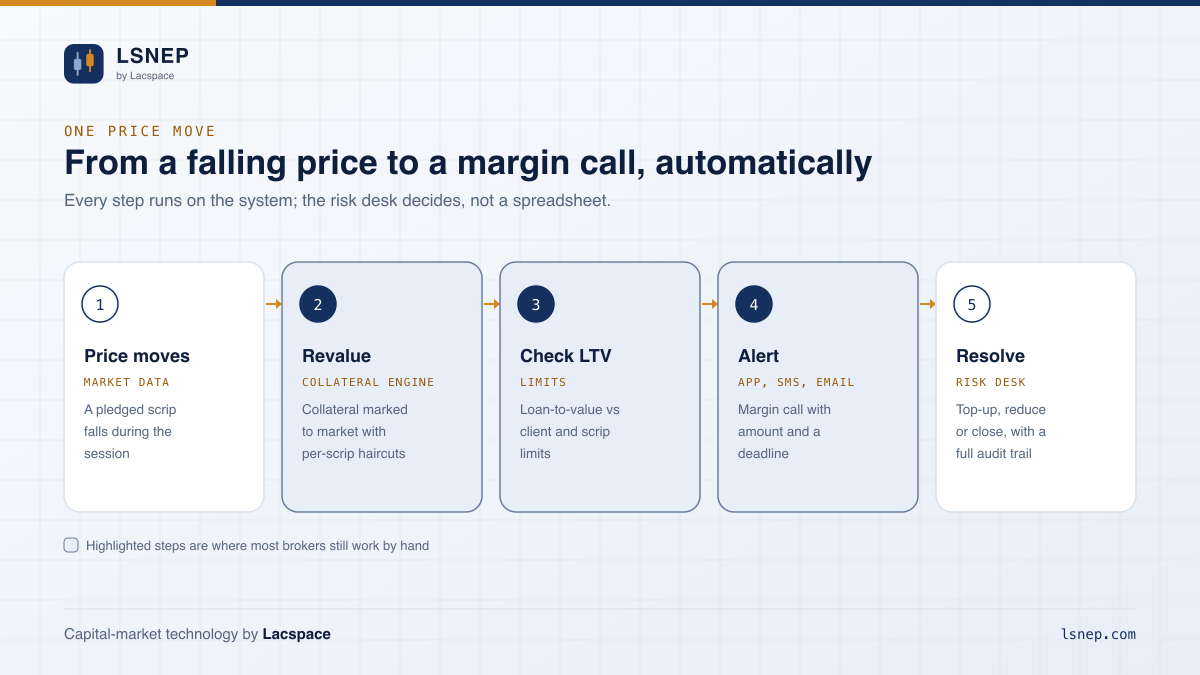
- Price moves. Market data updates the scrip’s price.
- Revalue. The collateral engine marks every client’s pledged holdings to market and applies per-scrip haircuts.
- Check loan-to-value. Each client’s loan-to-value (LTV) is compared with client and scrip limits.
- Alert. Clients over the line get a margin call by app, SMS and email, with the amount and a deadline.
- Resolve. The risk desk sees who has topped up, who has reduced exposure and who needs action, with a full audit trail.
The technology checklist
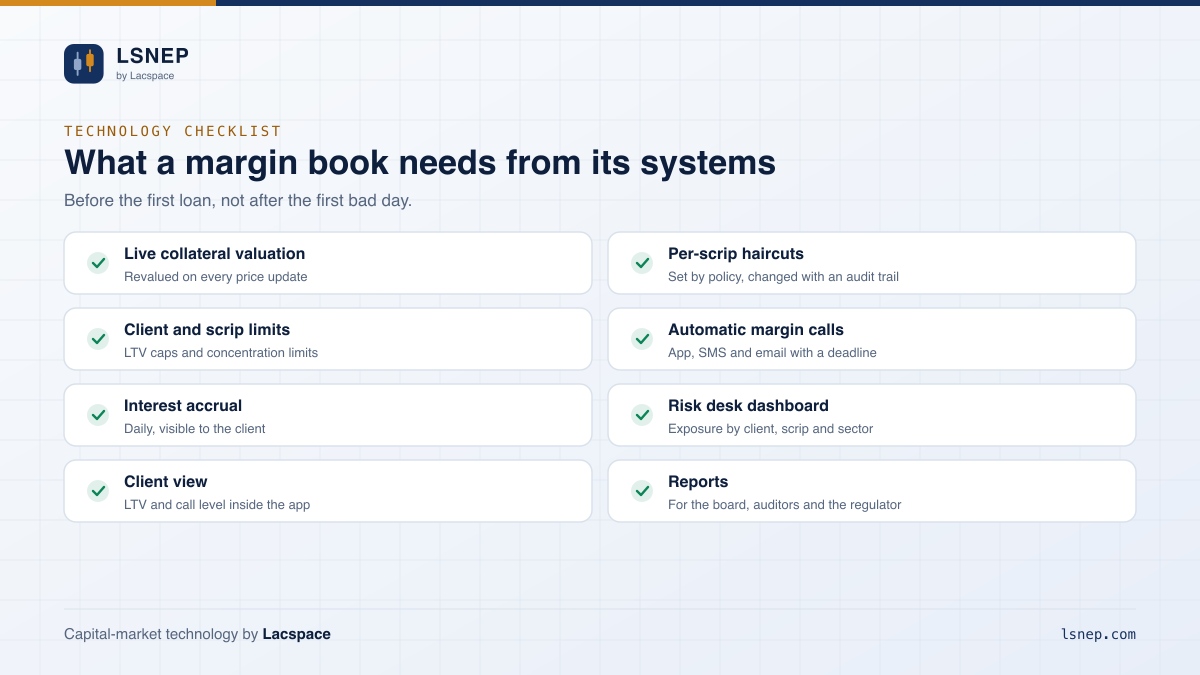
| Capability | Why it matters |
|---|---|
| Live collateral valuation | A morning snapshot is stale by 11:30 on a volatile day |
| Per-scrip haircuts | Riskier or less liquid scrips deserve bigger haircuts, changed with an audit trail |
| Client and scrip limits | LTV caps per client, and concentration limits per scrip and sector |
| Automatic margin calls | App, SMS and email with an amount and a deadline, logged |
| Interest accrual | Daily, transparent and visible to the client |
| Risk desk dashboard | Exposure by client, scrip and sector, and calls outstanding |
| Client view | LTV and call level inside the app, before the phone rings |
| Reports | For the board, auditors and the regulator, without manual assembly |
Where margin books go wrong
Margin problems rarely come from one big mistake. They come from small gaps that line up on a bad day.
- Stale valuations. Collateral valued once in the morning looks safe until a sharp afternoon fall. By the time someone refreshes the spreadsheet, several clients are past their limits.
- Calls that do not reach the client. A margin call made only by phone depends on someone being free to make it and the client picking up. Calls should go out by app, SMS and email at once, and be logged.
- Concentration. Many clients pledging the same scrip turn one stock’s fall into a firm-wide problem. Limits per scrip and per sector catch this early.
- Manual overrides without a record. Exceptions happen, but every override of a haircut or limit should say who approved it and why.
- Ledger mismatches. If margin sits in a separate tool from client ledgers, top-ups and sales can be applied late or twice. One record per client avoids that.
Questions for the board before launch
- Is the margin policy approved, and is every limit in it configured in the system rather than in a document?
- Who on the risk desk is responsible during market hours, and who is the backup?
- What is the deadline to meet a margin call, and what happens automatically if it is missed?
- How will clients see their loan-to-value, interest and call level before they borrow?
- Which reports go to the board each week, and can they be produced without manual work?
The client side of margin
Clients who borrow should never be surprised. The best margin products show, inside the broker’s app, how much a client has borrowed, the current value of collateral after haircuts, the LTV and the level at which a call happens. When a call comes, it should say exactly what to do: top up by a stated amount or reduce exposure by a deadline. That transparency reduces disputes and support load as much as it reduces risk.
Margin and settlement
Margin interacts with T+2 settlement and with the broker’s ledgers: purchases funded by the broker, sales that reduce the loan, top-ups that arrive by bank or wallet. That is why margin works best inside the same back office as client ledgers and payouts, not in a separate tool. In LSNEP, the margin module shares one record per client with the back office and the client app.
How LSNEP helps
LSNEP’s margin module values collateral on every price move, applies per-scrip haircuts, enforces client and scrip LTV limits, sends margin calls by app, SMS and email with a deadline, accrues interest and gives the risk desk one view of exposure. It runs alongside the broker’s existing TMS, and it is intended for brokers that hold a margin licence.
More on LSNEP: Introducing LSNEP · Own TMS in Nepal: what brokers need · National ID account opening, done digitally · Technology for merchant bankers, DPs and fund managers
LSNEP is software for licensed capital-market firms, built by Lacspace. It is not a broker, exchange, depository or investment adviser, and nothing in this article is investment advice. Regulatory details are summarised from public reporting and change by notice; confirm current requirements with NEPSE and SEBON.
Frequently asked questions
How many brokers in Nepal can offer margin trading?
By mid-June 2026, 31 brokers held a margin trading licence and 24 more had letters of intent.
What is loan-to-value in margin trading?
Loan-to-value (LTV) is the amount a client has borrowed divided by the value of their pledged collateral after haircuts. When LTV crosses the limit in the broker’s policy, a margin call is triggered.
What is a haircut on collateral?
A haircut reduces the value a broker gives a pledged share for lending purposes, to cover the risk that its price falls. Riskier or less liquid scrips usually carry bigger haircuts, as set in the broker’s policy.
Can margin calls be automated?
Yes. A margin system can revalue collateral on every price update, compare LTV with limits and send margin calls by app, SMS and email with an amount and a deadline, while the risk desk decides on action.
Does margin software need NEPSE approval?
Margin trading itself requires the broker to hold a licence. LSNEP’s margin module runs alongside the broker’s existing trading system and does not replace it.
Does LSNEP suggest haircut or LTV levels?
No. Haircuts and limits come from each broker’s approved policy and current regulation. LSNEP applies them consistently and records every change.