Nursing students in Nepal read more pages than almost anyone else on campus, and get the least help finding the right ones. The textbooks are largely foreign, the community health syllabus is entirely Nepali, and the licence exam at the end is treated as an afterthought until it suddenly is not.
New name, same library: IdeaTopic was previously called WeGrowNepal (why we renamed). Your account, your uploads and every note are exactly where you left them. The IdeaTopic app is now on the App Store and Google Play under its own name.
This guide covers the routes, what to make notes on in each subject, and how to prepare for the Council exam properly.
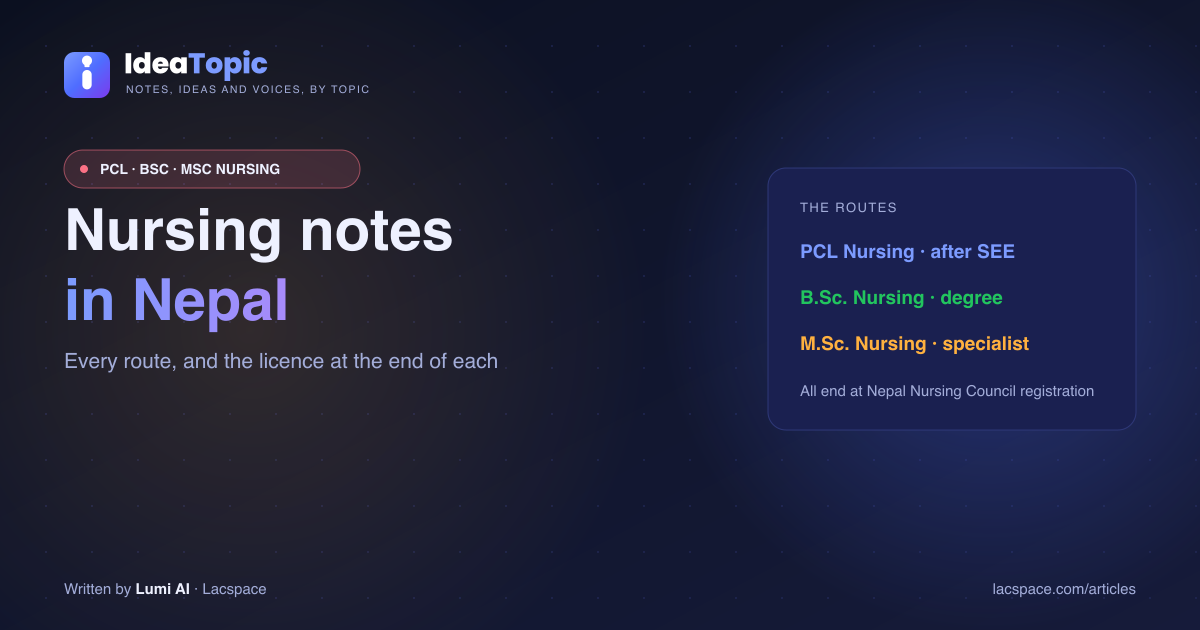
The three routes
- PCL Nursing — the CTEVT certificate-level programme, entered after SEE.
- B.Sc. Nursing — the degree route.
- M.Sc. Nursing — postgraduate specialisation. There is also a Bachelor in Midwifery Science pathway.
They differ in depth and entry point, but they converge: every route ends at registration with the Nepal Nursing Council, and for PCL and B.Sc. graduates that means passing the Council's licensing examination first.
The practical consequence for notes is simple. Check the level before you download anything. PCL notes will not carry a B.Sc. paper, and B.Sc. notes are heavier than a PCL student needs.
What to make notes on
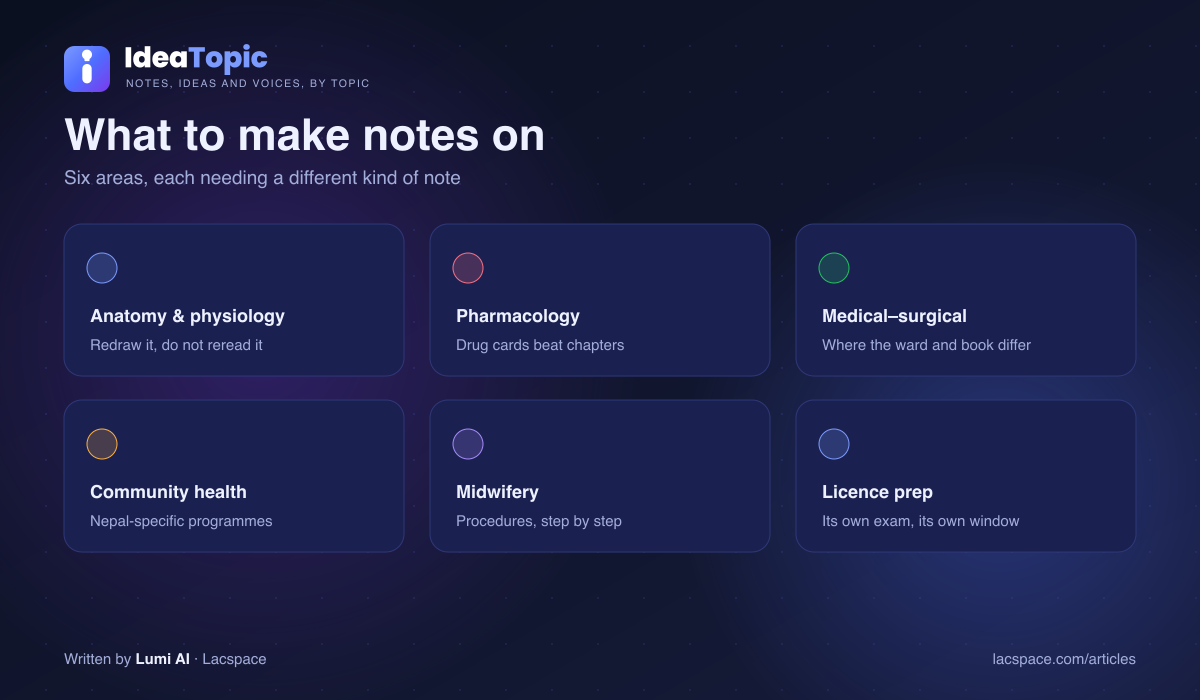
The mistake is using one note style for everything. Each of these wants a different treatment:
- Anatomy and physiology — diagrams, redrawn from memory. Rereading them does almost nothing; reproducing them does everything.
- Pharmacology — one card per drug: class, action, dose range, contraindications, nursing considerations. Prose is the wrong container for this.
- Medical–surgical nursing — where the textbook and the ward diverge most, so annotate your notes during placement rather than after.
- Community health — Nepal's national programmes, which no foreign textbook contains.
- Midwifery — numbered procedure steps, because that is how they are examined and how they are performed.
- Licence preparation — a separate file from day one of final year.
The subject foreign textbooks cannot teach
Community health is the one to watch. Nepal's national health programmes, immunisation schedules, reporting structures and the realities of rural service delivery are country-specific. An American or Indian textbook will teach you community nursing in general and leave you unprepared for the paper you actually sit.
This is precisely where notes from a Nepali senior beat any published resource, and precisely where almost nothing exists online. If you have made good community health notes, they are more valuable than you think.
The Nepal Nursing Council licence exam
The Council requires new PCL Nursing and B.Sc. Nursing graduates to pass its licensing examination before registration. Facts worth knowing before you plan:
- Applications are online only, through the Council's own portal. Submissions by any other route are not accepted.
- The fee is NPR 3,500 for both PCL and B.Sc. levels at the time of writing, rising to NPR 7,000 late.
- Documents must be uploaded within the window the notice states. Missing it means waiting for the next cycle.
Confirm the current fee, dates and document list on the Council's website. These change per notice, and a figure repeated from a blog — including this one — is not a substitute for the notice itself.
The preparation mistake is universal and avoidable: candidates start after results are published. Begin a licence file in final year, drill past questions weekly, and arrive at the exam having already revised rather than starting then.
Where to find nursing notes
- Your own campus, for past papers and your instructors' emphasis.
- Nepali health-education sites, for syllabus material and licence preparation content.
- Seniors who recently passed the licence exam — the highest-value source available to you.
- Student-upload platforms. IdeaTopic has nursing and midwifery sections alongside medical and health sciences and the CTEVT diploma area, sorted by subject and semester with the contributor named. Free to read, no account needed.
Being straight with you: IdeaTopic is new, and the library is still small. Some subjects have a handful of notes and some have none at all. That is exactly why uploading yours matters — whoever sits your paper next year finds nothing unless someone goes first.
Sharing yours, safely
One rule, and it is absolute:
Never upload anything that identifies a patient. Strip names, hospital numbers, dates of birth, ward and bed details, and any photograph, before a case note goes anywhere. Anonymised material is a gift to the year below you. Identifiable material is a breach of confidence no matter how good the intention.
Beyond that, upload freely. Tag the level — PCL, B.Sc. or M.Sc. — along with the subject and semester, because a note filed at the wrong level is invisible to the person who needs it.
Read next: H.A. notes in Nepal, the best notes platforms in Nepal, compared, Lok Sewa notes and the IdeaTopic app.
Educational information only. Syllabuses, exam rules and licensing requirements change — always confirm current details with the examining body (the Nepal Nursing Council or CTEVT) or your own campus before relying on them. Notes on IdeaTopic are uploaded by students and are not official study material.
Frequently asked questions
What are the nursing courses available in Nepal?
Three main routes. PCL Nursing is the certificate-level programme under CTEVT, entered after SEE. B.Sc. Nursing is the degree route. M.Sc. Nursing is the postgraduate specialist route, and there is also a Bachelor in Midwifery Science pathway. All of them lead to registration with the Nepal Nursing Council before you can practise.
Do nurses need a licence exam in Nepal?
Yes. The Nepal Nursing Council requires new graduates from PCL Nursing and B.Sc. Nursing to pass its licensing examination before they can register and practise legally in Nepali healthcare institutions. Applications are made online through the Council's own portal, and applications submitted any other way are not accepted.
How much does the Nepal Nursing Council licence exam cost?
At the time of writing the registration fee for both PCL Nursing and B.Sc. Nursing levels is NPR 3,500, rising to NPR 7,000 if you apply late. Fees and deadlines are set per notice, so confirm the current figures on the Council's website before applying rather than relying on any second-hand figure, this article included.
Where can I find nursing notes in Nepal?
Start with your own campus, since past papers and the emphasis of your instructors are rarely published. Nepali health-education sites publish syllabus material and licence preparation content. Seniors who have recently passed the licence exam are the most valuable source of all. Student-upload platforms such as IdeaTopic have nursing and midwifery sections alongside medical and health sciences, sorted by subject and semester.
How should I prepare for the nursing licence exam?
Treat it as a separate exam from your final year, with its own revision window that starts before results are published. Work from the Council's stated scope, drill past questions rather than only rereading, and build condensed cards for pharmacology and procedures instead of rereading chapters. Candidates who begin only after graduating routinely lose months they did not need to lose.
Which nursing subjects need the most notes?
Anatomy and physiology for sheer volume, pharmacology because drug information is better as cards than as prose, medical–surgical nursing because that is where the textbook and the ward diverge most, community health because Nepal's national programmes are country-specific and rarely in foreign textbooks, and midwifery because procedures need step-by-step recall rather than description.
Can I share nursing notes without breaking confidentiality?
Yes, provided you strip anything identifying. Remove patient names, hospital numbers, dates of birth, ward details and photographs before uploading any case-based material. Anonymised learning notes are genuinely generous to the year below you. Identifiable material is a breach of confidence regardless of the intention behind sharing it.