The Health Assistant course is one of the most practical qualifications in Nepal and one of the worst served by online study material. Search for H.A. notes and you get syllabus PDFs, a few coaching adverts, and very little that resembles what a student on the ward actually needs.
New name, same library: IdeaTopic was previously called WeGrowNepal (why we renamed). Your account, your uploads and every note are exactly where you left them. The IdeaTopic app is now on the App Store and Google Play under its own name.
This is a guide to the course, what to study at each stage, and where the notes that help actually come from.
What the H.A. course is
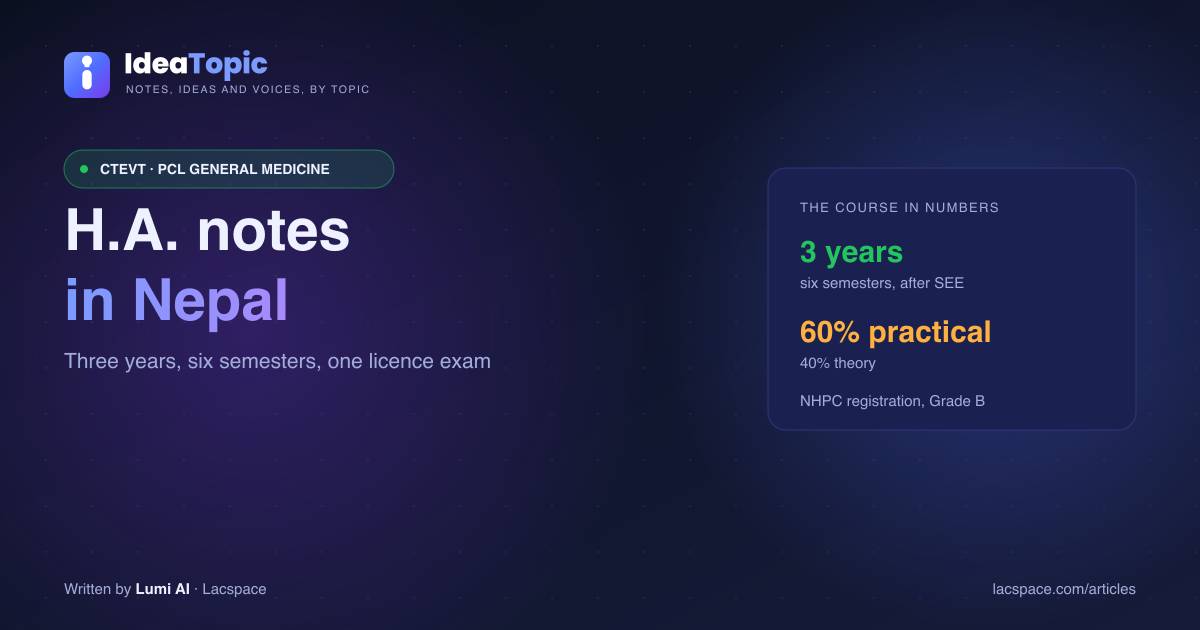
H.A. means Health Assistant. Formally it is the CTEVT programme in General Medicine — a three-year, six-semester course taken after SEE, which trains mid-level health professionals to deliver primary healthcare. In much of rural Nepal the health assistant is the health system as far as most patients experience it.
Two numbers define how you should study for it:
- Six semesters over three years.
- Roughly 40 percent theory, 60 percent practical.
That second number is the one students underestimate. A course that is mostly practical is not passed by reading alone, and the notes worth having reflect procedures as much as they reflect chapters.
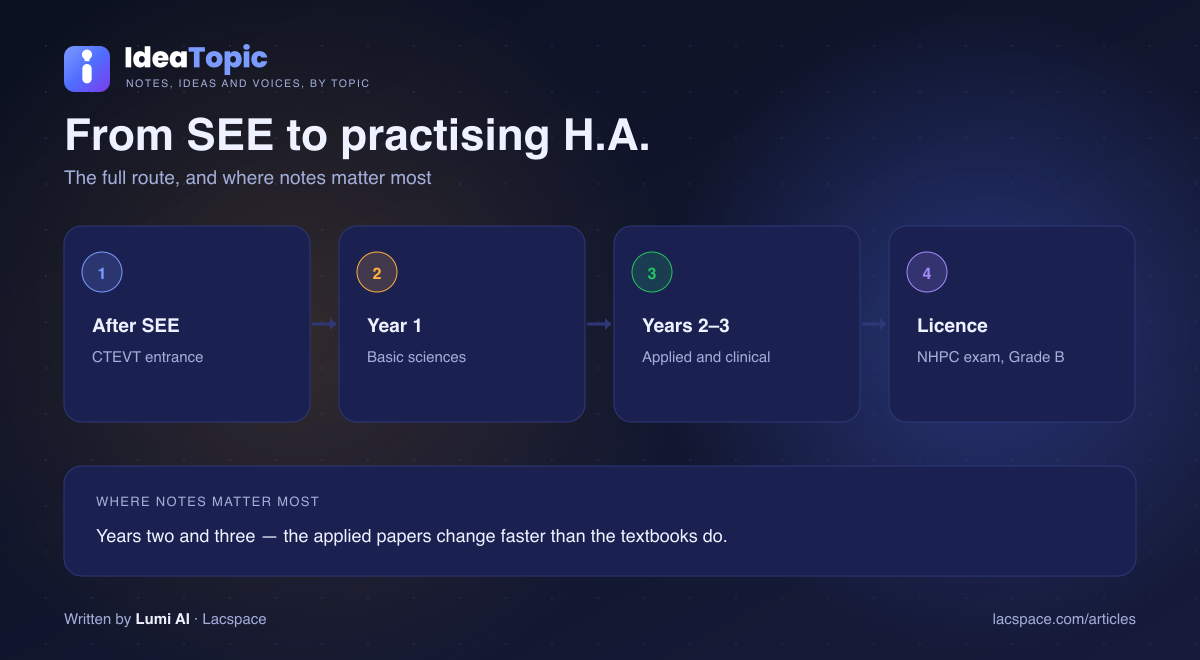
The route, from SEE to licence
Year one: volume
The first year is general basic science — anatomy, physiology and the supporting subjects. The difficulty here is not conceptual, it is sheer quantity, and the students who struggle are usually the ones trying to remember rather than to organise.
What works, in order:
- Condense before you memorise. A page you compressed yourself is worth ten you highlighted.
- Diagrams over paragraphs for anything anatomical. Redraw them from memory; that is the test.
- Use a senior's condensed notes as a checklist, not as a substitute for making your own.
Years two and three: the ward gap
From the second year the course turns applied and clinical, and a new problem appears: the distance between what the textbook describes and what the placement actually asks of you.
No published note closes that gap, because it varies by institution and by posting. The only material that does is notes from someone who has already done your placement at your college — which procedures you are expected to perform, how the logbook is marked, what the examiners ask in the practical.
This is the single strongest argument for student-shared notes in health courses, and the reason those notes are so rarely online: they live in one person's notebook and leave with them.
The NHPC licence
The programme is recognised by the Nepal Health Professional Council, and graduates register with the Council under Grade B after passing the licensing examination. You cannot practise professionally until you clear it.
Plan it as its own exam. Candidates who begin licence revision only after results are published lose months they did not need to lose.
Where to find H.A. notes
- Your own campus first. CTEVT colleges differ in emphasis, and departments often hold past papers that were never published anywhere.
- Nepali health-education sites that publish CTEVT syllabus material and licence preparation content.
- Seniors one or two batches above you — still the best source in this course, by a distance.
- Student-upload platforms. IdeaTopic has a Diploma and CTEVT area alongside its medical and health sciences sections, sorted by subject and semester, with the contributor named. Free to read, no account required.
Being straight with you: IdeaTopic is new, and the library is still small. Some subjects have a handful of notes and some have none at all. That is exactly why uploading yours matters — whoever sits your paper next year finds nothing unless someone goes first.
Sharing yours, safely
One rule specific to health students, and it is not optional:
Never upload anything that identifies a patient. Remove names, hospital numbers, dates of birth, ward details, photographs and anything else that could identify a real person before you share a case note. Anonymised learning material is generous. Identifiable material is a breach of confidence, whatever the intention behind it.
With that done, uploading takes two minutes. Tag the subject and semester, title it by the unit rather than "final notes", and your name stays on it for as long as it is read.
Read next: nursing notes in Nepal, the best notes platforms in Nepal, compared, Lok Sewa notes, engineering notes and the IdeaTopic app.
Educational information only. Syllabuses, exam rules and licensing requirements change — always confirm current details with the examining body (CTEVT or the Nepal Health Professional Council) or your own campus before relying on them. Notes on IdeaTopic are uploaded by students and are not official study material.
Frequently asked questions
What is the H.A. course in Nepal?
H.A. stands for Health Assistant. Formally it is the CTEVT programme in General Medicine, a three-year course divided into six semesters that students enter after SEE. It trains mid-level health professionals who deliver primary healthcare, and it is the backbone of clinical staffing in rural Nepal.
How long is the Health Assistant course and how is it structured?
Three years, six semesters. The first year is largely general basic science — anatomy, physiology, biochemistry and the supporting subjects. The second and third years are applied and clinical. The course is roughly 40 percent theory and 60 percent practical, which is why placement and skill logs matter as much as reading does.
Do Health Assistants need a licence in Nepal?
Yes. The programme is recognised by the Nepal Health Professional Council, and graduates register with the Council under Grade B. You must pass the licensing examination before you can practise professionally, so treat it as a separate exam with its own revision window rather than an automatic consequence of graduating.
Where can I find H.A. notes in Nepal?
Start with your own campus, because CTEVT programmes vary in emphasis between colleges and past papers are often held by the department rather than published anywhere. Then look at health-focused Nepali sites that publish CTEVT syllabus material, and at student-upload platforms such as IdeaTopic, which has a Diploma and CTEVT section sorted by subject and semester. Seniors one or two batches above you remain the single best source.
Which subjects are hardest in the H.A. programme?
Students most often name first-year anatomy and physiology for volume, and the applied clinical subjects in years two and three for the gap between the textbook and the ward. The volume problem is solved by structured notes and repetition; the applied problem is solved by notes from someone who has already done the placement at your institution.
Are H.A. and staff nurse the same thing?
No. Health Assistant is the CTEVT General Medicine pathway and registers with the Nepal Health Professional Council. Nursing is a separate pathway with its own programmes and its own council, the Nepal Nursing Council. The courses, the licensing bodies and the scope of practice all differ, so make sure any notes or past papers you download are for the right programme.
Can I share my H.A. notes with juniors?
Yes, and in a practical, placement-heavy course it is unusually valuable. On IdeaTopic you upload against the subject and semester and your name stays on the note. Photographed handwritten notes are welcome. Do not upload anything containing real patient details — remove names, hospital numbers and any identifying information before you share a case note.