Ask a Nepali student what they need and almost nobody says "more notes on the internet". There are already thousands of pages of notes for most common subjects.
New name, same library: IdeaTopic was previously called WeGrowNepal (why we renamed). Your account, your uploads and every note are exactly where you left them. The IdeaTopic app is now on the App Store and Google Play under its own name.
What they actually need is a specific thing: the notes made by someone who sat their paper, at their campus, last year. And those are exactly the ones that are never online.
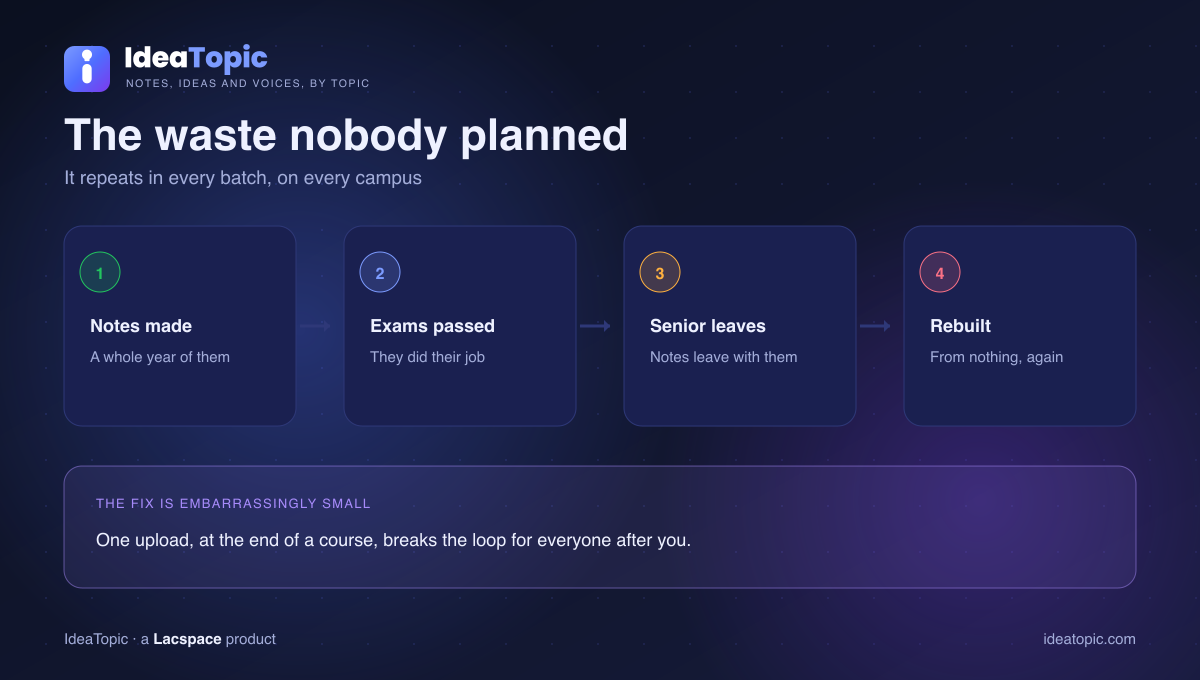
The cycle
- Notes get made. A whole year of them, usually handwritten, usually good.
- They do their job. The exam is passed.
- The senior leaves. The notes go with them — a laptop, a drawer, a chat thread nobody can search.
- The next batch rebuilds them. From nothing. Again.
Nobody is at fault. There has simply never been an obvious place to put notes where they outlive the person who made them, and by the time you would think of it you no longer care about the course.
Why published notes do not close the gap
Nepal's established notes sites are genuinely useful and cover far more ground than we do. Their limitation is structural, not a criticism: they publish one general version of a subject, and colleges do not teach one general version.
Two campuses on the same syllabus weight units differently, set different practicals and ask different questions. A national site cannot know which chapter your department skims. A senior at your campus already does.
The number problem

There is a temptation in this business to announce a big number. Ten thousand resources. A library of thousands. It converts a visitor — once.
Then that visitor searches their own subject, finds nothing, and now disbelieves everything else the page said. An inflated count is a loan against your own credibility, and the repayment is due on the first search.
So IdeaTopic publishes its counts live: 82 notes, against 2,214 subjects still waiting to be filled. That gap is not something to hide. It is the entire argument for uploading.
The two-minute habit that breaks the cycle
Upload your notes the week your results come out — while you still remember what mattered and before you stop caring about the course.
- Sign in and choose Upload.
- Pick the faculty, subject and semester. This is the step that makes it findable.
- Add the file. Photographs of handwritten pages are fine — flat, daylight, all four corners.
- Title it by the unit, not "final notes 2".
Two rules on what not to upload: no copyrighted textbooks or publisher material, and nothing containing another person's private information. Share what you wrote, not what you bought.
Your name stays on it for as long as it is read. Somebody's notes got you through last term; this is how you return it.
More: the app on iPhone and Android, notes platforms in Nepal compared, engineering notes, BCA notes, Lok Sewa notes, H.A. notes and nursing notes.
Notes on IdeaTopic are uploaded by students and are not official study material. Confirm syllabus and exam details with your own campus or the relevant examining body.
Frequently asked questions
Why is it hard to find good study notes in Nepal?
Not because nobody makes them. Because the best notes are made by a student for one exam, then leave with that student when they graduate — on a personal laptop, in a drawer, or in a chat thread nobody can search. There has rarely been an obvious place to put notes where they outlive their owner, so each batch rebuilds what the last one already had.
Are online notes in Nepal accurate?
They vary, and that is why the contributor matters. A note whose author, campus and course you can see is checkable. An anonymous PDF is not. Treat any student note as a revision aid rather than an authority, and verify anything that affects a grade against your syllabus or your lecturer.
Why do notes sites claim huge numbers of resources?
Because a big number converts a visitor, at least once. It stops working the moment that visitor searches their own subject and finds nothing, and it costs more trust than it ever gained. IdeaTopic publishes its counts live for exactly that reason — currently 82 notes, against 2,214 subjects still to fill.
What actually helps a student in Nepal the most?
Notes from someone who sat the same paper at the same campus, because they are already filtered down to what is genuinely examined rather than covering a syllabus evenly. That is the one thing a national notes site structurally cannot provide, and it is precisely what disappears when a senior graduates.
How long does it take to upload notes?
About two minutes. Sign in, choose the faculty, subject and semester, and add the file. A photograph of handwritten pages is perfectly acceptable — shoot flat, in daylight, one page per shot with all four corners visible.
What should I do with my notes when I graduate?
Upload them before you stop caring about the course, which in practice means the week results come out rather than a year later. That single habit is what breaks the cycle, and it costs you nothing you still need.
Does sharing notes count as cheating?
No. Sharing your own study notes is ordinary academic collaboration and is how students have always learned. What is not acceptable is uploading copyrighted textbooks or publisher material, or anything containing another person's private information. Share what you wrote, not what you bought.